• Skip to primary navigation
  • Skip to main content
  • Skip to primary sidebar
  • Skip to secondary sidebar

Plant Based U

Fat-Free and Low Fat Vegan Plant Based Recipes

  • Home
  • Recipes
    • Raw Vegan Recipes
    • Cooked Vegan Recipes
    • Eat to Live Dr. Fuhrman Recipes
  • Products
  • Coaching
  • Videos
  • Articles
  • About
    • What Is Low Fat Vegan/Whole Foods Plant Based
    • Resources
  • Contact

Articles

Fb-Button

My TOP TEN Favorite Things To Do To Feel Better When Feeling Down, Sick Or Having a Bad Day

March 25, 2012 by Veronica Grace 2 Comments

Fb-Button

My new recipe eBook Comfort Soups To Keep You Warm is available!

Somedays are better than others and somedays can be worse. Maybe you’re feeling under the weather, maybe you’re a little stressed out, over tired, sore from a work out or working too hard, whatever the case may be. Instead of just feeling blah and laying around like a lump on the couch or sitting in a “poor me” or foul mood, here are some things I suggest doing to feel better, de-stress, and get back to your normal happy energetic self.

“How do I feel better?” you might ask? Well here are some helpful tips for you below.

#10 Take A Day Off and Fast And/Or Sleep

If you have the flu, a viral infection, got food poisoning, or just ate too much and don’t feel well, you can benefit from skipping a meal or two, or even for a whole day and just taking it easy. You might even want to have a nap and catch up on some sleep, or if you’re feeling that awful you may even want to spend all day in bed. Fasting (abstaining from eating food) can help when you are dealing with viral infections and stomach issues. It gives your body a break from digesting food 3-5 times a day, and instead can focus on detoxing and processing any leftovers in your stomach and bowels from the day before. Also if you feel lethargic it can help to skip a meal so you can have more energy later in the day. Fasting is NOT recommended when you have a “cold” or BACTERIAL infection. Fasting actually stresses the body in a negative way when you have a bacterial infection. Your body has surrounded the bacteria and quarantined it so that it does not infect the rest of your body and give you blood poisoning. If you stop eating for a long period of time, it weakens your immune system and this bacteria can break through the protective barrier and take over and make you even sicker, or cost you your life. There have been many fasters that have died of blood poisoning when they got an infection before or during their fast and chose to ignore it. There have also been people who fasted when they had Lyme Disease and this complicated their problems and caused lasting damage to themselves. Lyme Disease is a bacterial infection as well. *Fasting for a viral infection is ok, because you are making the virus weaker by not feeding is sugar and nutrients. Bacteria are not the same as viruses, and you may need antibiotics if you have a serious infection so you need to consult a qualified health professional. If you have a cold, at the very least I recommend resting, and also eating something whether it be fresh fruit or some soup to stay hydrated and feel better.
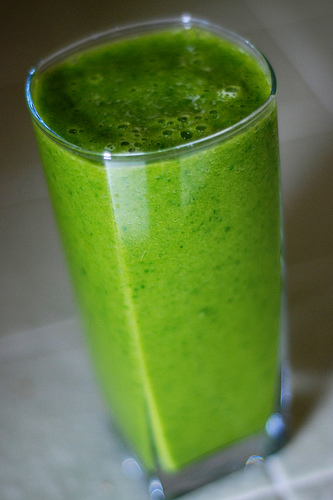
 

#9. Have A “Green” Smoothie

I can honestly say I have NEVER felt worse after having a green smoothie. I have actually felt better and was really glad I had it. Now some Dr.’s like Dr. Caldwell Esselstyn might be extremely against the idea of having a smoothie (because it partially breaks down and blends the fibre) I have yet to see anyone’s health get worse, or gain weight from an occasional fat free raw green smoothie. I have a few favourites, make sure to check out my Cherry Green Smoothie & Green Smoothie FAQ, and my Blueberry Grape Green Smoothie Recipe as these are two of my favourites, and you probably have not had them before. I recommend making your own smoothies as you know what goes into them and can insure fresh greens and good tasting ripe fruit goes into it (unlike the smoothie bar). But if you’re on the go hopefully you can find a fresh fruit smoothie bar, and not something like a chain smoothie bar that uses ice-cream, sorbet, bottled fruit juice, sugar and protein powders as these are not health foods.
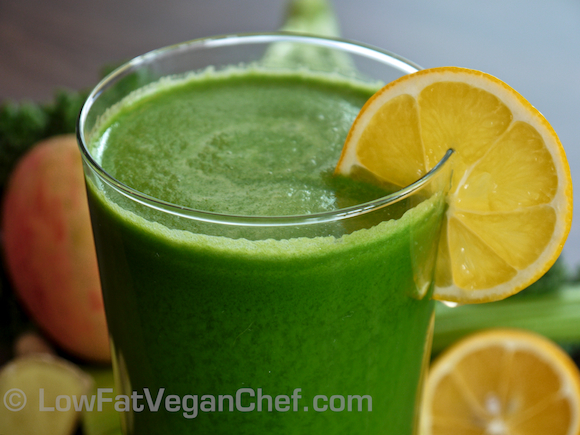
 

#8 Have A Fresh Juice

Whether you like green juice, or a fresh squeezed orange, apple, or grapefruit juice there is something for everyone. It’s best to have a green juice first thing in the morning as opposed to a fruit juice unless you have just worked out or intend to work out. As you’ve been sleeping you don’t have a high need for instant sugar in your blood stream, it’s better to have whole foods that release sugar steadily to keep you full until lunch. But if you are feeling parched, dehydrated, or sapped from a work out a fresh juice is just the thing to perk you up and help you on with your day. Check out my Kale Apple Celery Juice Recipe and Pomegranate Apple Juice Recipe  here.
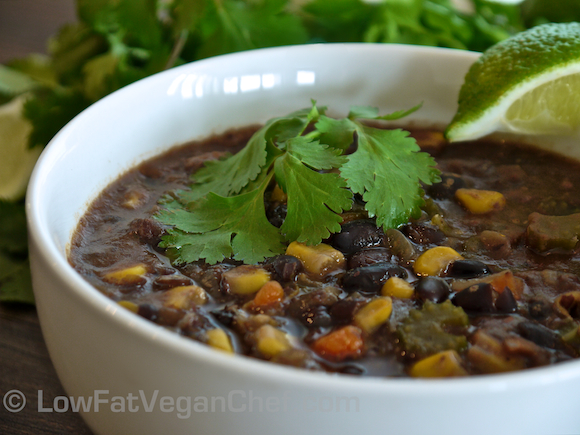
 

#7 Have A Warm Homemade Vegetable Soup

When you’re feeling under the weather with a cold, the chills, or are just plain tired of smoothies and salads, a homemade healthy vegetable soup might be just the thing you are looking for. Not only will you love it, but your family is certain to warm up to your veggie cuisine with a hearty tasty homemade soup. Check out my Mexican Black Bean Corn Soup, Clean Out The Fridge Vegetable Soup Recipe , or Dr. Fuhrman’s Anti Cancer Soup. My new recipe ebook Comfort Soups To Keep You Warm also has 30 healthy vegan soup recipes to wow your tastebuds and includes recipes from all over the world.


#6 Take A Warm/Hot Shower

If you’re feeling tired, exhausted or even run down, sometimes just having a really nice warm or hot shower will pep you up and bring you back to life. If you’re short on time, or without a bathtub this can help you feel more like yourself again. I can’t say I’ve ever felt worse after having a nice shower, and I always think man why did I procrastinate? I should have done this sooner, I feel so much better. Us girls can put things off because we tire of washing and drying our hair so frequently, but go for it, or wear a shower cap. You won’t regret it.


#5 Do Some “Yoga In Daily Life” or A Relaxing Style of Yoga

Yoga that focuses on breathing, slow movements, and stretching can help you calm your mind, de-stress and relax. You don’t have to be flexible, you don’t have to do anything a contortionist would do or any difficult poses. It’s great for people who have stick backs, bad posture or sit all day at the computer. (I would know!) I love Yoga In Daily Life, I wish I did it every day, because I always feel more relaxed, stretched out and have better circulation after. Check out http://www.yogaindailylife.com/ for more information.


#4 Do Some Cardio To Get Your Blood Pumping or Go For a Walk

Sometimes I get the “working from home blues” where you’re inside all day in the kitchen and then on the computer and you feel so cut off and isolated from people. Getting out of the office, or out of the house to get some fresh air and get your body moving will do wonders for your mood AND your circulation. If you’re the kind of person who loves to jog, or go to the gym do that. If you prefer a nice stroll gazing at the trees and smelling the fresh air, go for it!

 

#3 Curl Up With a Book And Enjoy Some Fiction

Reading fiction novels can help your mind relax and focus on something else for a while. I do suggest something other than horror and Stephen King novels though! Most woman enjoy reading and lament that they don’t read enough, or get enough time to themselves. With the advent of Kindles and iPads it’s easier than ever to take your book collection with you and read wherever you are. The Kindle is great for reading in all locations because of it’s E-ink technology which means it’s not back lit and can be read in direct sunlight without any glare. Kindle or Kindle Touch have really come down in price over the past few years and start as low as $79.


#2 Take A Hot Bath With/Without Epsom Salts

Epsom Salts or magnesium sulfate is a compound of magnesium sulfer and oxygen that is named after the town Epsom in Surrey, England. Epsom salts help sooth sore feet and body aches. It helps prevent your skin from wrinkling so much when you take a long soak and when it’s absorbed into your body it can reduce inflammation. It is also effective at healing and soothing outbreaks of herpes and shingles (as Wikipedia informs me). You may not notice a huge difference in your bath if you add Epsom salts, but it can make you feel a bit better if you have very sore muscles or feel achey all over.


# 1 Relaxing Or Therapeutic Massage

My absolute favourite way to feel better is of course having a massage. My top choice would be a Thai massage or a Chinese Accupressure massage. Although different in technique they work on the entire body and not just rubbing your back and tickling your skin like many Swedish massage therapists. Thai massage is done wearing a pair of loose pyjama-like pants and a light loose shirt. The therapist uses their hands and feet to stretch out the muscles in your body while you lie on a soft mat on the floor and relax. The movements are slow and you can specify your preference for pressure. The end the massage by working on your back and neck while you sit up and this is pleasant because I think it ends with the best part. Chinese Accupressure starts out with you laying face down on a table with a thin sheet over you, and the therapist uses their palms, fingers, and elbows to press and work out your muscles and tendons. It’s like being stretched on a micro level I think, and they follow the lines of your body all the way down your legs and feet to realign your muscles and tendons. It can stay like this or end with a Swedish oil massage at the end. I like this because it’s generally very inexpensive and they are very thorough getting into every nook and cranny of your muscles and getting rid of any soreness or tension. In Canada I go for Chinese Accupressure more often and in Thailand I go for Thai Massage because it’s so much more affordable there. ($5-$10/hour)

Well, I hope you enjoyed my list of suggestions and found something that will help you feel better today and give you just what you needed to get back on track and feeling like your old self again!

What’s your favourite thing to do when feeling stressed out, sore or under the weather?


Filed Under: Articles, How To Tagged With: feel better

How To Tell If A Fruit Is Ripe Enough To Eat – Banana, Peach, Nectarine, Pear, Kiwi, Apple, Orange and Tomato

March 21, 2012 by Veronica Grace 2 Comments

Fb-Button

Sometimes you want to know if the fruit you are eating is actually ripe. Especially if you’re eating it raw or in a salad, you want to make sure that it’s at the peak ripeness (flavour and sweetness) and that it will taste good and not be sour, starchy, bitter or pasty and inedible.

Here I show you how to tell if your most common fruits in North America are ripe and when you want to eat them.

I couldn’t tell from my perspective what the banana would look like when I peeled it. What I meant was that the speckled spots do not mean that the banana is bruised or gone bad inside. The banana has a small discolouration from being knocked before it ripened.


Let me know what you think! Did you learn anything new?
Filed Under: Articles, How To, Videos Tagged With: fruit, how-to, Raw Food Tips, ripe

The Fat Future Of America Is Frightening (This Applies To All of North America)

March 15, 2012 by Veronica Grace 2 Comments

Fb-Button

Fat American Couch Potato Eating Chips Cartoon
I have a really great educational graphic on the affects of obesity in America that I wanted to share with you. The designer asked if I could post it on my website as it is in line with what I’m teaching. (Scroll down)

I want everyone to realize that people are gaining more weight and faster than ever before because of the amount of fast food and convenient foods available.

In many states children grow up without every really having a home cooked meal. I even know many adults that would rather eat out every meal of the day than cook something at home (even though this is much more expensive). Yes cooking takes some time, but honestly exercising and dieting takes even more time, so why not make a few more meals at home and save both time AND money doing so?

You may or may not have heard about the KFC Double Down. Many of you will think oh, but not many people eat like that. Well KFC would not have put so much time and money into promoting this sandwich nationally if they didn’t know for a FACT that Americans (and Canadians) would want to eat it, given the chance. And they were right. Even though you know this is obviously not healthy for you, many people are eating it as a novelty, for fun, or because it looks decadent or “manly”.

Kentucky Fried Chicken Double Down Chicken Sandwich

This nutritional info is straight from KFC’s website 

 Item:  Calories  Fat (g)  Sodium (mg)
 KFC Double Down 540  32  1380
 Potato Wedges  290  15 810
 20 oz. Pepsi  210  0  45
 Total:  1040  47  2215

Avg. Rec. limit 2000 calories/ Daily limit 65 g/ Daily limit 1500 mg

(Even if you don’t eat a double down chicken sandwich meal, remember a lot of people eat fried chicken, cheese and bacon as part of fast food meals as well.)

My goal with this website is to help educate people on how to eat MORE plant foods and how to make them 100% healthy and low in fat. Far too often people fall into the trap of craving only battered, deep fried, cheezy, creamy and barbecued food and forsake simple fruit and vegetable based dishes because they’ve either never had them or don’t think they would taste good at all.

This is a shame.

I guarantee you that if you try some of my recipes you will enjoy them. My recipes are not just designed for vegans and vegetarians who like healthier foods, they are designed with lots of flavour that many SAD (Standard American Diet) eaters or omnivores don’t even realize that it is oil free and vegan.

If I can get a SAD/omnivore to exclaim wow this is really good I want more, then my job has been a success.

So far it is working on my friends and family and they are slowly learning how to make more meals from scratch (and they are losing weight too!)

If you continue to eat fast food and junk food when you’re young, it’s very likely that your future will end up like this. The pounds will continue to creep every year and one day you won’t know what happened or even when it started.

Did you know that just overeating ONLY twice a year (On Thanksgiving and Christmas) can cause you to gain a pound or more? So every year your weight is increasing by 1 lb and in 10 years you’ll be 10 lbs heavier.

American Thanksgiving Weight Gain Eating Turkey Scale

Combine that with DAILY treats and overeating just to satisfy your “sweet tooth” or “fat tooth” (in some people) and this can be as much as 5 lbs a year. I’m not kidding. To gain an extra 5 lbs a year, you’d only have to eat an 48 EXTRA calories more than you needed every day! That’s the equivalent to an apple or 1 bite of a chocolate bar! (If you ate an extra apple a day you probably would not gain this much weight as it has so much fibre and takes more energy to digest, but chocolate bars and desserts are high in sugar and fat and unlike a piece of fruit.)

What if you could just walk for 20 minutes a day and switch your dessert for some fruit? What if you switched your breakfast from a mcmuffin and hash browns to a fruit smoothie instead? Or your burger and fries for lunch into a oil free soup and salad?

What if you gradually switched where every meal you were eating was oil free and based on fruits and vegetables instead of bread, oil, meat, cheese, butter and cream?

These things make a big difference over the long run for your health. Not just affecting your weight but affecting your risks for heart disease, diabetes and even cancer.

Start out just trying to eat a little healthier than yesterday. Only compare yourself to yourself, and no one else. Take the time you need, educate yourself, learn how to cook something healthy and new, start walking for fun with a friend.

Filed Under: Articles, Obesity Tagged With: lose, obesity, weight

How To Select and Cut A Ripe Pineapple Video

March 14, 2012 by Veronica Grace 22 Comments

Fb-Button


Pineapple is something many people are often afraid to buy whole in the store. They are used to the overly sweet pineapple chunks or rings you get in a can that you grew up on as a kid. But when they start eating healthier or going vegan they might pick one up and sigh “Where do I even start with this thing? It’s so big and prickly and I don’t know how to cut it properly!”.

Not all pineapples come with instructions on how to cut it either!

Fear not, here is a video demonstration I did in my kitchen to show you how I cut a pineapple and how to tell if your pineapple is sweet and ripe.

There are many many ways to cut and serve pineapple, this is just one of them.

Want More Delicious Raw Food Recipes and Insider Tips?

Check Out My Savory Raw Dinner Recipes!

Please click below to watch my video on youtube:
How To Cut and Select A Pineapple

I don’t always cut my pineapples meticulously, but this is the way to do it if you want to get the most out of your pineapple or make it look pretty for serving.

You can also use a pineapple slicer, but honestly I’ve just found them to be so messy and sometimes they shred the pineapple and/or don’t fit the pineapple and it’s either too big or too small for your pineapple. And at the end my counter is covered in pineapple juice and it’s very sticky when it dries!

If I’m in a rush, I will basically cut off all the sides of the pineapples and instead of cutting out the eyes at an angle I will just cut straight down and shave off more of the flesh until the eyes are gone. This is a little more wasteful, but sometimes our pineapples are so big that we don’t miss the little extra bits.


You can freeze any leftover pineapple in bags in the freezer, or use in fruit salad for the next few days, or to put in smoothies.

How Do I Know If My Pineapple Is Ripe?

The best way to check if your pineapple is ripe is to turn it upside down and smell the bottom of it and see if has a fragrant smell. Often the bottom or the whole pineapple will be a yellowy golden color.  Although color is not the definitive guide to telling if a pineapple is ripe, I have found that yellow pineapples seem to be a bit sweeter and less acidic than hard green pineapples. And BTW pulling a leaf from the inner section of the pineapple is NOT an indication of ripeness. That means absolutely nothing! LOL.

How To Ripen a Pineapple?

Pineapples generally take about 2 years to grow and aren’t exactly a fruit, they are a bromeliad, and they have been bred to be edible. Pineapples ripen from the bottom and don’t really ripen much more once they’re picked. BUT there is still some enzyme activity going on and you can make your pineapple a little bit sweeter. Turn your pineapple upside down on your counter for a few days and the enzymes from the bottom of the pineapple will trickle down into the top of the pineapple and it will change your pineapple and make it a bit softer and sweeter all the way through. This is a trick I just learned and I thought it was so cool I’m going to do this from now on. Softer sweeter pineapples also seem to be less acidic so they won’t hurt your tongue as much after eating a few pieces.

What do you like to do with your fresh cut pineapple?

Filed Under: Articles, How To, Videos Tagged With: how-to, pineapple, raw, video

How To Sauté and Cook Without Oil, How To Cook Fat Free and Make Fat Free Vegan Salad Dressings

March 9, 2012 by Veronica Grace 13 Comments

Fb-Button

How To Cook Without Oil

Cooking without oil and creating oil free recipes like salad dressings is pretty easy in most cases. It’s very easy to cook without olive oil. You can steam, boil, sauté (in water or vegetable broth) or bake food all without any added oils. Oil has 120 calories per tablespoon and is 100% fat. When you’re looking to cut a few calories in your diet and give your arteries (and waistline) a little break from things like butter, olive oil, cheese, etc this is a good way to cook.

Baking/Roasting Without Olive Oil

When you’re baking in the oven, not adding oil or cooking spray will just make your dish take a little bit longer to cook, but that’s about it. You can add a little water to your roasting pan if you are worried about burning, or turn the temperature down just a little and cook it for longer. For instance, you can bake Russet potatoes in the oven at 400 F/205 C for about an hour without any oil rubbed on their skin and they will cook just fine. It’s also less carcinogenic if you avoid cooking oils at very high temperatures. I roast things like squash, Brussels sprouts, potatoes, cauliflower and more in the oven without oil. Add a little water or vegetable broth to a roasting pan if you like, or use a little balsamic vinegar and water for oil free roasted Brussels sprouts, or roast your russet potatoes dry in the oven like I show you here.


In baked goods, substitute applesauce or mashed banana for any oils. Canned pumpkin works great too in certain recipes. In my vegan baked goods I add a 1 tbsp. ground chia or flax and 2 tbsp. of water to substitute for the eggs, and then I add applesauce for the amount of oil and I find that this helps give moisture and texture to whatever I am making. My Fat-Free Two Bite Brownies  and Fat-Free Pumpkin Raisin Muffins will show you how to do this.

Sautéing/Cooking Onions Without Oil

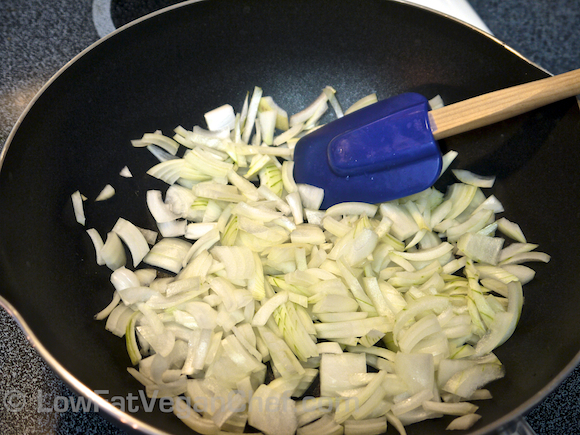
Many people think you need oil to cook with over the stove. When you’re sautéing onions or garlic in a pan you can sweat them dry over medium heat, as long as it’s non stick. Doing this for 5-6 minutes should be just fine and you won’t have a problem with anything getting stuck. If you’re going to cook them for longer then you can add a little water or vegetable broth if necessary. The better the pan, the less stick you will have though. You can also use a ceramic pan.

Check out my recipe for Home Made Vegetable Broth that I use for sautéing my onions and garlic and soups:

Sautéing Onions And Garlic Without Oil Dry In A Pan Wok


This is how I sauté onions dry in a pan without olive oil. This is a great method for stir fries or starting sauces.

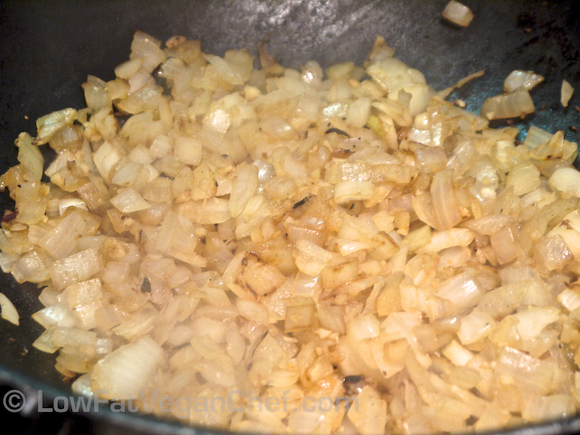
Sautéing Onions And Garlic Without Oil Dry In A Pan Wok

This is what my onions look like when they are done. They were dry sautéed in a non-stick pan over medium heat for 5-6 minutes and they caramelize themselves without oil!

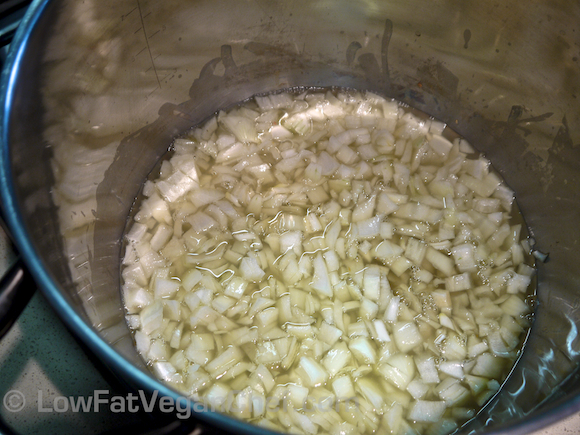
Sautéing Onions and Garlic Without Oil In Vegetable Broth

Here’s how to sauté onions in a pot in vegetable broth for making soups or stews. Garlic and ginger can go in too.

It’s really easy! Just add a little more broth or water if you start running out of liquid.

For Making Oil Free Vegan Salad Dressings

Use things like water, lemon or vinegar, blended fruits or cucumber for the base of the dressing to give it liquid. Then add seasonings like sugar/dates/honey/agave, salt, pepper, fresh herbs, mustard etc to create an oil free dressing. (Make sure you add only 1-2 tsps of vinegar or lemon juice to start so it’s not too tangy, and then adjust.)


The best oil-free salad dressings will have at least 3 flavours. Sweet, tangy and salty. If you just use one flavour like orange juice or vinegar over a salad it’s going to be one dimensional and not as flavourful. If you’re trying to cover a large salad and eat a lot of greens, it’s better to make a dressing that is a little more flavourful and interesting to eat.

I find ripe ataulfo mangoes (bright yellow skinned) or strawberries and orange juice make a great base for fat free raw vegan salads dressings.

For creamy vegan salad dressings you can use silken tofu as the base instead of cream or milk. (Nut butters work too, but only add 1-2 tbsp as they are much higher in fat than tofu or almond milk.)

For tangy vegan salad dressings make sure you add some lemon, sweetener and a few seasonings to your dressing to pump up the flavour.


To thicken it up you can add psyllium husk or chia gel/chia seeds (and blend it in) or add some cornstarch and water and thicken your dressing over  heat on the stove. Refrigerate the rest of your salad dressings. If they are raw use within 3 days, if they are made from non raw ingredients or cooked over the stove they will last longer.

—————–

There you have it! Cooking without oil and making oil free food is really easy! Did you think it would be complicated?


Filed Under: Articles, Eat To Live - Dr. Fuhrman Recipes, How To Tagged With: Cooking Tips, fat-free, how-to

How To Cut And Prepare Leeks For Recipes

March 9, 2012 by Veronica Grace 1 Comment

Fb-Button

Leeks are something many people have heard of, but have no idea how to use or what they taste like. You can use leeks just like you would onions in a recipe, they are part of the allium family. They have a nice mild creamy taste and are great in blended soups.

They usually come in sets of 3 from the grocery store and have big long green tops on them. You can slice off the top 3-4 inches and throw that away or save the tips to use in vegetable stock along with any other cleaned vegetable trimmings.

How To Cut and Trim Leeks For Sautéing

Step 1: Cut off the very top of the leeks and set aside.

How To Cut, Trim And Chop Leeks For Sautéing Or In Recipes

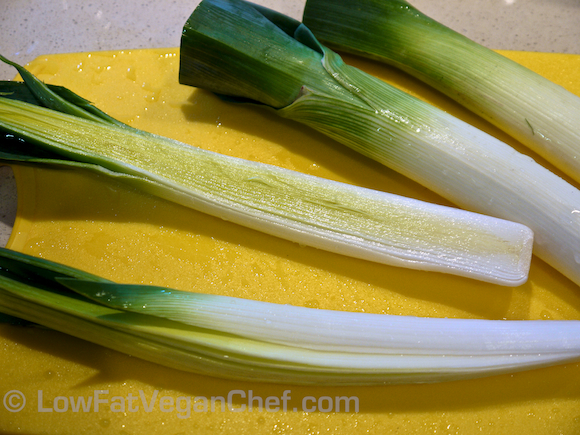
Step 2: Slice the leeks in half lengthwise.

How To Cut And Wash Leeks For Recipes

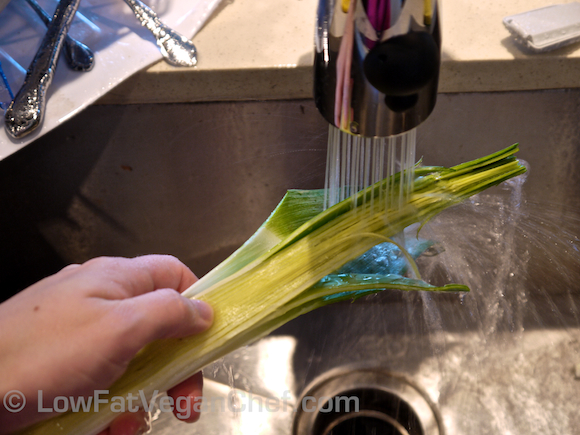
Step 3: Carefully wash in between each leaf of the leek. They usually have a lot of dirt trapped between the layers.

How To Cut And Chop Leeks For Sautéing and In Recipes

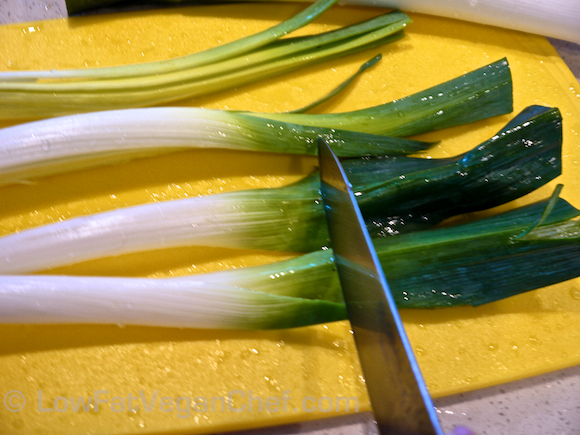
Step 4: Take off the large outer layers.

How To Cut And Chop Leeks For Sautéing and In Recipes

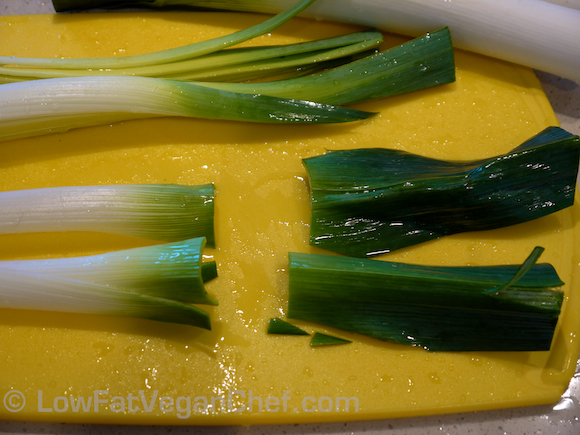
Slice off the dark green parts of the leeks and set those aside. You want to use the light green parts and the white parts only for your recipe.

How To Cut And Chop Leeks For Sautéing and In Recipes

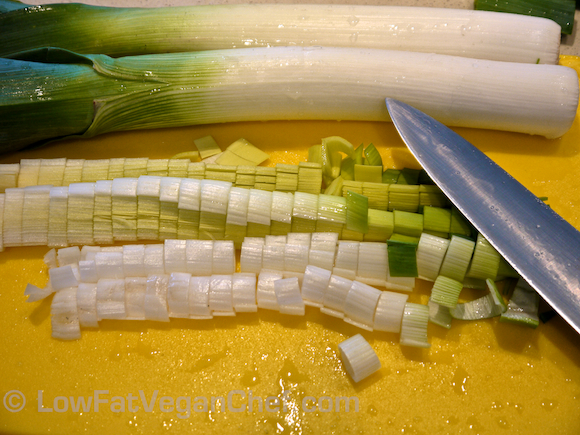
Step 5: Slice the light green parts and white parts like you would slice celery.

Now you are ready to cook your leeks, just like you would cooked diced onion.  Just sauté it in a pan or pot with some vegetable broth and when they are soft you can add the rest of your ingredients and continue cooking your dish.

Filed Under: Articles, How To Tagged With: Cooking Tips, how-to, Leeks

How To Make Homemade Vegan Vegetable Stock Easily On The Stove Or In A Pressure Cooker Without Oil

March 9, 2012 by Veronica Grace 49 Comments

Fb-Button

Homemade Vegan Vegetable Stock Broth Low Sodium Recipe

Oil-free vegetable stock is something most people don’t make, but it is pretty easy to do (aside from chopping the veggies) and it’s worth it because it’s fresh, tastes better and is cheaper than buying it if you cook like I do. I use my vegetable stock for sautéing onions and garlic in (instead of oil) and as a base for my (oil free) vegan soup recipes.

For my Low Fat Vegan Comfort Soups Recipe eBook I had to make A LOT of stock. Often the store bought stock is only 1 quart or 1 liter and often I needed more than that. It can cost up to $2.99 a pop and that can add up when you use stock as much as I do.

So once a week or maybe twice a week I’ll make some fresh vegetable stock in my pressure cooker. It’s a great way to use up some leftover carrots or celery and some herbs like thyme or parsley that you don’t need for any other recipes.

When compared to the store bought low sodium vegetable broths mine taste MUCH better and have a nice light flavour and a natural sweetness. I find the store bought ones are a little too strong and bitter and are not something you’d want to drink a cup of.

You can use homemade vegetable broth or stock for soup, sautéing, risotto and more. And this way you get to control the flavour and the amount of sodium in it.

So here are my recipes. I have one for a 9 cup recipe and a large one for a 14 cup recipe. Sometimes you just need a lot, and sometimes you just need a little.

Homemade Vegetable Broth/Stock Recipe (smaller recipe)

Yields about 9 cups/2.25 qts/~2.12 L of broth

Ingredients:

8 cups/2 quarts/~1.9 L of filtered water
2 large onions, diced
4-6 cloves of garlic, minced
4 large carrots, peeled and sliced
3 large stalks of celery, sliced
Mushroom stems and ends *optional
1/2 bunch of parsley and a few sprigs of fresh herbs like thyme
2 bay leaves
1/4 tsp. whole peppercorns
Dash of salt *optional

Pressure Cooker Method:

1. Place the vegetables, water and seasonings into a pressure cooker. Fill with water and bring to high pressure and cook for 5-6 minutes until vegetables are very tender. Use the quick release method (putting in the sink and pouring water over the lid until it releases) and let it cool until you can open the lid.

2. Strain vegetables from broth in a large mesh strainer and use a ladle, nested measuring cup or bowl to press out the excess liquid from vegetables through the strainer to yield the most broth.

Stovetop Method:

1. Place vegetables, water and seasonings into a large pot and bring to a boil. When it’s boiling turn it down to low and simmer for an hour. Don’t let your vegetables overcook and completely fall apart, check on them after 45 minutes or so.

2. Strain vegetables from broth in a large mesh strainer and use a ladle, nested measuring cup or bowl to press out the excess liquid from vegetables through the strainer.

Additional Tips:

Use the broth right away or let it cool and store in a sealed container(s) in the fridge for up to 3 days. You can freeze any extra you won’t use in that time. Use in recipes or for daily sautéing for onions and garlic.
For the pressure cooker, I chop the vegetables a little smaller. For the stovetop you can cut them into bigger chunks and keep the garlic whole, as they will cook longer.

This recipe is really flexible, if I need more for a soup recipe I’ll just add a little more water and dilute it. When I’m making it, I will use what vegetables I have but the main important ones are onions, carrots and herbs. The point is you want the water to taste like vegetables and not like plain water and homemade broth gives the best flavor for soup.
You can also use any other vegetable tops or skins if you like, but leave out the celery leaves, as they can be too bitter. I suggest that the vegetable peels be organic if you do use them. You can also add leeks, green/spring onions, other root vegetables, already cooked beans etc. to add more depth to the flavor.

Things You Do Not Want To Add To Vegetable Broth

Don’t add cruciferous vegetables as they contain sulfur and can make the broth bitter and smell unpleasant. No kale, collards, cabbage, broccoli, cauliflower, Brussels sprouts or leafy greens aside from fresh herbs.  You’d get more out of eating or juicing the greens than adding them to your broth. It won’t make it taste better for your recipes. Please do not add raw beans, grains or pasta to your vegetable broth either.

Homemade Vegan Vegetable Stock Broth Low Sodium Recipe

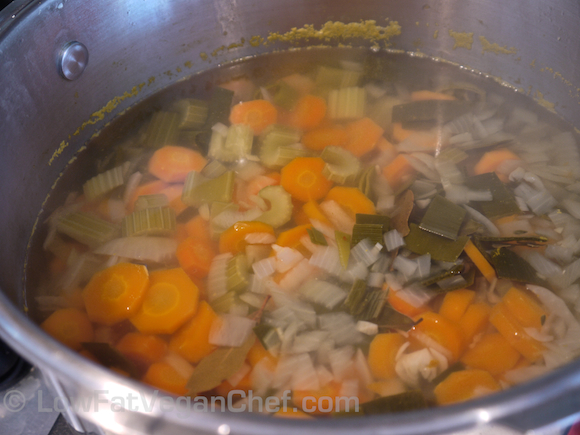
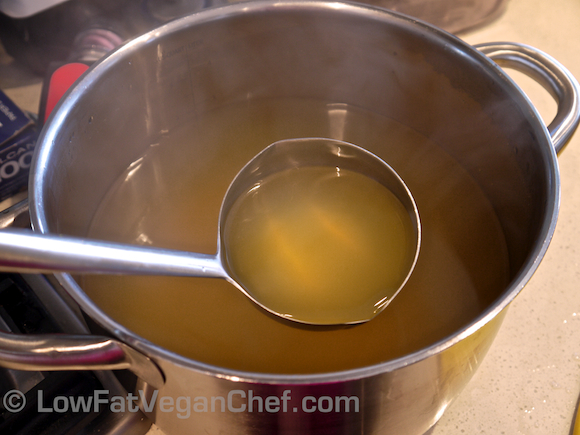
My stock is done cooking so I open the lid.

Straining Homemade Fresh Vegetable Stock Broth

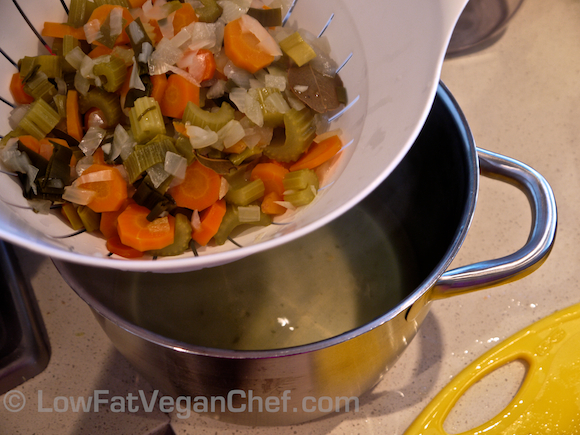
I ladle it out into a strainer/colander that is over another pot or bowl.

Straining Homemade Fresh Vegetable Stock Broth

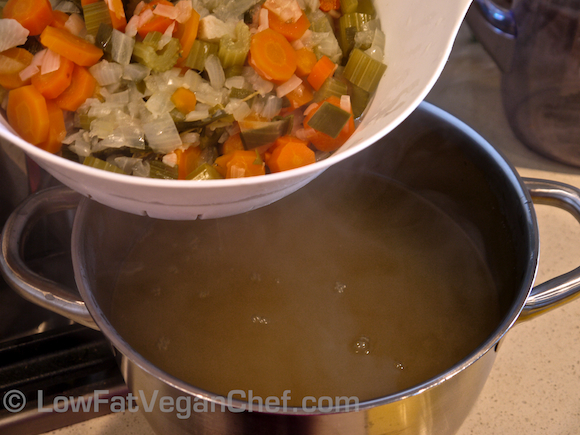
Pick up the strainer/colander filled with cooked vegetables and strain it.

Straining Homemade Fresh Vegetable Stock Broth

I push the juices out the veggies to get any extra broth.

Fresh Homemade Vegetable Stock Recipe

Now my vegetable broth/stock is ready to be used in my recipes!

Fresh Homemade Vegetable Stock Recipe

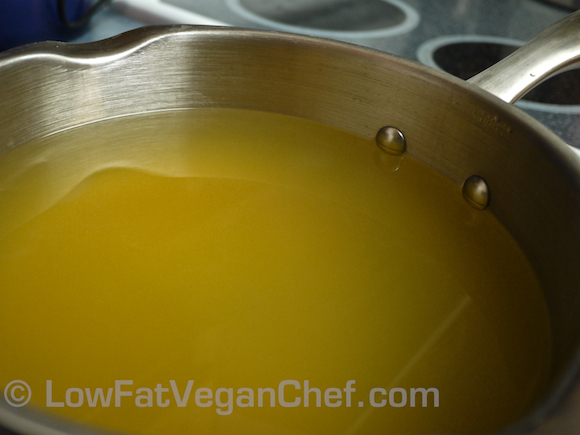
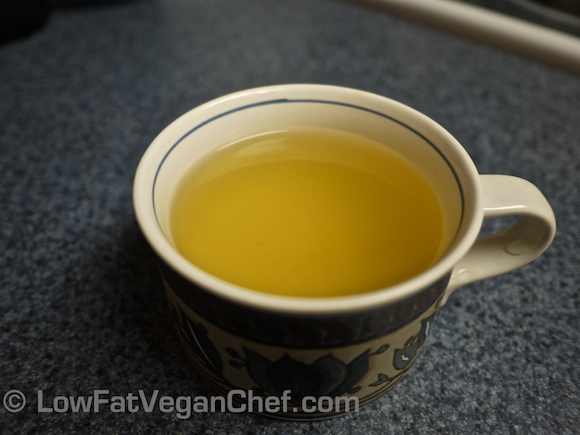
How about a cup of fresh vegetable broth?

Larger Vegetable Soup Stock Recipe

Yields 14 cups of broth

Ingredients:

12-13 cups/~3 qts./2.9 L of filtered water
2 large onions, diced
6 cloves of garlic, minced
8 large carrots, sliced
10 stalks of celery, sliced
Any other vegetable leftovers like the tops of leeks or ends of mushrooms
3 bay leaves
3 sprigs of fresh thyme
Pinch of salt
1/4 tsp whole peppercorns

Pressure Cooker Method:

1. Place the vegetables, water and seasonings into a pressure cooker. Fill with water and bring to high pressure and cook for 5-6 minutes until vegetables are very tender. Use the quick release method (putting in the sink and pouring water over the lid until it releases) and let it cool until you can open the lid.

2. Strain vegetables from broth in a large mesh strainer and use a ladle, nested measuring cup or bowl to press out the excess liquid from vegetables through the strainer to yield the most broth.

Stovetop Method:

1. Place vegetables, water and seasonings into a large pot and bring to a boil. When it’s boiling turn it down to low and simmer for an hour. Don’t let your vegetables overcook and completely fall apart, check on them after 45 minutes or so.

2. Strain vegetables from broth in a large mesh strainer and use a ladle, nested measuring cup or bowl to press out the excess liquid from vegetables through the strainer.

Filed Under: Articles, Cooked Vegan Recipes, How To, Soups and Stews Tagged With: Cooking Tips, how-to, soup

How To Cut, Prepare and Cook An Artichoke For Recipes or Stuffed Artichokes

March 4, 2012 by Veronica Grace 8 Comments

Fb-Button

How To Cut And Prepare An Artichoke For Steaming Or Stuffing

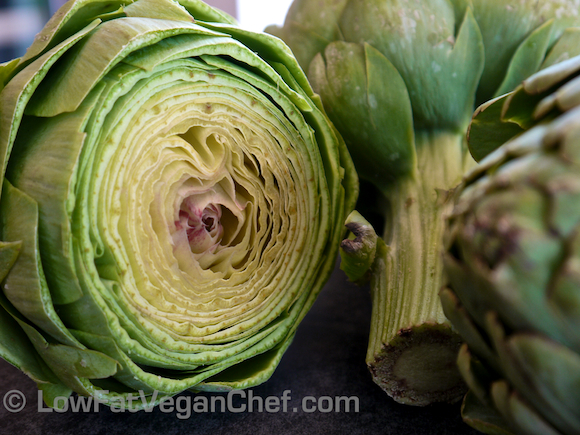
I have to admit that artichokes are something that always sounded weird and a little frightening to me at first.

Before I was vegan, I had never had an actual artichoke. I had tried Spinach Artichoke dip at Moxie’s before, but it’s filled with cream cheese, and let’s be honest, most vegetables covered in cream cheese probably taste good anyway. So this was not a good indication for me whether I would like them or not!

How To Cut And Prepare An Artichoke For Steaming Or Stuffing

The first time I ever had artichokes in their vegetable form was on one of Amy’s cheese-less pizzas and it was a new experience. I wasn’t sure I liked them at first.

I’ve tried marinated artichokes in oil and brine, and now steamed artichokes on their own and even in soup. I have to say I am a BIG fan of fresh made artichokes. The canned/jarred ones are seasoned a little too much and the ones in oil are just gross to me.

When you prepare them yourself they have this nice creamy taste (the artichoke heart) and you can do so many things with these delicious morsels it’s not even funny…

How To Cut And Prepare An Artichoke For Steaming Or Stuffing

So in case you’ve never tried an artichoke or were seriously intimidated by these beastly looking vegetables I want to show you how to cut and prepare them yourself.

If you’re just doing one or two for a snack or for stuffed artichokes, it’s not that much work. I did 4 and it took a little longer. Mostly because I had to keep photographing every step!

How To Cut And Prepare An Artichoke For Steaming Or Stuffing

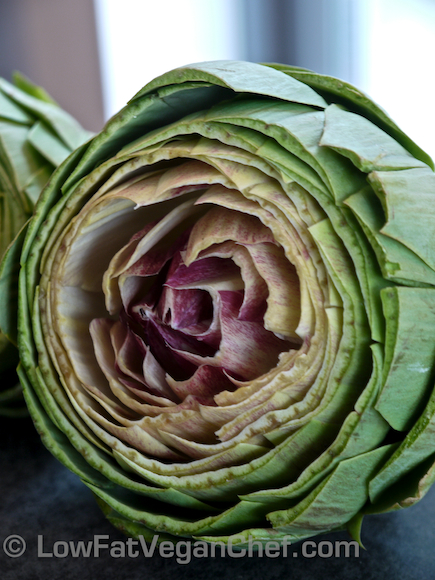
I love how pretty the purple centre is.

How To Cut, Prepare and Cook An Artichoke

for Recipes or Making Stuffed Artichokes


How To Cut And Prepare An Artichoke For Steaming Or Stuffing

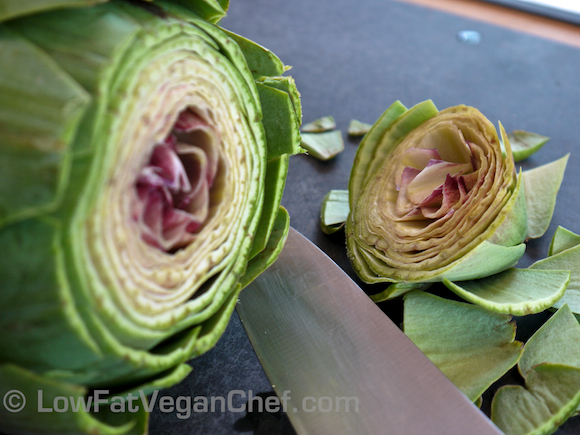
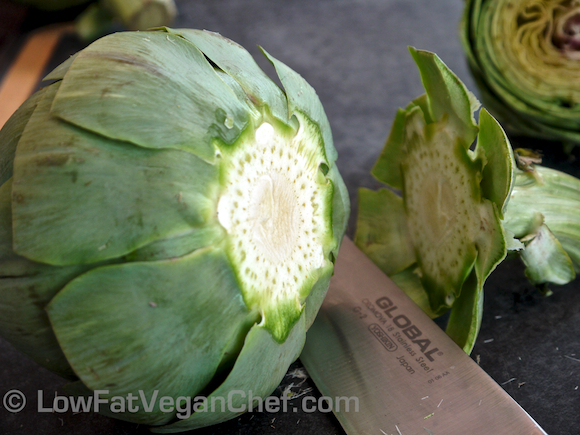
Step 1: Using a very sharp knife, cut the top point off of the artichoke. Get about the first 2 inches. These tips are prickly and you’re not going to eat it anyway.

How To Cut And Prepare An Artichoke For Steaming Or Stuffing

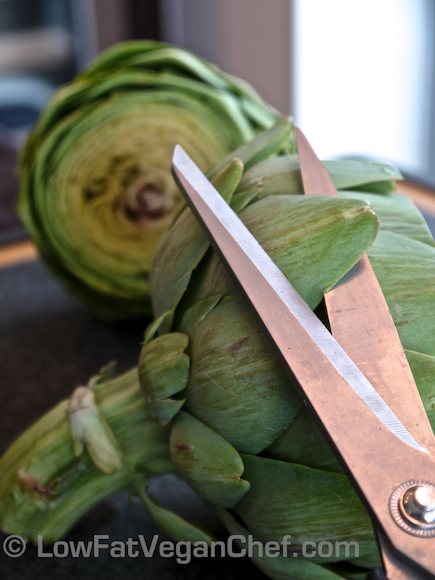
Step 2: Using a very sharp pair of scissors, cut off the pointy tips of each leaf all the way around on all the remaining tips. These are sharp and pokey and you don’t want them.

How To Cut And Prepare An Artichoke For Steaming Or Stuffing Purple Center

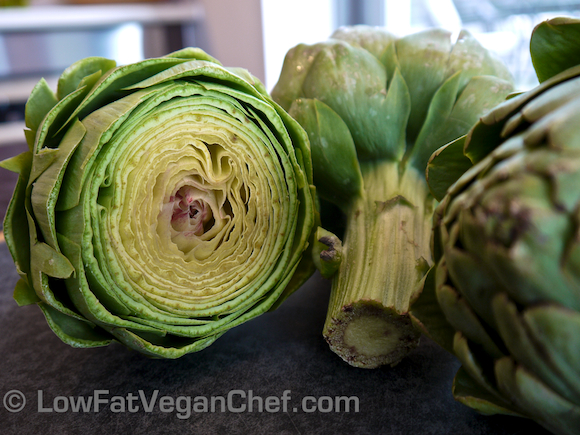
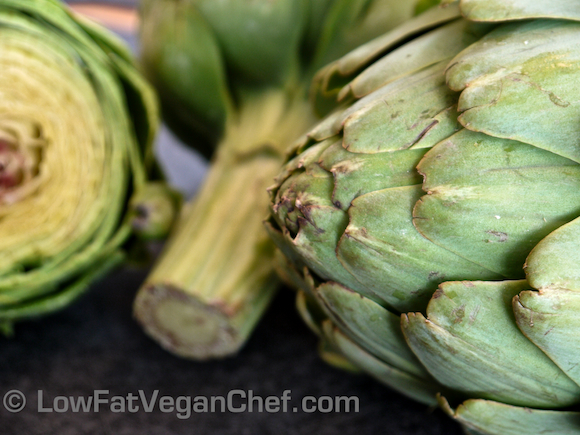
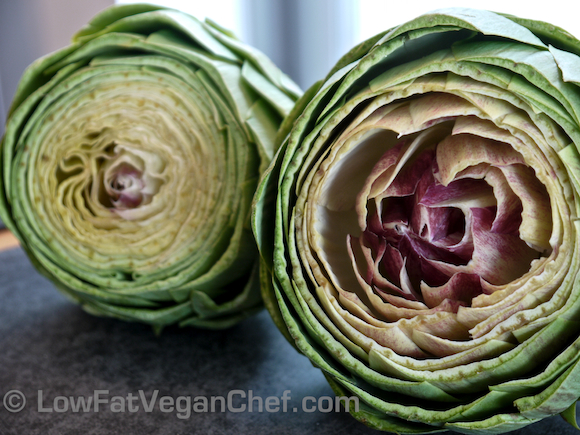
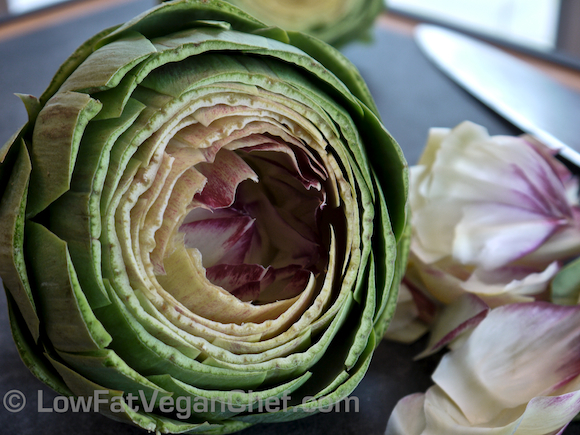
Step 3: Grasp the bottom of the artichoke in your hands and using your two thumbs, fan out the centre of the artichoke so that it is separated. The one on the right has been fanned out, the one on the left has not been.

How To Cut And Prepare An Artichoke For Steaming Or Stuffing Purple Center

(Close up.)

How To Cut And Prepare An Artichoke For Steaming Or Stuffing Purple Center Leaves

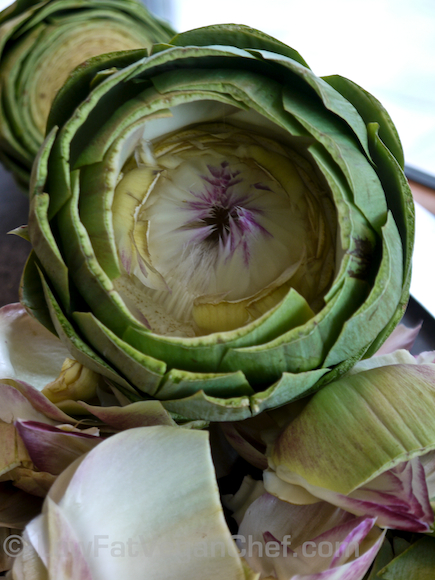
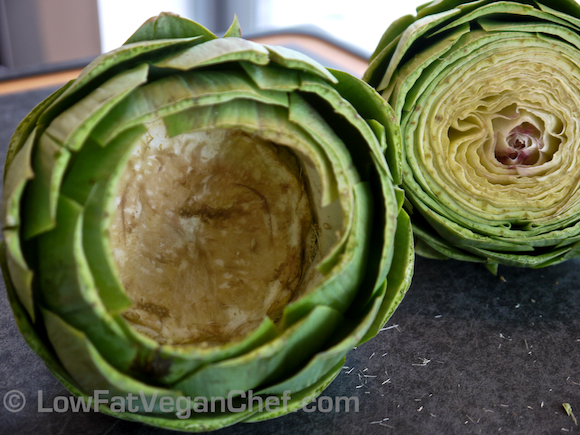
Step 4: If you want to make stuffed artichokes you can pull out the inner leaves that are light green with purple tips (Being careful not to poke yourself of course.) Go slowly one or two leaves at a time. (If you don’t care and are just going to cook the whole thing to eat it petal by petal, you can skip this step. It will just take longer to cook)

How To Cut And Prepare An Artichoke For Steaming Or Stuffing Center Of Artichoke

This is what it looks like when you start pulling the inner petals out. The inside part can be a little sharp.

How To Cut And Prepare An Artichoke For Steaming Or Stuffing Scooping Out Center Of Artichoke

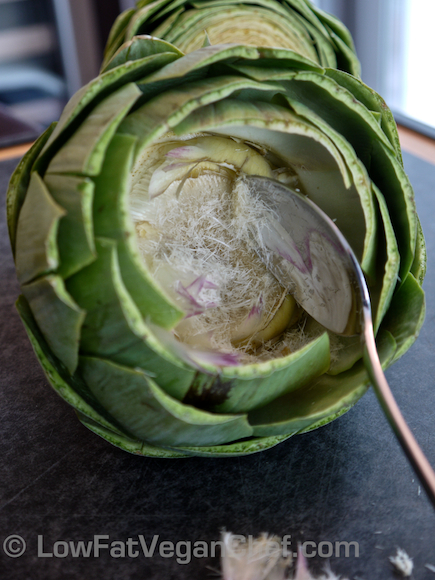
Step 5: (If you’re pulling out the centre petals) Get a spoon and start scraping out the fuzzy “choke” of the artichoke. Make sure you get all the way around the sides. Some artichokes are easier or harder to clean. I had 3 easy and 1 hard one.

How To Cut And Prepare An Artichoke For Steaming Or Stuffing Stuffed Artichoke

Step 6: Now that your artichoke “heart” is revealed you want to dribble some fresh lemon or lime juice on it to keep it from oxidizing too badly and give it some flavour.

Chopping Off Stem Of Artichoke To Cook

Step 7: Slice off the bottom stem from the artichoke close to the root. You can discard, or cut off the hard green exterior and steam the light green/white interior to use in your recipe.

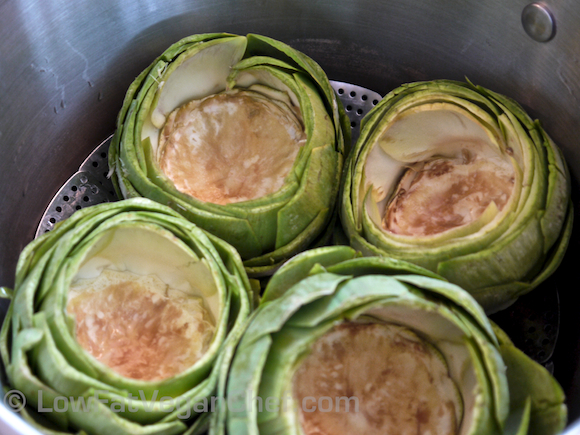
Steaming Artichokes In A Steamer Basket

Step 8: Steam or pressure cook your artichokes. Steam them for 20-30 minutes. Check on them after 15-20 minutes. It depends on the size of them and how hard they are as well.  I pressure cooked mine. Because the inside choke was taken out they will cook MUCH faster than if you leave it in. So it’s up to you if you want to save on cooking time by doing this step or not. Pressure cook for 7-8 minutes just until tender. You don’t want your artichoke to fall apart.

What To Do With Steamed Artichokes?

When your artichokes are done you can let them cool and either fill them with dip or stuffing, or cut out the interior “hearts” to put on pizza, sandwiches, blend into soup etc. The leaves you can peel off one by one and put the inside portion into your mouth and scrape off the thin layer of tasty flesh. A lot of people like to dip these in mayo (I don’t do this) but you could make like a tahini or peanut dip or just eat them plain.

If you want to make a vegan spinach artichoke dip you can look for some Tofutti Better Than Cream Cheese vegan cream cheese at Whole Foods or your local health food store. I haven’t made one yet, but I’m sure it would be good. I just try to stay away from the really fatty vegan dairy alternatives myself.

I used my artichokes for a Cream of Artichoke Soup that is in my Comfort Soups To Keep You Warm recipe ebook. It will be available soon, I’m just finishing writing the intro and doing the layout and metric conversions. I will let you know when it’s ready! None of the recipes in it are on the blog here, they are all secret so far…

Alternatively, if you have a recipe that calls for artichokes you can buy an 8 oz can of artichoke hearts in water or brine (skip the oily ones, even rinsing won’t get rid of the oil) or you can find frozen artichoke hearts at a lot of grocery stores.

Filed Under: Articles, How To Tagged With: artichoke, how-to

How To Peel Ginger Quickly and Easily With A SPOON!

March 4, 2012 by Veronica Grace 7 Comments

Fb-Button

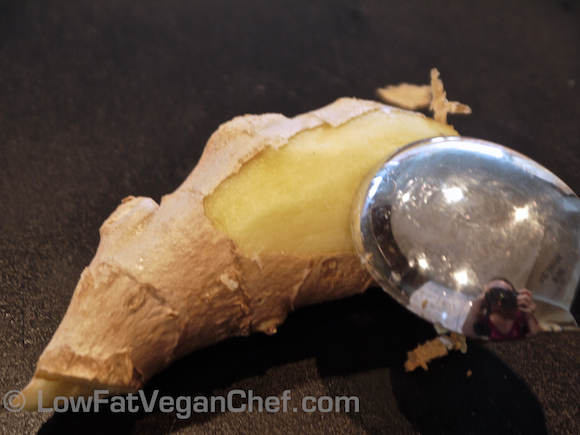
So how do you peel ginger easily? This is a neat little trick that you may not know about. You can actually save all of your ginger by peeling it with a spoon instead of cutting it or paring it with a knife. It’s really easy and safe too. When you cut it with a knife you can loose a bunch of it and then it can be all uneven and choppy.

I am using this peeled ginger here to put in some celery-apple juice. It’s really good. Even juicing this much isn’t that strong when you juice a whole head of celery.

How To Peel Ginger Using a Spoon

How To Peel Ginger With A Spoon

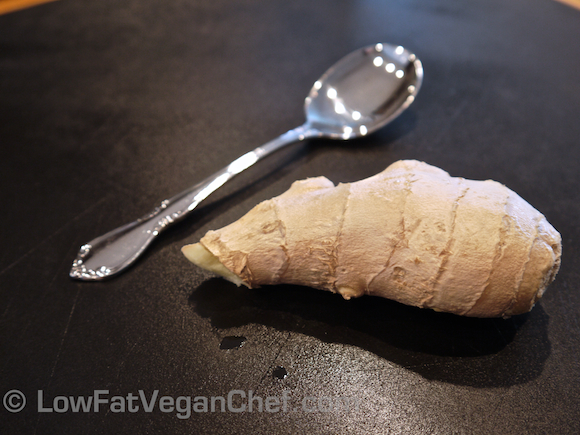
Step 1: Get out a large soup spoon or something other than a narrow teaspoon. It should be metal, not plastic or you may snap it.

How To Peel Ginger With A Spoon

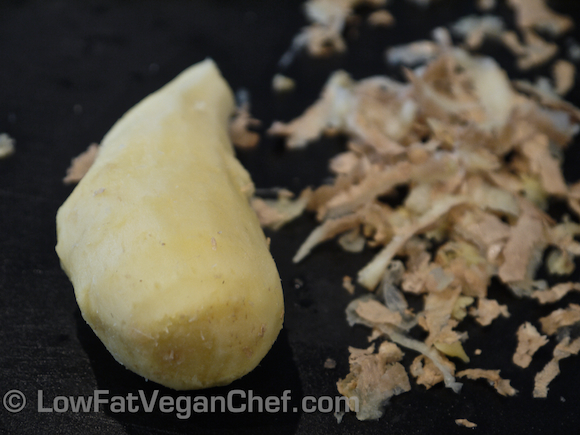
Step 2: Start scraping the outer peel off of the ginger with your spoon. This way it is safe and if you slip or have any weird nooks or crannies to get into you won’t cut yourself!

How To Peel Ginger With A Spoon

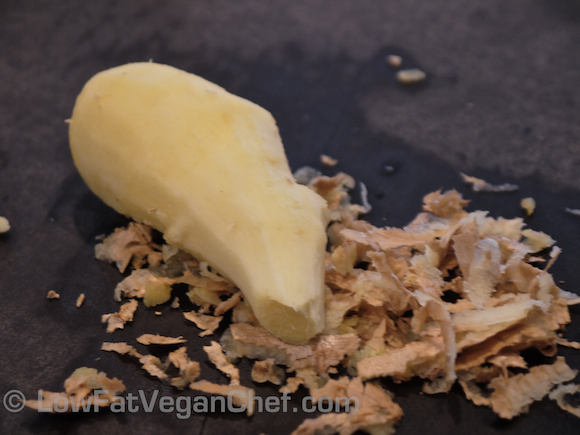
Go all the way around the ginger until all the skin is gone.

How To Peel Ginger With A Spoon

Wow that was easy! Now your ginger is ready to be used.

I know some people find  chopping or mincing ginger regularly a pain so they do up a bunch and freeze it so that it’s ready to use. I don’t do this as my freezer is always jammed full of frozen fruit, but you an and then it’s ready to grate or use in your mini garlic chopper (after you let it sit on the counter for a bit first) and you can use it in recipes quickly.

Ginger is essential for Asian and Indian dishes, so I use it quite often. It’s also dirt cheap so I always make sure to have some in the fridge. It’s definitely an essential ingredient like onions and garlic for vegan recipes or even raw vegan salad dressings.

Filed Under: Articles, How To Tagged With: ginger, how-to

How To Roast Garlic In The Oven Without Oil: Fat Free Roasted Garlic

February 29, 2012 by Veronica Grace 20 Comments

Fb-Button

Yes you can make roasted garlic without oil! There’s actually no real need to use oil when roasting garlic in the oven. When you add oil to oven baked foods it makes them cook faster and at a hotter temperature and the oil does retain a little moisture so they don’t dry out. But when you are putting your garlic in tin foil anyways to steam, it’s unnecessary. It might take a few more minutes to roast, but it will be calorie free and still delicious.

I’ve seen some peoples’ directions recommend a teaspoon or two of oil for each head of garlic! Holy calories! Let’s skip that shall we?

My roasted garlic turns out perfectly fine without any oil in my convection oven. Just watch!

How To Roast Garlic In The Oven Without Oil

Or Make Roasted Garlic Without Oil For Recipes

Step 1: Preheat oven to 400 F / 205 C (or 375 F on a convection oven).

How To Roast Garlic In The Oven Without Oil For Roasted Garlic

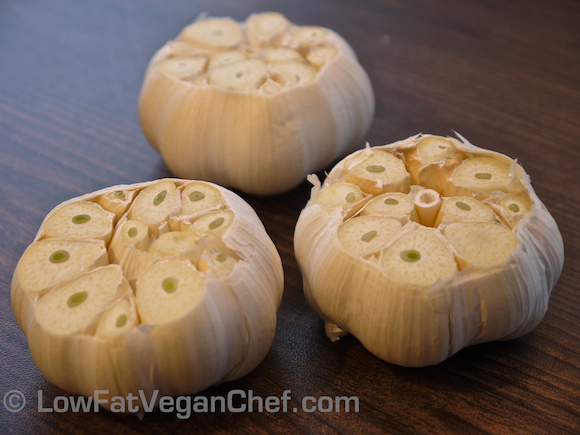
Cut off the tops of the garlic cloves

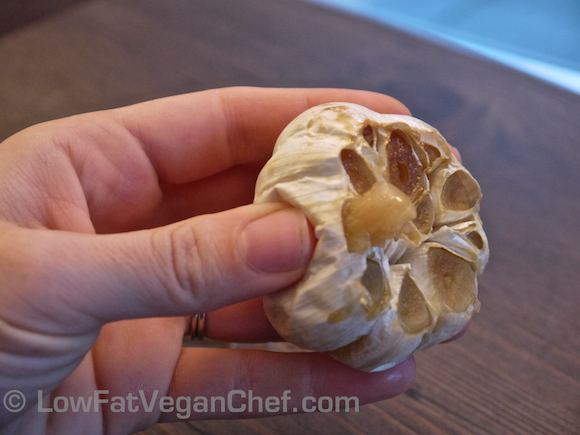
Step 2: Slice off a good chunk off the top of the head of garlic. Make sure all of the cloves are exposed so you will be able to get them out. (It’s best to have garlic with no green sprouts in it, but mine had some as they sat for a while on the counter. I used them anyway.)

How To Roast Garlic In The Oven Without Oil For Roasted Garlic

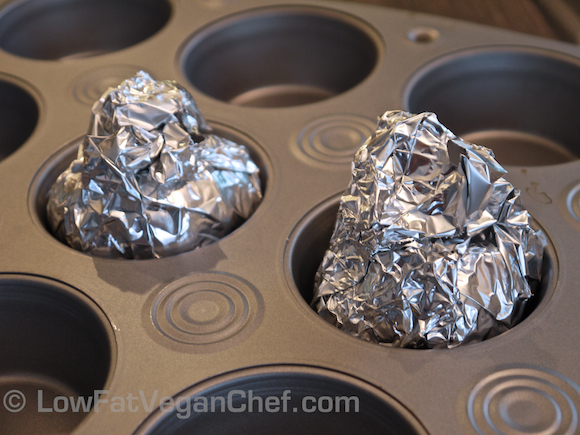
Wrap the garlic cloves in tinfoil

Step 3: Wrap the garlic cloves individually in tinfoil and place on a baking sheet or in a muffin tin. If using a muffin tin you can add some water to the muffin holders you are using. I think this will help with the moisture of your garlic and help it cook faster. It seemed to cook faster for me than usual.

Step 4: Bake in the oven (when it’s up to temperature) for 35-45 minutes until the cloves are soft. They will be very hot, so you need to use oven mitts to squeeze them gently to see if they are done.

How To Roast Garlic In The Oven Without Oil For Roasted Garlic

Cool and gently unwrap to see the caramelized roasted garlic cloves inside

Step 5: Let the garlic cloves cool before touching. Unwrap the tinfoil.

How To Roast Garlic In The Oven Without Oil For Roasted Garlic

Squeeze out the roasted garlic for your recipe

Step 6: You can either squeeze each clove of garlic out one at a time (careful to not let hot garlic burn you, or slip out of the bottom) or you can peel the cloves and remove them one by one if you are stickler for maximizing your garlic output! How do you know if your roasted garlic is ready? It will be a golden brown color and be very soft inside. If it’s still white and not fully soft, it’s not ready yet.

Step 7: Your (oil-free) roasted garlic is ready to use in soups, mashed potatoes, dips, or just to spread on bread. Save any leftovers in a container in the fridge.

Enjoy!

How did you like my tutorial for how to roast garlic without oil?


Filed Under: Articles, How To Tagged With: fat-free, gluten-free, how-to, nut-free, roasted garlic

  • « Go to Previous Page
  • Page 1
  • Interim pages omitted …
  • Page 10
  • Page 11
  • Page 12
  • Page 13
  • Page 14
  • Go to Next Page »

Primary Sidebar

Follow Us:

Newsletter

Get The Low Fat Vegan Starter Kit

natural organic skin care line

Free Skincare Samples

Earn Free Crypto At Binance

Earn Free Bitcoin on Gemini Exchange

Earn $10 in Bitcoin With Gemini Exchange
Dr. Fuhrman
Dr. Fuhrman
Dr. Fuhrman

Tags

80/10/10 apple avocado banana blueberries breakfast broccoli Carrots celery chickpeas cilantro corn cucumber Curry dill dinner easy Eat To Live fat-free gluten-free how-to Indian Dishes lemon low-fat mango mexican mushrooms nut-free oil-free pasta pineapple plant-based raw raw vegan rice smoothie soup soy-free spinach tofu tomato tomatoes vegan vegetarian vitamix

Secondary Sidebar

Recipes:

  • Cooked Vegan Recipes
  • *My Recipe Books
  • Breads and Baked Goods
  • Breakfast
  • Brunch
  • Burgers
  • Casseroles
  • Curries
  • Desserts
  • Dinner
  • Dips for Veggies or Chips
  • Eat to Live-Dr. Fuhrman Recipes
  • Engine2Diet
  • Ethiopian Dishes
  • Greek
  • Green Dishes
  • Holiday
  • Indian Dishes
  • Mexican
  • One Pot Meals
  • Pasta
  • Pizza
  • Quinoa
  • Salads
  • Sandwiches and Wraps
  • Raw Vegan Recipes
  • 80/10/10
  • Raw Breakfast
  • Raw Desserts
  • Raw Dips
  • Raw Dressings
  • Raw Entrees
  • Raw Juices
  • Raw Salads
  • Raw Smoothies
  • Raw Snacks
  • Raw Soups
  • Sauces
  • Side Dishes
  • Slow Cooker Recipes
  • Snacks
  • Soups and Stews
  • Spices/Seasonings
  • Sushi
  • Thai
  • Vietnamese

Copyright © 2026 · Foodie Pro & The Genesis Framework