• Skip to primary navigation
  • Skip to main content
  • Skip to primary sidebar
  • Skip to secondary sidebar

Plant Based U

Fat-Free and Low Fat Vegan Plant Based Recipes

  • Home
  • Recipes
    • Raw Vegan Recipes
    • Cooked Vegan Recipes
    • Eat to Live Dr. Fuhrman Recipes
  • Products
  • Coaching
  • Videos
  • Articles
  • About
    • What Is Low Fat Vegan/Whole Foods Plant Based
    • Resources
  • Contact

Articles

Fb-Button

Is Your Favorite Salad Dressing Making You Fat?

September 6, 2012 by Veronica Grace 10 Comments

Fb-Button

Today I want to talk to you about something that could secretly be sabotaging your weight-loss goals. Something so popular in America many people don’t even think twice about eating regularly. Some may even think that it’s OK to eat or even “harmless”.

I’m talking about store-bought salad dressings and the fact that they are probably making you fat… or at least keeping you fat!

Those creamy, oily, sugary processed salad dressings that come in hundreds and hundreds of different flavors could be keeping you fat.America is convinced that although salad is health food, the only way to choke down bland and boring lettuce is to slather it in rich decadent dressing.

I really don’t like store bought dressings. I actually despise them and almost NEVER use them.

I’ve had so many salads in my life that pretty much any store bought salad dressing turns my stomach. Even those oil-free supposedly “healthy” salad dressings (which in no way shape or form are even remotely healthy.)

 The top 3 Reasons Why Store Bought Salad Dressings Are Bad For You:

 

#1. Classic Dressings Are Oil/Mayo/Cream Based

Often times creamy dressings have even MORE calories than pure oil. How can they manage to make a dressing worse than pure concentrated fat? By adding high fructose corn syrup to it!

Check out the calorie count of some popular salad dressings:

Calories and Fat in 2 TBS Caesar Salad Dressing
150 cals       16 g

Calories and Fat in 2 TBS Thousand Island Dressing
140 cals       13 g

Calories and Fat in 2 TBS French Dressing
120 cals       12 g

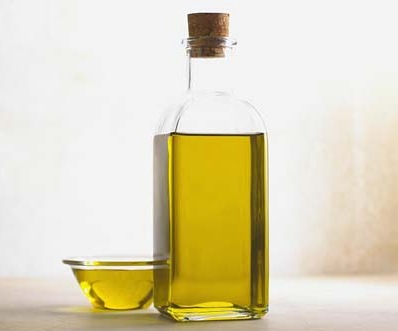
Calories and Fat in 2 TBS Olive Oil
120 cals       14 g

Now while you may think that 100-200 calories of dressing is not a big deal, I want you to ask yourself, when was the last time you had a gigantic salad and only used 1 or 2 TBSP of dressing? It is extremely hard to make the dressing stretch that far and give your salad enough flavor. Many lunch salads come with 2-4 oz of salad dressing. Did you know that’s the equivalent of 4-8 tablespoons? That can be an extra 300-600 calories in your dressing alone!

A green salad with some vegetables might have between 50 and 100 calories depending on how many vegetables you add to it. If you’re also tossing some nuts, avocado, cheese, bacon or chicken onto that salad as well you can be adding another 200-500 calories and your “innocent” little lunch salad is looking rather indulgent compared to a fast food hamburger (which is mostly bread anyway and lower in fat). A high fat diet has been shown time and time again to negatively impact those with heart disease, diabetes, cancer, and many other common diseases.

P.S. Check out my healthier raw vegan Caesar salad dressing recipe.
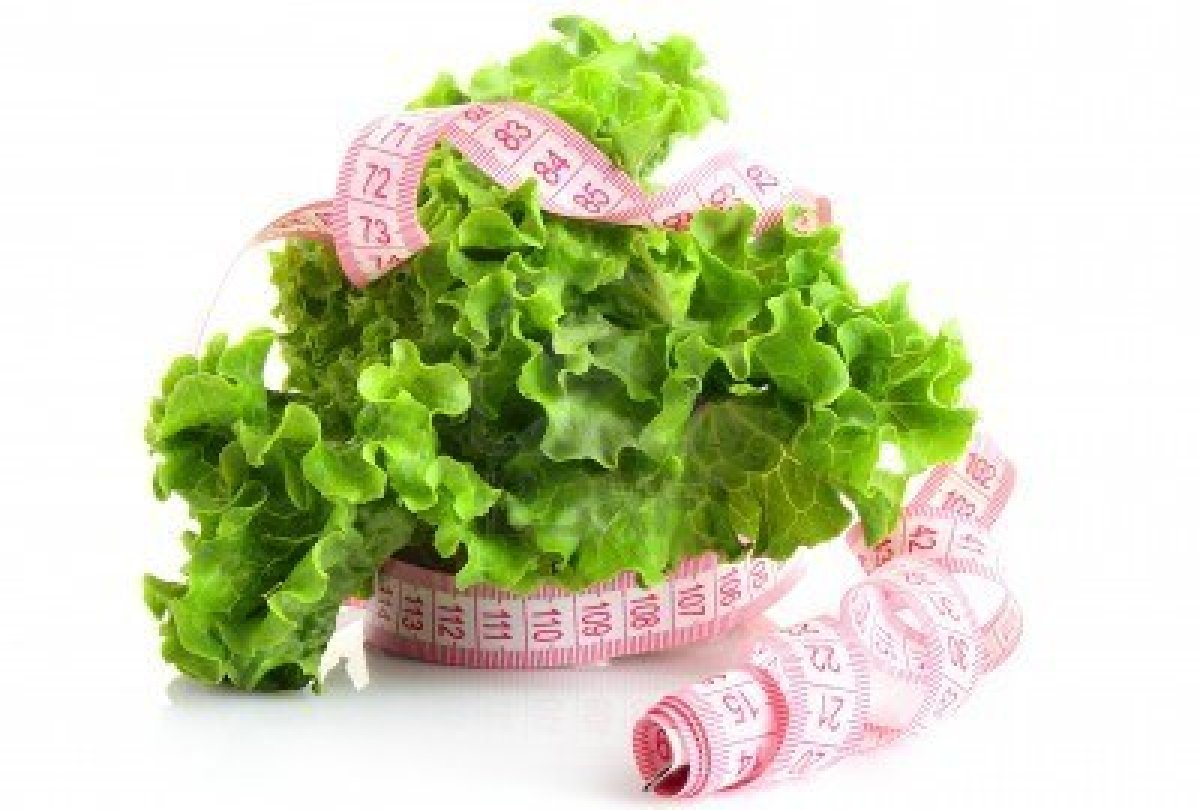
photo from 123RF

#2. Rich High Calorie Dressings Prevent You From Losing Weight

Most women think that the key to losing weight is to skip their regular lunch fare and just have a salad for lunch. Well as we learned above, what you put in your salad and what dressing you choose really matters in terms of calorie and fat content. Drizzling dressing haphazardly over your daily salad is not going to help you reach your weight-loss goals if you already have a problem with portion control and late night snacking.
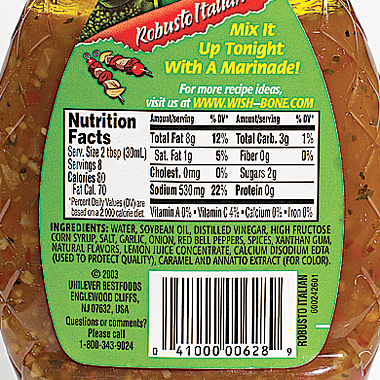
#3. Store Bought Dressings Are Mass Produced And Contain Questionable Ingredients

Many dressings are based on 3 things, oil/fat, vinegar and high fructose corn syrup. Next they add in artificial flavourings, colours and preservatives and salt. None of these items are good for you, and they are all 100% refined. While the low calorie dressings may seem like a “better” choice, they are still based on vinegar and high fructose corn syrup, and let’s face it, you deserve better than that to build your body with. Artificial colours such as “caramel” (also used in colas) are added to many store bought dressings to make it look better but caramel colouring has been labeled in California as “known to the state to cause cancer or reproductive toxicity.” 1.

So what is the solution then?

Figure out how to MAKE your own tasty and nutritious salad dressings from WHOLE FOODS and healthy fats. It’s a good idea to learn how to master both low calorie and nut based dressings so you have a variety to choose from and you don’t have to eat the same ones week in and week out.

For this weekend only I’m giving away a copy of ’70 Healthy Salad Dressings’ when you buy the GOLD package of my new ebook ‘Simply DecadentSmoothies’. Essentially you are getting 2 ebooks for the price of one and access to over 120 whole foods recipes you can make in any old blender in 5 minutes or less.

I have to say I much prefer homemade salad dressings to store bought ones. Even though they take a few minutes to prepare and don’t last for months in the fridge they are infinitely tastier and better for you. Also instead of adding nuts to my salads, I prefer to blend nuts or seeds into my salad dressings instead of using oil. Ingredients like hemp seeds, tahini (sesame seed butter) almond butter and chia seeds are some of my favorites. I also make some really tasty fat free salad dressings with fresh citrus juice and
vegetables.

If you make salad dressing just once every 3 days you’ll be well on your way to having a heart healthy AND waist line friendly salad that will help you achieve your weight loss goals.

So get in your kitchen and start blending your way to a healthier trimmer you with ‘Simply Decadent Smoothies’ and for this weekend only get ’70 Healthy Salad Dressings’ as your bonus to keep.

What’s your favorite homemade salad dressing recipe?

Filed Under: Articles, Obesity, Raw Dressings Tagged With: article, obesity, salad dressing

5 Secrets For Making Quick And Healthy Vegan Meals At Home

September 1, 2012 by Veronica Grace 21 Comments

Fb-Button
I want to share with you some more helpful hints on how cooking low fat vegan and plant based meals at home can fit into your schedule and help you on your way to losing weight without too much fuss. If you’re new to the lifestyle and want to reach your goals faster, check out my Low Fat Vegan Starter Kit which covers meals for breakfast, lunch AND dinner!

image credit: thesurvivorsclub.org


5 Secrets For Making Quick Healthy Meals At Home

 
1. Plan in advance what you will be eating (at least 5 days a week) breakfast and lunch and then 4 or 5 nights for dinner if you like.
Take a few minutes to write down some ideas for what you enjoy eating (that is healthy and nutritious) and what you think you can manage preparing for the week. It is very hard to stick to a healthy diet if you don’t do this crucial first step in figuring out your meal options. 
 
2. Shop once a week on a weekend for all the food you will be eating throughout the week. 
Know how many fruits, veggies and bags of salad you will need for the week and keep it on hand. If you have healthy items in the fridge you are more likely to eat them than if you have nothing around when you’re short on time and having hunger pangs. Also cleaning out your fridge regularly and keeping it organized will help you see not only what you have to work with but also prevent you from letting food go to waste by spoiling or freezing if it’s stuck at the back of the fridge. 
 
3. Eat the same (or very similar) thing for breakfast and lunch during the week to keep things simple. 
Studies have shown those who eat the same healthy breakfast or lunch every day have an easier time sticking to their diet plans and reaching their goal weight. Control temptation for eating on the go and grabbing takeout by planning in advance and eating meals you love every day during the week. 
 

Breakfast ideas during the week: large fruit smoothie, large green smoothie, steel cut oats with dried fruit and nuts, fruit salad with toast and jam and/or peanut butter, fruit salad with coconut or almond yogurt (available at the health food store), fruit salad and a whole grain muffin etc. See my ‘Simply Decadent Smoothies’ recipe ebook for delicious ideas.  

Lunch ideas during the week: large salad with fruit, vegetables and homemade nut based dressing (oil-free of course), steamed vegetables and/or lentils and rice with a homemade or low fat store bought sauce, baked potato with hummus and a side salad, homemade soup, stew or chili, roasted vegetable sandwich on whole grain bread with fruit, etc. See my ‘Comfort Soups To Keep YouWarm’ recipe ebook for hot lunch ideas. 
 
4. For hot meals (or salads) do your cooking (or prepping) once or twice a week. 
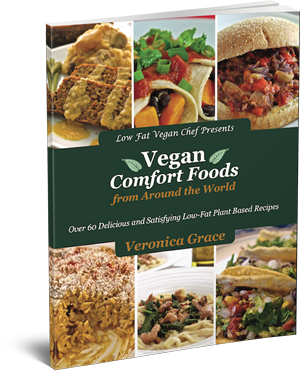
Make a big batch or double batch of soup, stew, casserole, curry etc. that you can easily pair with a whole grain such as rice or quinoa and a salad or veggies. For salads use large tupperware containers and portion out your lettuce and assorted veggies, dried fruit and toppings. Make a homemade dressing or find a tasty oil-free dressing you enjoy and have little containers to take with your salad each day. For delicious dinner recipes the whole family will enjoy I recommend my “Vegan Comfort Foods From Around The World” recipe ebook. 
 
5. Use cooking devices such as slow cookers or pressure cookers to save active cooking time in the kitchen.
 
With a slow cooker you can prep everything on a Sunday morning or afternoon and then by dinner time you will have a hot meal ready to eat and you can save any leftovers for meals throughout the rest of the week. With a pressure cooker you can easily make homemade vegetable broth, soup, or fresh beans in only a fraction of the time so you don’t have to hang around watching the stove for an hour while things cook. 
 
The most important aspect to sticking to a healthy diet and lifestyle is planning ahead. Life can get hectic at times and we can feel rushed and make a lot of excuses for eating unhealthy snacks and meals on the go, but if you master the art of shopping in advance and learn how to make a few healthy recipes you like to eat every week you will be well on your way to success. 
 
Just schedule yourself some time every week for shopping and preparing a few healthy recipes, a little effort in these areas can make a big difference to your health and not to mention your waistline…
 
I hope I’ve inspired you to take the next step and get back into the kitchen. 
 
You can do it, I believe in you!

Filed Under: Articles, How To Tagged With: article, cooking, Cooking Tips, dinner, easy, eat healthy, get organized, low fat vegan, menu ideas, secrets, smoothies, soups

5 Good Reasons to Include Fermented Foods In Your Diet

August 16, 2012 by Veronica Grace 3 Comments

Fb-Button

photo credit: openjourney.com

Today I want to talk to you about something new and exciting that I’m experimenting with…

Cultured foods!

My good friend Kevin Gianni from Renegade Health absolutely loves including homemade healthy cultured foods in his diet. And for good reason.Many of us have or have had impaired digestion at one time or another in our lives. Maybe it was from a processed foods diet, frequent use of antibiotics, or even a run in with a parasite while traveling.Or you may have a more serious condition like chronic constipation, irritable bowel syndrome, celiacs disease, Crohn’s disease or colitis.

If any of these situations resonate with you, then keep reading. I’m going to share with you the benefits of eating homemade cultured foods and why you should consider adding them to your diet.

Proper digestion is crucial when it comes to building and maintaining a healthy body and immune system. So when your digestion is out of whack you can experience a lot of pain, bloating and discomfort and possibly even end up with some absorption problems depending on the severity of your issue.

If you need some help with building more beneficial bacteria in your system you should check out Kevin’s new book called

Cultured: Learn To Make Healthy Fermented Foods At Home

Let’s take a look at some other reasons you may want to include cultured foods in your diet:

5 Good Reasons to Include Fermented Foods In Your Diet

1. Cultured Foods are Easy to Make at Home and Taste Great

We all know how much people love the taste of fermented foods like cheese, yogurt, kefir, sourdough bread, sauerkraut, miso, and traditional pickles. They have an interesting tangy and complex flavour that ads zip to whatever you’re eating.

Even if you’re vegan there are many delicious cultured foods to experiment with and try making at home. Almost any vegetable can be turned into a delicious fermented food!

2. Fermenting Vegetables Increases Their Nutritional Profile

On top of the existing vitamins and minerals vegetables provide naturally, the beneficial bacteria in cultured foods produce new enzymes and additional minerals which increases their nutrition content. So fermented foods can be a great “good for you” condiment for any meal.

3. Fermented Foods Can Aid In Healing Your Digestive Tract

Processed and refined foods can damage the sensitive villi in your digestive tract and kill off the beneficial bacteria that resides in them. By bringing in new cultured and fermented foods you can help repopulate your intestinal flora with beneficial bacteria and help restore your natural PH balance.

4. Homemade Fermented Foods Are Better Than Supplements

Probiotics generally only contain 1 or 2 main strains of beneficial bacteria, but homemade fermented foods can develop many more strains of good bacteria and diversify the flora in your digestive tract.

5. Fermented Foods Can Promote Good Oral and Dental Health

Many oral and dental health issues such as gingivitis, halitosis, and cavities occur because of a proliferation of bad bacteria in the mouth. When you eat fermented foods that are rich in lactic acid and other beneficial bacterias they can reduce the levels of harmful bacteria in your mouth and keep them in check.

Some of the delicious fermented foods included in Kevin Gianni’s recipe ebook are:

  • sauerkraut
  • applekraut
  • pickles
  • coconut and water based kefirs
  • almond and coconut yogurts
  • vegan cheeses and sour cream
  • rejuvelac
  • miso
  • tempeh
  • gluten free breads with teff and lentils
  • popsicles
  • and many more

If fermented foods sound like something you’re considering including in your diet check out Kevin’s ebook Cultured: Learn To Make Healthy Fermented Foods At Home:

http://www.1shoppingcart.com/app/?Clk=4818804

What’s your favorite cultured food to eat? 


Filed Under: Articles Tagged With: article, cultured, fermented

How To Make Perfect Vegan Smoothies And Green Smoothies Every Time

August 5, 2012 by Veronica Grace 5 Comments

Fb-Button

How To Make Great Vegan Smoothies Every Time

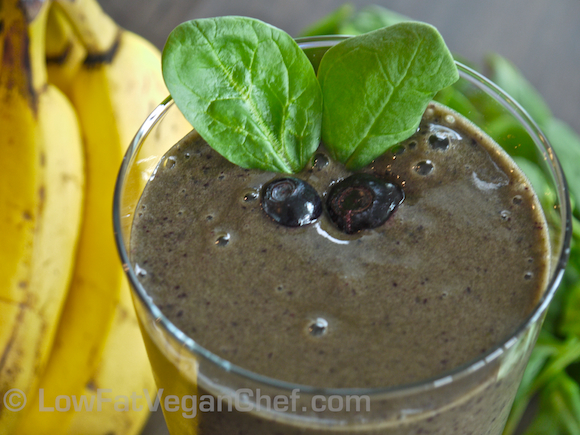
Low Fat Vegan Chef's Beginner's Green Smoothie Blueberry Banana Spinach Smoothie

Tools Necessary For Making The Best Smoothies

There are a few tools that will help you make the best tasting smoothies. The most important is obviously a good blender. I recommend using a high power blender if you are serious about making delicious smoothies regularly and if it fits your budget.

My preferred blender of choice is a VitaMix because of the superior motor, warranty and large size (64 oz.) container. I use it almost daily, some days multiple times! It’s excellent for breaking down fruits and greens into tiny particles, which results in a very smooth and creamy end product. It’s also excellent for making blended soups, (raw or cooked), homemade salad dressings, sauces, and baby food. It is the first major kitchen gadget I suggest everyone invest in, as it is by far the most used in my kitchen.

If a high-powered blender seems a little out of reach for your budget at the moment, consider doing what many others do. Forgo that weekly (or even daily) gourmet coffee or shake and save that money towards getting a blender in 6-12 months. If you save just $10 a week you will be have enough to purchase any high-powered blender you desire in less than a year. I know many of you spend much more than that each week on beverages while you’re on the go our out dining!

Check out my YouTube channel where I demonstrate how to make smoothies with my VitaMix at home.

Another high-powered blender you may consider would be a Blend-Tec, which is a little different than the Vitamix in that it has preprogrammed settings, no tamper (which I use to make Banana Icecream from frozen bananas) and a smaller container.

For now though as long as you have a blender that works you can start making these smoothies recipes. Just know that the more items you put into the blender and the harder they are to blend the longer it will take to make and you could possibly burn out the motor. So take care when adding greens and frozen fruit to a regular blender. Either chop (or rip) the ingredients into smaller pieces or let the frozen fruit thaw on the counter for 5 minutes before adding to the blender. Adding more liquid than I specify in the recipe will help too.  The amount of liquid I use is what works in my VitaMix so you may need more for a regular blender to get things moving.

How To Make A Tasty Smoothie Every Time

The key to making a delicious whole food and sugar free smoothie is to use fully ripe and quality ingredients. Also you don’t have to throw a lot of things into it like some witch’s brew. I prefer to use only 2-4 ingredients to make a fruit smoothie and I generally start with a base of ripe (very spotted) bananas or ataulfo/champagne (yellow skinned) mangoes and then I add other things like ripe papaya, pineapple, berries, peaches, plums, spinach, etc. Whatever is ripe and sweet tasting can go into a great tasting smoothie.

The biggest crime at smoothie bars is probably using underripe yellow bananas or even worse yellow bananas with green still on them. Bananas contain a lot of starch and the enzymes in the bananas have to process the raw starch and convert it into natural sugars for it to taste sweet instead of sticky and pasty. To compensate they put in sugar, when it’s really not necessary.

Please see my post on How To Tell If A Banana Is Ripe for more details.

The best tip for having quality ripe produce every day  for smoothies or recipes is to make sure you are buying it at least a week in advance. I always have bananas and mangoes or papayas (when in season) ripening on the counter. It generally takes 4-8 days to ripen (I’m in Canada and it’s not hot or humid right now) on the counter in cooler climates. In tropical and subtropical places fruit can ripen in 3-4 days and then be stored in the refrigerator when it’s ripe. Frozen berries or bags of pineapple or mango are great additions to a base of ripe bananas or even fresh papaya.

How To Create Your Own Green Smoothies

Creating your own green smoothie recipe is much the same as creating your own fruit smoothie with a sweet fruit as the base, and then you just add in a handful or two of your desired greens.

Please note that a green smoothie does not mean adding tough green vegetables like broccoli, cabbage, green beans, etc. A green smoothie is essentially a fruit smoothie with LEAFY greens added.

Generally speaking if you are new to green smoothies or apprehensive about trying them you should start off with a mild tasting green like baby spinach, or leaf lettuce. These can be added in quantities of a cup or two (depending on your tastes) and you should not notice much flavor from them at all. Then once you are used to that you can venture into trying new greens.

When using a leafy green that has a tough stalk like kale or Swiss chard, remove the leaf from the stem and only use the leaves. Discard the stem, or steam or add to a stir-fry later.  They are harder to blend and don’t add a pleasant flavor to your green smoothie.

Generally you shouldn’t add sprouts to green smoothies, as they are quite bitter. You can add small quantities of mild sprouts like sunflower or pea shoots though if you like. But please do not add raw sprouted beans or sprouted grains to your smoothies.

You may know of some wild edibles (generally weeds that are edible) in your area, but make sure to always practice caution and be certain what plant you are eating if you pick it in the wild. For more information on wild edibles please check out Sergei Boutenko’s website.

Rotating your greens that you use in your smoothies each month is important. Try not to use the same green every week or every month. Some people can have an adverse reaction to using just baby spinach or kale in every single smoothie. Rotating your greens is something that Victoria Boutenko highly recommends. You can check out her books Green For Life and Green Smoothie Revolution.

The following greens should be added in small quantities at first so you get used to them:

  • Kale
  • Swiss Chard
  • Spring mix/mesclun mix
  • Celery
  • Collard greens
  • Dandelion greens
  • Mâche/corn salad
  • Beet greens
  • Turnip greens
  • Lambs quarters
  • Stinging nettle
  • Endive
  • Cactus, napal leaves
  • Mustard greens
  • Arugala/rocket
  • Escarole
  • Frisee
  • Radicchio
  • Radish tops
  • Wheat grass
  • Aloe vera
  • Parsley
  • Mint
  • Basil
  • Dill
  • Cilantro
  • Stevia
  • Fennel

How To Make Your Green Smoothies More Appetizing

If you want to serve green smoothies to your loved ones, or friends it might be a good idea to mask the color of the smoothie if they have never had one before. As soon as people see something green, they tend to think, “Hmm that probably doesn’t taste very good even though it’s good for me” and they may turn their nose up at it and decline.

First make sure you taste test the smoothie and use ripe fruit like banana or mango to ensure that it is naturally sweet enough. Secondly you may want to add some berries to the smoothie to hide the green color and turn it more of a blue or purple color. People seem to be more open to drinking smoothies that are red, purple or yellow and not green! And last of all you can add a pretty little garnish to your smoothie like a fresh berry, a pineapple wedge, an orange slice, or a small leafy green so that it looks pretty and presentable.

Filed Under: Articles, How To Tagged With: green smoothie, greens, how-to, smoothie, vitamix

How To Select And Ripen Mangoes For Recipes and Smoothies

August 5, 2012 by Veronica Grace 2 Comments

Fb-Button

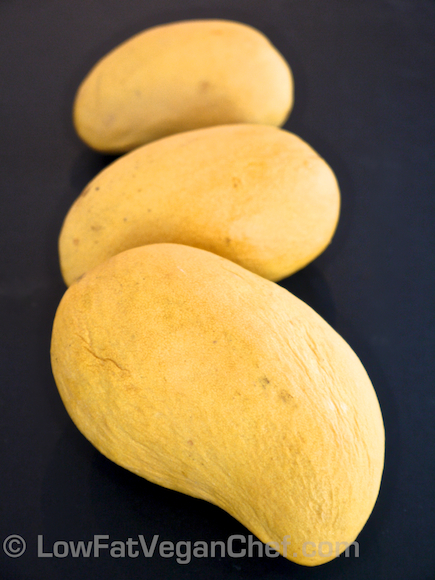
What a ripe ataulfo mango looks like

Mangoes can be hard to understand for those new to tropical fruits. They often don’t know how to select them, when they are ripe, or know how to cut them. Generally I buy the yellow skinned ataulfo/champagne style mangoes because they don’t have a stringy flesh and are very sweet and creamy when ripe. Most people buy the Tommy green/red type mangoes. When ripe these can be good too but they are much stringier and have a larger woody core in them.

Mangoes will take 5-10 days to ripen depending on when they were picked and what kind of climate you live in. You can tell a mango is ripe when it is starting to wrinkle on the skin and get soft. (Just like an avocado gets soft to the touch when ripe.) It should not have any hard spots on it and should be slightly soft and juicy inside and not taught and rock hard. The inside colour will change from light yellow to dark yellow or orange depending on the variety. Unripe mangoes don’t make for tasty recipes, and when it doubt leave it another day or two. Even I sometimes get impatient and open a mango too early and am disappointed that it’s not at it’s peak ripeness yet.

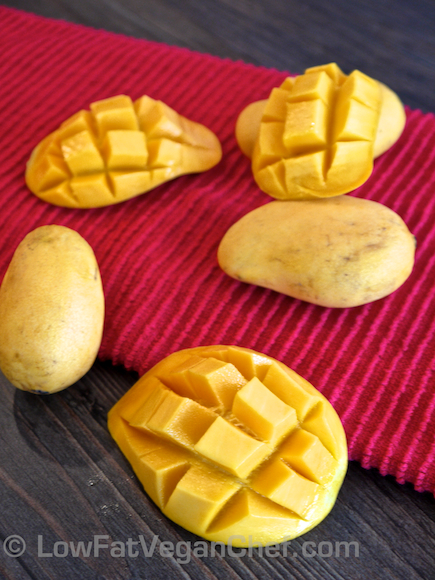
Low Fat Vegan Chef Ripe Mini Ataulfo Champagne Mangoes

Another tip I have to getting good mangoes is to NOT buy them at the regular grocery or mainstream grocery stores. I find that their supplies are often poor, they are picked super early and don’t always ripen properly. This is a terrible place to buy mangoes. Bananas can generally be bought anywhere and will ripen, but not mangoes or papayas. Buy your mangoes from fruit markets, farmers markets, China Town/Asian fruit markets, Indian markets, Whole Foods, health food stores or Costco. (Costco’s ataulfo mangoes are usually fine, but the red/green mangoes when bought out of season often don’t ripen so I avoid those until the spring/summer.)

If you live in tropical places or states like California, Hawaii or Florida you may be able to get mangoes at the regular grocery stores that are fine, but this is usually because they were shipped shorter distances and thus did not need to be picked so hard and unripe or gassed. If you live in the northern states, Canada or northern European countries, you’ll want to avoid the regular grocery stores for tropical fruit purchases because of their bulk suppliers and slow turn around times. Going to Asian markets, Indian markets or other whole sale places will be a better bet for fresher produce.

Filed Under: Articles, How To Tagged With: how-to, mango

Want to Peek Inside a Successful Raw Fooder’s Kitchen and See What They Eat Every Day?

July 26, 2012 by Veronica Grace 2 Comments

Fb-Button
Have you ever wondered what exactly a raw foodist eats? Or more specifically what a successful LONG TERM raw foodist eats? I sure have. There are SO many different versions of a raw vegan diet that the differences from one person’s meals to the next is astonishing.
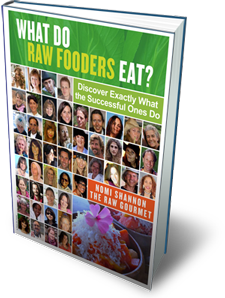
Well my good friend Nomi Shannon (author of the amazing raw recipe book The Raw Gourmet) has compiled day to day journals, recipes and dietary regimens of 48 long term raw and high raw food eaters.


The list includes well-known raw foodists such as:


  • Victoria Boutenko (author of “Green For Life“)
  • Dr. Doug Graham (author of “The 80/10/10 Diet“)
  • Cherie Soria (from the Living Light Culinary Arts Institute)
  • Matt Monarch (from the Raw Food World)
  • Dr. Jameth Sheridan (from Raw Food Research)
  • Dr. Ritamarie Loscalzo
Plus, a variety of people who eat a 50-90% (aka. high raw) raw diet such as:


  • Will Tuttle (author of “The World Peace Diet“)
  • Susan Schenck  (author of “The Live Food Factor“)
  • Trevor Justice (owner of The Vegetarian Health Institute)
Although you may not be able to bust in and check out their kitchen, but I’m going to let you in on the next best thing. Nomi Shannon’s new collection called  “What Do Raw Fooders Eat?” is now available and it’s going to blow your mind with just how jam packed full of fascinating information it is. Nomi had 48 raw fooders keep meticulous food journals for an entire week and submit them along with their personal dietary habits and health stories.


Nomi also compiled a MASSIVE number of bonus ebooks that she includes along with her “What Do Raw Fooders Eat?” collection. All in all you get hundreds and hundreds of new raw food recipes, everything from simple juices, smoothies and salads to gourmet raw food recipes for entertaining. It’s quite impressive.


Right now she’s doing a special promotion for me and my readers, and the first 300 people to order get all of these bonus recipe ebooks and videos absolutely free. (A $393.67 value!)


Insane right?


Check it out here:


http://rawgourmet.com/cmd.php?Clk=4787957


This special bonus offer of $393.67 worth of freebies ends as soon as it hits 300 orders. They’re going fast….

Filed Under: Articles, Product Reviews, Raw Vegan Recipes Tagged With: Nomi Shannon, Raw Gourmet, raw recipes, raw vegan

Things Every Bikram Yoga Newbie Should Know

July 26, 2012 by Veronica Grace 1 Comment

Fb-Button

I am a yoga novice… seriously novice.  I am not very flexible, I am much better at cardio and weight lifting and such. But apparently whatever sports you are not very good at are better for you physically than ones you’re already good at. Like the girls that already can every single yoga move with their eyes closed without breaking a sweat are NOT going to get as much out of a yoga class workout than those of us that are trying our hardest to make our bodies bend and move in ways that we wish we could…

Follow me?

I have done a few basic hatha yoga classes and some Yoga In Daily Life classes. I like these as they are not too impossible for me to do most of the moves. In fact if yoga weren’t so darn expensive I’d probably go more often.

Bikram yoga is a little different, it’s a type of “hot” yoga where you complete a set of 26 postures and 2 breathing exercises in a heated room for about 90 minutes. Depending where you go the rooms are heated at 40% humidity to about 104 F or 40 C. It’s hot!

I have never tried Bikram yoga before… frankly because I’m flat out too scared to do it on my own and I don’t know if I could handle the heat and the pressure of feeling like I want to fit in and not fall on my face. haha.

But Bikram yoga still intrigues me and I like to read about people’s experiences with it. Many people have had great results with becoming more flexible, losing weight, getting clearer skin, better sleep, lowering their stress levels and much more.

It’s one of those sports that people either LOVE it or they HATE it and couldn’t be more vocal and convincing about it.  It probably has a lot to do with people’s expectations, their fitness level and how helpful/intimidating their bikram yoga teacher is.

Everyone has good and bad experiences.

So I wanted to share this article I found online for those that are interested in trying bikram yoga for the first time, but are a little hesitant. You kind of wish you knew what to expect and if you’ll feel out of place if you can’t do some of the moves, or if you need to leave the room because you’re so hot etc.

The article is here: http://justherejustnow.wordpress.com/2012/07/24/bikram-yoga-beginner/

It’s got some great tips on what everyone should know as a bikram yoga beginner.  Apparently leaving the room because you are too hot is NOT a good idea, or you can pass out from getting up too quickly and trying to get out. It’s better to just lay back and relax and be calm if you cannot manage to do anymore of the postures. It’s not about finishing every single posture, it’s about staying in the room and training your body to be able to handle it.

Very interesting!

Let me know what you think.

Filed Under: Articles Tagged With: health, yoga

Vegan Bloggers Make Money With Your Blog By Selling Recipe Ebooks As An Affiliate

July 13, 2012 by Veronica Grace 3 Comments

Fb-Button

Are you looking for a way to make some money with your vegan or plant-based blog?

Did you know that placing Google Ads or other companies’ ads on your blog is NOT how most blogs make money? Unless you’re a major blogger who is getting hundreds of thousands of visitors to your website every month, placing google ads that pay a few cents here and there is NOT going to make you a decent income.

Instead, you should work on first having a weekly newsletter and getting people to subscribe to it. My subscribers come from my pop up sign up box on my website. Currently I have over 2500 subscribers that get my recipes every week.

The next thing you need to do once you have an email list and some subscribers on it is to start giving them some free information like an ezine of the week or free recipe of the week to give them some free content that they can enjoy and hopefully find helpful to them.

After you’re emailing your awesome free content to your newsletter subscribers you can think about monetizing your blog or website by offering some recipe ebooks or How-To ebooks as an affiliate. You don’t have to create products right away (but this is very important if you want your website to generate you income) as you can offer other people’s content as an affiliate to start off.

Right now I use Clickbank  as my payment processor and affiliate program. Whenever someone makes a purchase of one of my ebooks they pay Clickbank and Clickbank tracks the sale and then pays me every week. What’s great about being a Clickbank affiliate is that Clickbank will ALWAYS pay you out regularly (once you’ve made $50 in sales) and you don’t have to worry that someone is making money off of your promotions and might forget to pay you. This can’t happen with Clickbank. Once you hit $50 in sales, you WILL get paid by Clickbank. Just make sure you have the correct mailing address in your profile and then correct banking information (if you want to be paid by direct deposit).

You decide whether you want to receive a cheque or direct deposit payment in USD or CAD and if you want to be paid weekly, biweekly or monthly. It’s really that simple!

Once you have a Clickbank account you just need to remember what your username is and find out the username of the person who’s product you want to sell and the product number.

You can easily create your own “hop link” which is a link that will track your user name and give you credit for any sales you make.

For example my Clickbank username is lowfatchef . And I sell an awesome affiliate package for Comfort Soups To Keep You Warm and Savory Raw Dinner Recipes. To make your own hop link you just need to know your username and the vendors username.

In example: http://AFFILIATE.VENDOR.hop.clickbank.net

“Affiliate” should be replaced with your username. “Vendor” would be replaced with the vendors name, or in my case my name lowfatchef . If the vendor only has one product you don’t need to put the item number in.  But if they have more than one you will. Example: http://AFFILIATE.VENDOR.hop.clickbank.net for me is http://AFFILIATE.lowfatchef.hop.clickbank.net

So let’s say your Clickbank username was veganblogger, the hop link would be http://veganblogger.lowfatchef.hop.clickbank.net

As a Clickbank affiliate you get paid 65% of the item price. So in the case of my combo package for Comfort Soups To Keep You Warm and Savory Raw Dinner Recipes you would receive $23.37 (after Clickbank takes it’s % processing fee)

So go right now and sign up for a Clickbank account, put in your information (mailing address etc) and then under your account settings you can select whether you want to be paid by cheque, or direct deposit (you need your banking info) and then whether you want to be paid weekly, biweekly, or monthly.  Then once you’re set up use the formula above (with your username) and create the hop links.

Once you get to this point if you still need help, let me know and I will help you.


Filed Under: Articles Tagged With: blog, click bank, comfort soups, savory raw dinner recipes

Low Fat Vegan Comfort Soups To Keep You Warm Now Available on Amazon in Kindle Store!

July 10, 2012 by Veronica Grace 1 Comment

Fb-Button

My ebook Comfort Soups To Keep You Warm is now available in the Kindle Store on Amazon.com.uk.ca.etc.etc. I’ve always sold it directly from my website before with a kindle version, epub version and pdf version, but now you can get JUST the kindle version if you want for a cheaper price. (You won’t get any of my standard bonuses if you buy it directly through Amazon though).

How Do Authors Use The Amazon Kindle Store?

Amazon encourages authors and publishers to price ALL of their Kindle Books AT or BELOW $9.99. This is why you see Kindle versions generally that price, the author actually makes a higher percentage of commission (70%) if they sell it for cheaper than if they list it for $14.99 and up. (Anything above $9.99 and your commission is only 30%).

So just in case you didn’t know, that’s how Amazon’s Kindle Store works for those who want to publish their own ebooks. If you want to sell your own Kindle Ebook, first have someone create the file (from word) into a .MOBI or other kindle supported file. You can use contract workers at elance.com to do this for you.

Then once it’s ready and you’ve double-checked that everything looks right you can submit it to the Kindle Publishing website at kdp.amazon.com.

Filed Under: *My Recipe Books, Articles, Cooked Vegan Recipes Tagged With: soup

Quick and Easy Dr. McDougall Program Dinner Meal Ideas

July 2, 2012 by Veronica Grace 54 Comments

Fb-Button

Eating a whole foods plant based diet doesn’t have to be hard or time consuming.  It can be very cheap, quick and satisfying, but you need to be able to design a meal that will at least give you enough calories and be enjoyable to eat to succeed in the long term.

Dr. John McDougall has come out with a new book in 2012 called The Starch Solution: Eat the Foods You Love, Regain Your Health, and Lose the Weight for Good! and he talks about why starch is the best food to base a healthy plant based diet on. Cultures all over the world are thriving on a predominantly plant based high starch diet, whether in the form of potatoes, white rice, pasta, or corn (maize, not yellow sweet corn), supplemented with green and yellow vegetables and some fresh fruits.


Starch is a complex carbohydrate, so it is a slower releasing carbohydrate compared to fruit. When you eat starches they take longer to digest and so you get some energy right away and some later. This is why a meal including mashed potatoes or pasta can be so satisfying and keep you full for a long time. If you get the majority of your energy from whole food starches you will find it very easy to lose or maintain your ideal weight.

In fact there was even a man named Chris Voigt who ate 20 potatoes a day for 60 days and lost 23 lbs! He also significantly reduced his cholesterol and his triglycerides eating white potatoes 3 times a day!

So white potatoes are not “bad” for you like many carb phobic health gurus claim.  What is unhealthy is all the butter, sour cream, cheese and bacon that people load up onto a giant jacket potato and eat ON TOP of a large piece of fatty meat and a side that has more cream or cheese in it. Often it’s just too many calories from rich animal foods. The white potato itself is not making you fat, it’s too many rich foods and too many nutrient poor calories on top of the potato.


Sure there are other starches that are higher in nutrients than a white potato, like sweet potatoes or yams, but the point is the white potato is not going to harm your health or make you fat, just the opposite in fact. Including some healthy high carb low fat foods into your daily meals will help keep you full and your waistline trim. The key is to eat smart and keep it simple!

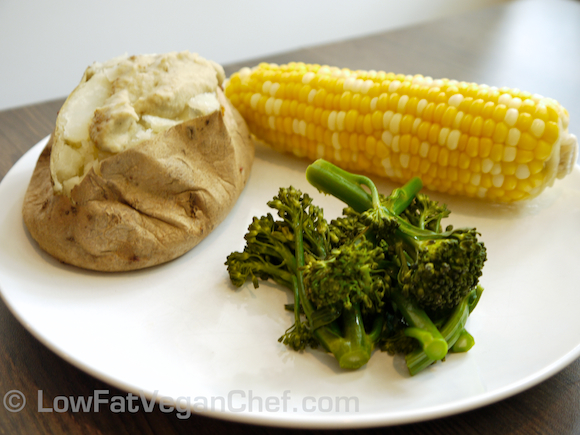
One of my basic McDougall meals is a large baked jacket potato topped with either my oil-free hummus or salsa, and an ear or two of sweet corn and a green like steamed broccoli, kale, collards, Brussels sprouts etc.

When you think about how simple and inexpensive this meal is even compared to a fast food meal you’ll realize it’s not that hard to do and is quite easy on the pocketbook too. A potato might cost 20-50 cents depending on how many you buy, an ear of corn could be 75 cents to a dollar and a small head of broccoli can be a dollar or two and even less if you’re using frozen vegetables.  So you have a meal that could cost you around $2 for a plate, more if you increase the amount of vegetables or choose organic, but even still it’s much cheaper and better for you than a $3.99 value meal at McDonalds. This is a very basic example, but there are many McDougall recipes that are quite inexpensive to make. Check out my Low Fat Vegan Comfort Soups Recipe eBook for some more great ideas.


Often people think a healthy diet is:

#1. Bland and boring

#2. Expensive

#3. Time consuming

#4. Not practical

Well we can start off by fixing the bland and boring part by choosing different combinations of healthy inexpensive foods to build a meal out of. Then you can spice it up with some zesty seasonings or low fat condiments (it’s even better to make your own) and then it will be more palatable and exciting to eat. Just because we take the cheese and bacon out of potatoes and salads for a healthy vegan diet doesn’t mean that you have to eat them plain and lament about it. When you take something that is a typical standard food item and switch it for a vegan version, don’t just take take take and be left with plain lettuce or a plain bun. There’s a plethora of fresh, cooked, pickled and fermented goodies you can use for toppings in place of cheese, meat, mayo, and creamy dressings.

Eating a low fat plant based or vegan diet can be expensive or inexpensive. It really depends on where you shop, what you buy and if you buy in small quantities or in bulk. To make this diet cheaper, it’s better to buy some things in bulk like potatoes, sweet potatoes, rice, whole grains etc. because the price per serving is greatly reduced. You can shop at places like Costco, or even organic wholesale distributors and get seasonal vegetables and fruit in bulk for a discount. Also don’t forget you can buy frozen vegetables and fruit to keep around for a quick meal. Check for sales in local flyers, or check them online before you head to the grocery store.


I have to say that eating simple McDougall based meals is NOT time consuming at all. For a starch I can throw a few potatoes in the oven at 400 F/205 C for an hour or put some rice in my rice cooker and my main source of calories is taken care of. Then I can just steam or boil any accompanying vegetables if desired. Or you can make a big vegetable stew or soup in a slow cooker, or cook your own beans and lentils in a pressure cooker if you’re looking for a quicker turnaround time. Really the most important thing to being able to put meals together quickly is to have a stocked refrigerator and pantry with healthy whole foods that you can put together into a complete meal. (It also helps if you make foods you enjoy as well as trying new ones.)

When you’re eating out, or making meals for family and friends you may think that eating a low fat plant based diet isn’t practical or very attractive and it depends on your outlook and how you execute it. If your family or friends are on board with your healthy lifestyle that’s great, and if they aren’t there’s still a good chance they can eat most of what you’re making for yourself anyway for their meal as well. They can choose to have some meat or dairy on the side if they insist and still join you.

When you’re eating out, it’s best to check out restaurant menus in advance (or online) and see if there’s anything that can be modified to work for you. If you can’t or if you have any doubts CALL THE RESTAURANT and talk to the chef or sous chef during the day before the dinner rush. They will not be upset, they will try to please you and will often get excited about the challenge of coming up with an oil free/low fat vegan option using their own creative skills. It’s best not to ask a hostess or server as they really don’t know what ingredients chef’s have to work with in the kitchen and they’re likely to be less creative, ie. bringing out a salad with just the chicken and cheese removed and nothing else on to substitute it with. Depending where you live the wait staff will know more or less about dietary restrictions and allergies as well. When I have friends or family members with dietary restrictions, I go out of my way to make something for all of us that they can have and generally any good chef will accommodate you.


Here are some ideas for building a healthy and satisfying starch based McDougall plate at home. I would suggest choosing 3-5 items from the list below:

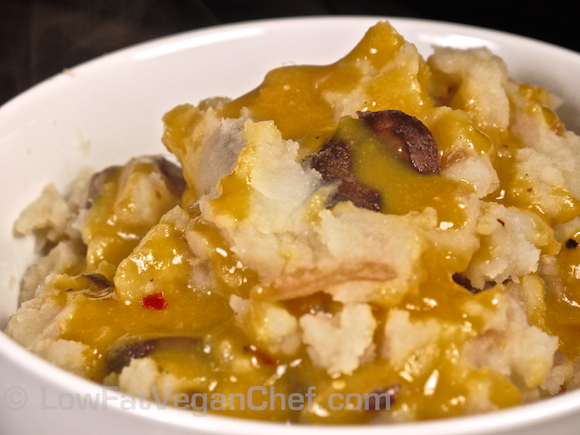
Garlic Mashed Potatoes and Gravy from Vegan Comfort Foods From Around The World

Healthy Starches

Sweet potatoes – yams/kumara

Potatoes – yellow/purple/white etc.

Whole grains – quinoa, steel cut oats, barley, bulgar, couscous, millet, rye, amaranth, spelt, canawa, wild rice

Rice – brown, basmati, jasmine, sticky white, red Bhutanese, black etc.

Pasta: whole grain pasta, egg free pasta, buckwheat pasta etc.

Starchy vegetables: winter squash, sweet corn, carrots, beets, turnips, parsnip, plaintain, taro, etc

Healthy Plant Based Proteins

Beans – black, kidney, pinto, chickpeas, white, soy, tofu, tempeh, adzuki, black eyed peas, fava, gigantes, lima, mung, etc.

Other legumes – peas, split peas, red lentils, brown lentils, French green lentils, black lentils, masoor lentils, peanuts, etc

Seeds – pumpkin, sunflower, flax, hemp, chia (in moderation as these are also high in fat too)

Wheat protein: seiten/wheat gluten (if you’re not gluten intolerant)

Leafy Greens and Vegetables:

Leafy Greens – kale, collards, Swiss chard, leaf lettuce, Romaine, spinach, arugala, lamb’s lettuce/mache, turnip greens, beet greens, mustard greens, cabbage, bok choi,  Brussels sprouts, watercress, wild edibles like lambs quarters and purslane, etc.

Green vegetables: broccoli, broccolini, broccoli rabe/rapini, celery, asparagus, green string beans, zucchini, green/spring onions, kohlrabi,

Orange, red and yellow vegetables: bell peppers/capsicum, yellow beans, yellow summer squash, tomatoes, radishes,

Misc vegetables: onions, garlic, mushrooms, eggplant/aubergine etc.


And what about fruits? Make sure you get a few servings of fruit a day into your diet. This can be in the form of a smoothie, (which I have TONS of fruit smoothie and green smoothie recipes on here) a snack or a fruit dessert. There are literally hundreds of fruits to choose from.

Some fruits that go really well on salads (if you’re looking for some raw options) are apples, sliced grapes, fresh berries like strawberries, raspberries, and blackberries, orange segments, Mandarin oranges or Clementine oranges, grapefruit, pommelo, kiwi fruit, persimmons, dragon fruit, raisins, dried cranberries and more!

To keep things fairly inexpensive and hassle free you can eat basic meals like rice or potatoes with some beans, tofu or tempeh, and a salad or steamed or sautéed veggies. There are so many different combinations and you can eat whatever is in season. Then to add some variety you can make things like a vegetable stew, a vegan soup, veggie tacos with rice, lentil curry and rice, noodles with sautéed veggies etc. a few times a week. They key is to find some healthy foods and meals that you really enjoy eating and it doesn’t feel like a chore or you are depriving yourself. It always helps to have some tasty homemade or store bought low fat condiments to add some flavour as well.

Condiment Ideas to Compliment Mcdougall Style Meals:

-fresh or store bought salsa/pico de gallo

–homemade oil free hummus, or store bought

–homemade oil free babaganoush (eggplant tahini dip)

-barbecue sauce

-hot sauce

-ketchup (look for low sodium, corn syrup free varieties)

-gourmet mustards

-pickled vegetables

-fat free/low fat dressings

-soy sauce or tamari

-teriyaki sauce or hoison sauce

-roasted garlic, sautéed onions, sautéed mushrooms, roasted bell peppers/capsicum


Now Available! Vegan Comfort Foods From Around The World – 100% oil free and McDougall friendly recipes!

There are so many ideas out there to add a little flavour and excitement to a low fat plant based diet. Even if you’re only eating this way when you’re at home you will notice some health benefits and feel satisfied with these whole food comfort foods.

Have you ever read one of Dr. McDougall’s books or tried The McDougall Program?


Filed Under: Articles, McDougall Program Tagged With: John McDougall, Low Fat Vegan Dinner Ideas, McDougall Friendly Recipes, McDougall Program, Starch Based Meals, Starch Solution

  • « Go to Previous Page
  • Page 1
  • Interim pages omitted …
  • Page 8
  • Page 9
  • Page 10
  • Page 11
  • Page 12
  • Interim pages omitted …
  • Page 14
  • Go to Next Page »

Primary Sidebar

Follow Us:

Newsletter

Get The Low Fat Vegan Starter Kit

natural organic skin care line

Free Skincare Samples

Earn Free Crypto At Binance

Earn Free Bitcoin on Gemini Exchange

Earn $10 in Bitcoin With Gemini Exchange
Dr. Fuhrman
Dr. Fuhrman
Dr. Fuhrman

Tags

80/10/10 apple avocado banana blueberries breakfast broccoli Carrots celery chickpeas cilantro corn cucumber Curry dill dinner easy Eat To Live fat-free gluten-free how-to Indian Dishes lemon low-fat mango mexican mushrooms nut-free oil-free pasta pineapple plant-based raw raw vegan rice smoothie soup soy-free spinach tofu tomato tomatoes vegan vegetarian vitamix

Secondary Sidebar

Recipes:

  • Cooked Vegan Recipes
  • *My Recipe Books
  • Breads and Baked Goods
  • Breakfast
  • Brunch
  • Burgers
  • Casseroles
  • Curries
  • Desserts
  • Dinner
  • Dips for Veggies or Chips
  • Eat to Live-Dr. Fuhrman Recipes
  • Engine2Diet
  • Ethiopian Dishes
  • Greek
  • Green Dishes
  • Holiday
  • Indian Dishes
  • Mexican
  • One Pot Meals
  • Pasta
  • Pizza
  • Quinoa
  • Salads
  • Sandwiches and Wraps
  • Raw Vegan Recipes
  • 80/10/10
  • Raw Breakfast
  • Raw Desserts
  • Raw Dips
  • Raw Dressings
  • Raw Entrees
  • Raw Juices
  • Raw Salads
  • Raw Smoothies
  • Raw Snacks
  • Raw Soups
  • Sauces
  • Side Dishes
  • Slow Cooker Recipes
  • Snacks
  • Soups and Stews
  • Spices/Seasonings
  • Sushi
  • Thai
  • Vietnamese

Copyright © 2026 · Foodie Pro & The Genesis Framework