• Skip to primary navigation
  • Skip to main content
  • Skip to primary sidebar
  • Skip to secondary sidebar

Plant Based U

Fat-Free and Low Fat Vegan Plant Based Recipes

  • Home
  • Recipes
    • Raw Vegan Recipes
    • Cooked Vegan Recipes
    • Eat to Live Dr. Fuhrman Recipes
  • Products
  • Coaching
  • Videos
  • Articles
  • About
    • What Is Low Fat Vegan/Whole Foods Plant Based
    • Resources
  • Contact

Backyard Vegetable Gardening And Top 10 Vegetables and Herbs To Plant In Your Garden

June 14, 2012 by Veronica Grace 21 Comments

Fb-Button

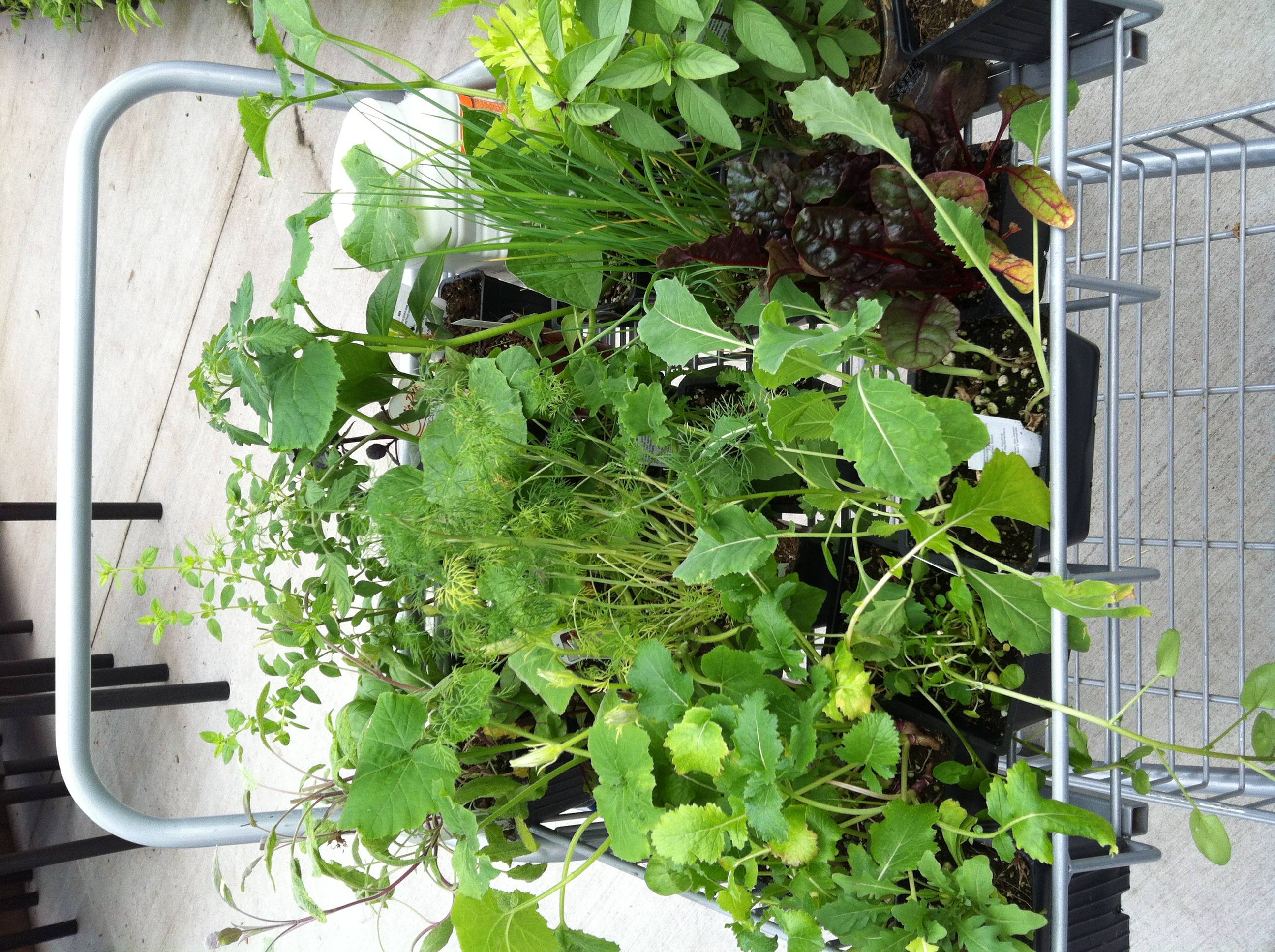
So this past weekend I spent about 3 days setting up my new backyard garden. It was a late start as we just moved into a new place, so I bought a bunch of seedlings from the garden centre. Aren’t they cute?
First I had to weed the garden and remove last years mulch.  It was a total mess! There were a few plants remaining from last year, some purple potatoes, chives, and  some dill so I left them. There are two trees in the garden, but I don’t really know what they are! There’s no blossoms on them, so if they are fruit trees they are not producing this year.
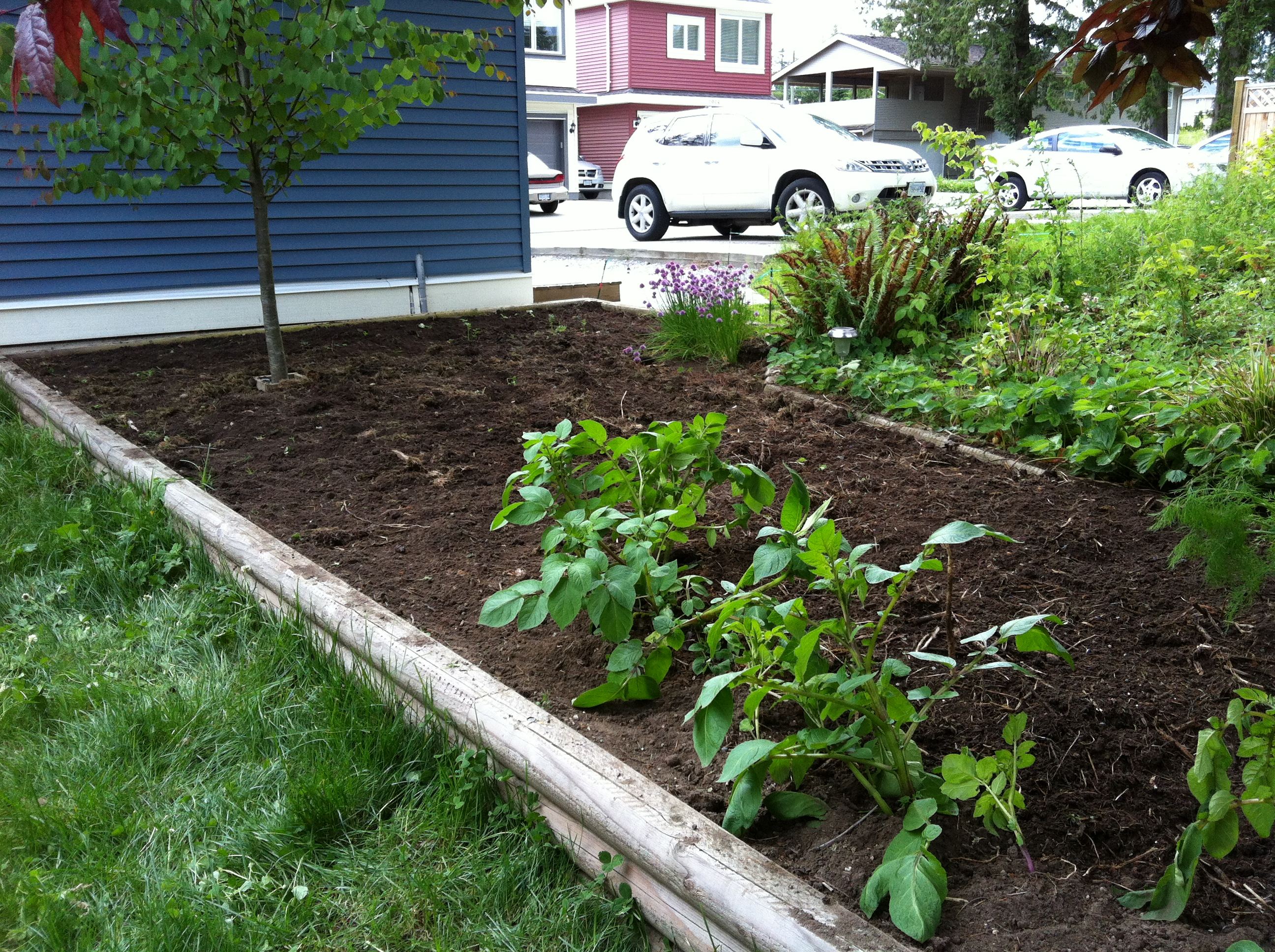
Weeded Backyard Garden

It took me about 8 hours to get all the seedlings broken apart and into place. I am really not a skilled gardener.  All I did was estimate the space they needed and installed them in little hills so they wouldn’t get too wet in the rainy climate we live in. I figure if it’s supposed to grow it will grow. Most things grow like crazy here because of the rain in spite of the lack of constant sun and heat.
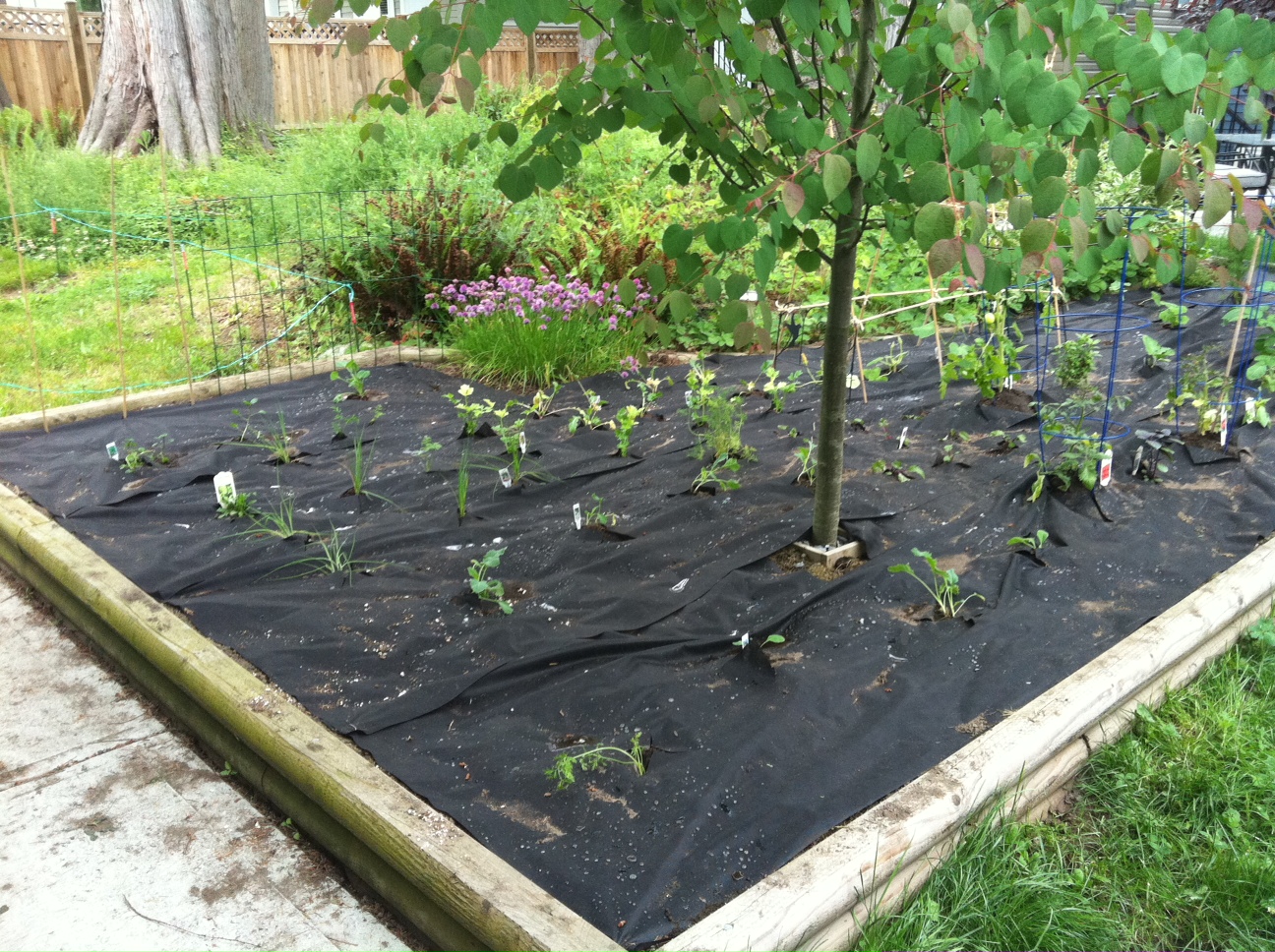
Backyard Vegetable Garden Photo

Peas, carrots, beets, turnips, celery, kohlrabi, leeks, nobel giant spinach, arugala, chives, Brussels sprouts

Xander was happy to spend the entire day outside with me. He supervised of course and then became exhausted and took a nap… lol
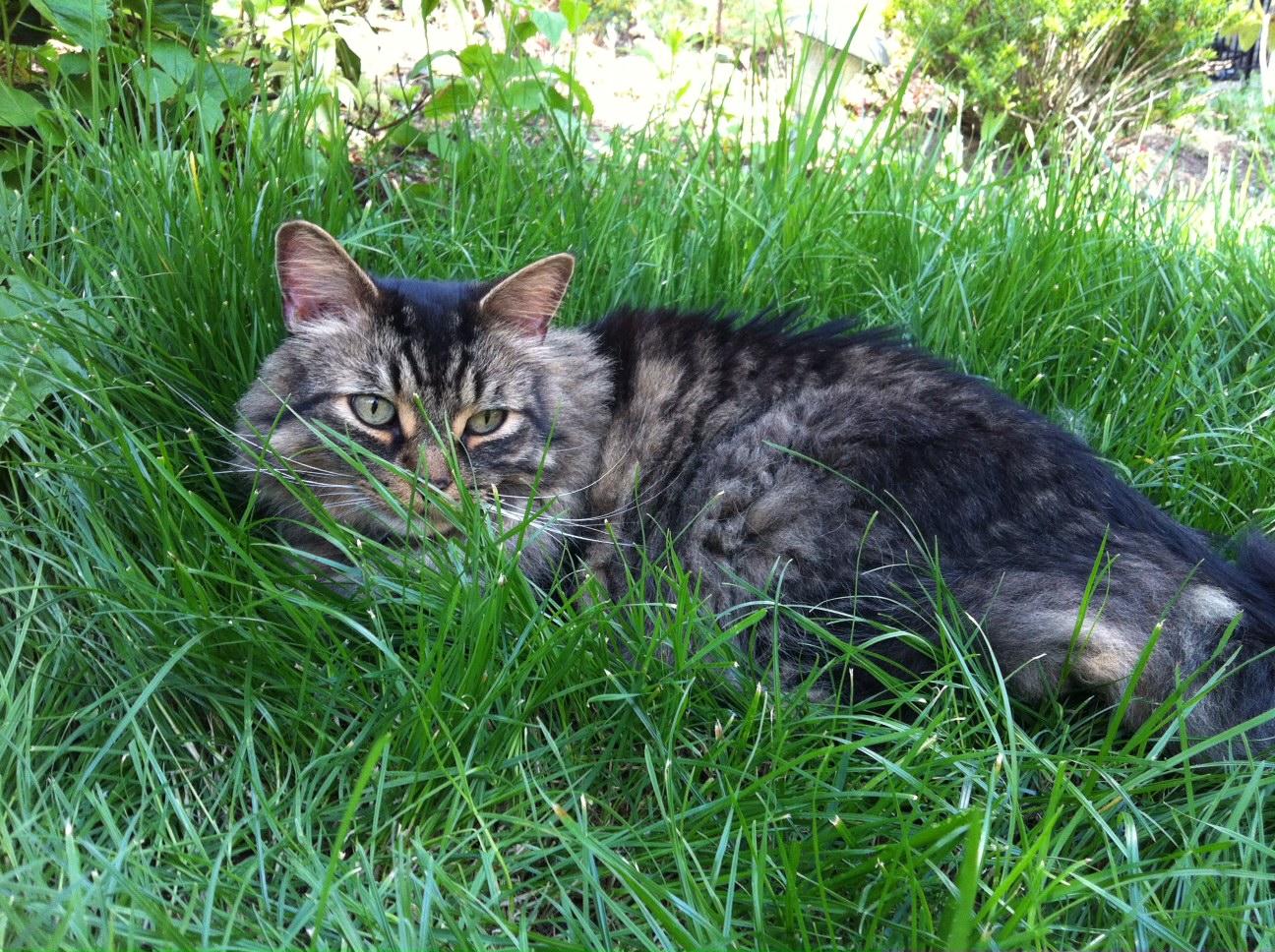
I installed a ground cover because I was NOT about spend hours every week weeding. (That is the worst part about gardening) and I already have a weak lower back from 2 car accidents, so it’s really not good for it.  It was a pain to insert it around plants and plant through it, but it will also probably deter the cat from thinking the  garden is a giant litter box, so this another benefit! Now he just thinks it’s a runway and traipses through it…
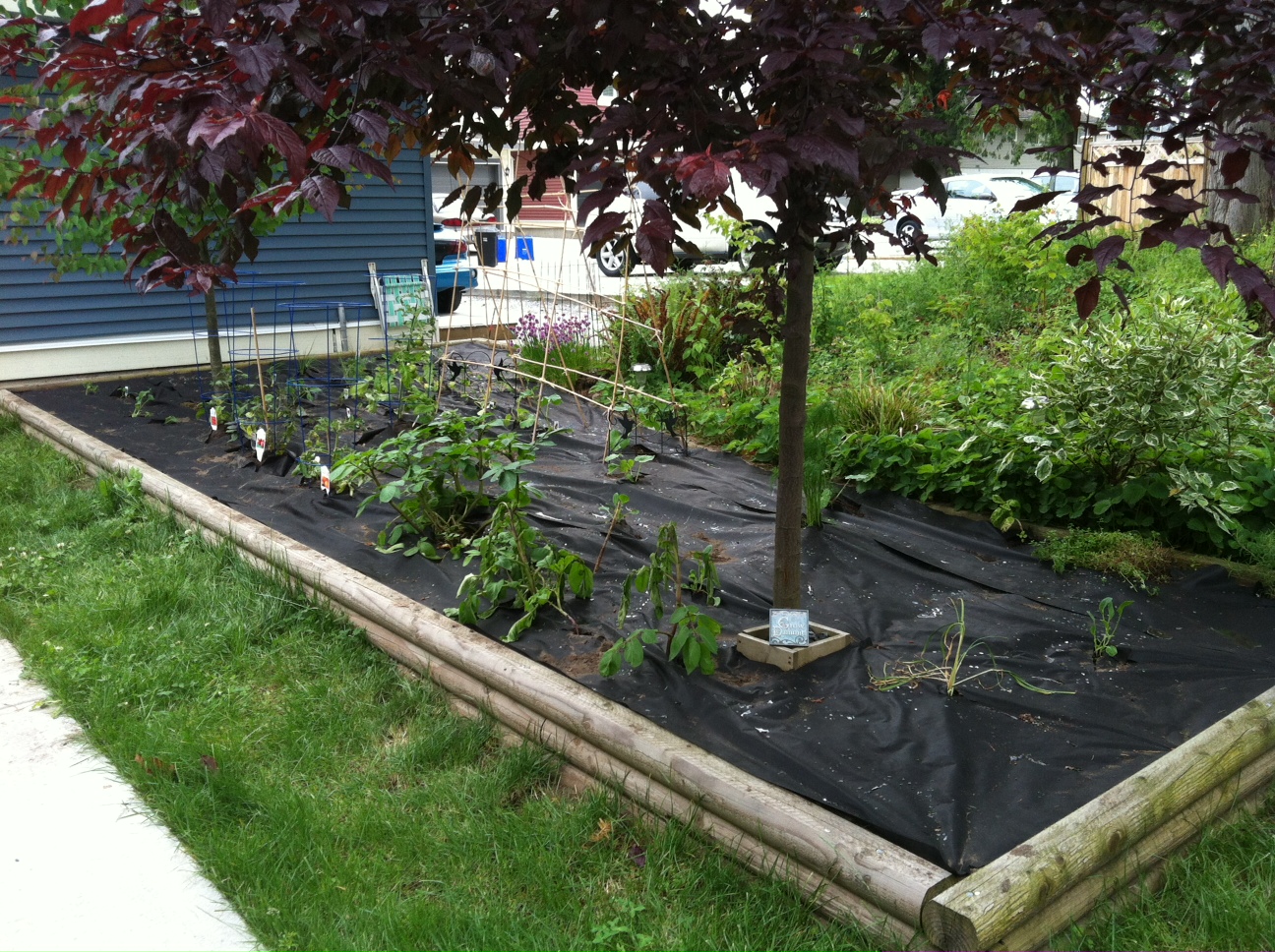
4 varieties of tomatoes, eggplant, English cucumbers, acorn squash, zucchini, 4 varieties of basil (including a beautiful African blue basil), purple potatoes, dill, thyme, rosemary, oregano, onions

So now all my plants are in. I’ve got a little bamboo trellis I attempted to build for the acorn squash and English cucumbers. I don’t know that it’s really worth it to build a lot of garden trellises, it may be cheaper, but it took me hours and hours to figure out how and then to do it and it may or may not work/last. We will see how it goes!
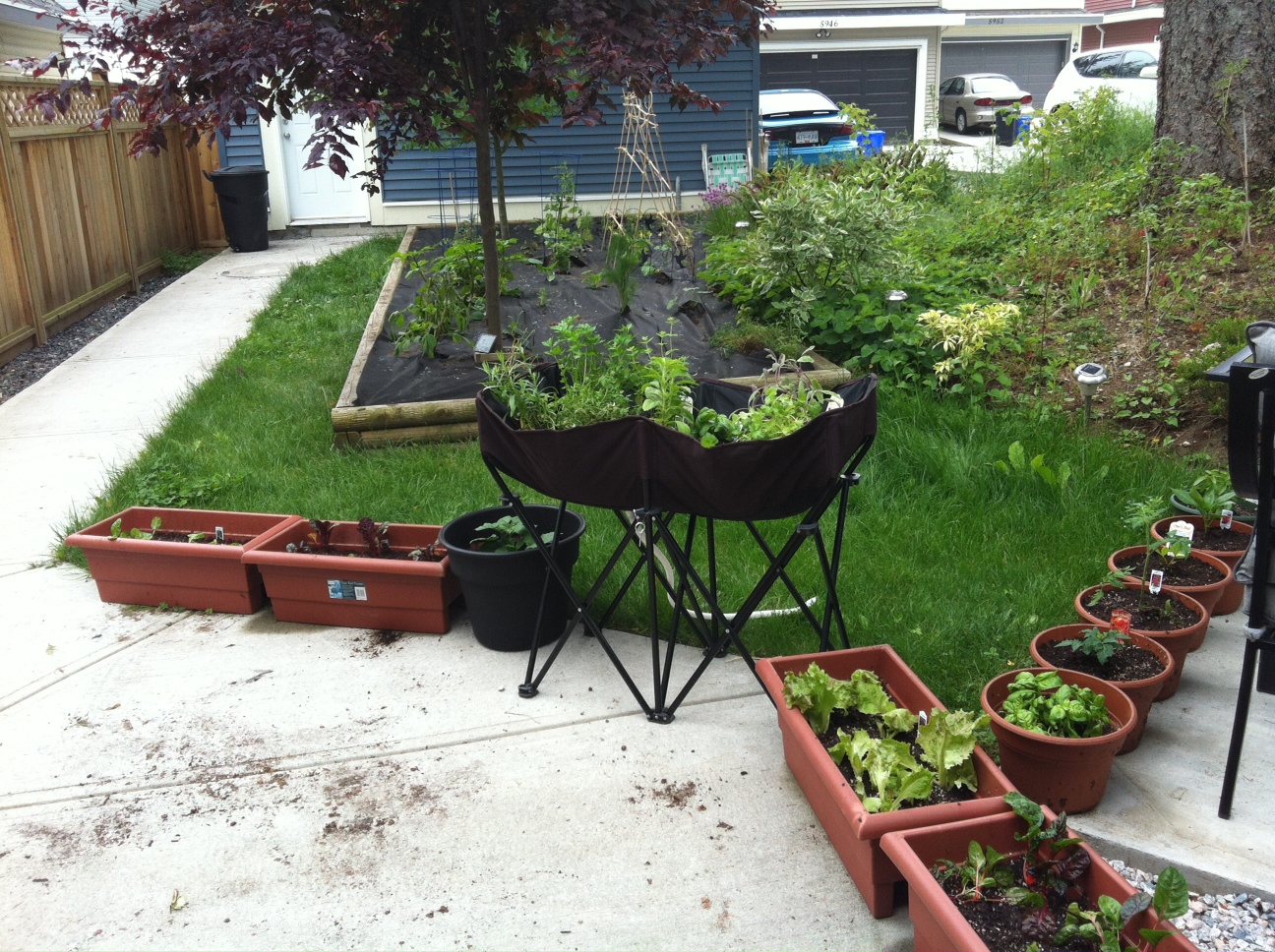
Swiss chard, Rainbow chard, white potatoes, red leaf lettuce, green kale, basil, red bell pepper, cherry tomatoes, Thai basil, bay laurel shrub, and in the black herb container: cilantro, parsley, purple sage, tarragon, more basil, oregano, thyme

As I didn’t want to crowd the garden I put most of my herbs and lettuces in container pots I had from last year’s patio garden and a few things like cherry tomatoes, white potatoes and a mini bell pepper plant. This also deters the cat from getting on my raw edibles like lettuces and herbs! He seems to have thought the thyme in the garden was offensive enough to sprinkle on a few times… so yeah.

As you can see I still have a little more work to do, tidying up and mowing the lawn, as well as I will plant a few more containers of leaf lettuce soon. I don’t have any romaine or butter lettuce planted yet.

We aren’t getting a CSA box this summer, so I thought I would invest in having some of our own home grown vegetables and greens.  There’s also a bunch of strawberry plants and blueberry and raspberry bushes by the big tree, so hopefully we will have some of those goodies too! I figure since everything was already grown as a seedling it probably means it will grow in this climate and I am so happy our backyard gets much much more sun than our little patio did previously. (I only had a 1 foot wide strip to work with before) Also what I like is not having the fridge crammed full of herbs and greens that go bad. It’s much nicer to keep it out in the garden until it’s ready to use and then you can just pick it!

I think it’s a lot of work to plant everything perfectly and coordinate everything so eat plant has the perfect amount of sun, space and fertilizer, so really I am just winging it and we’ll see what happens.  I’ll add some nutrients if it needs and hopefully things will have enough sun and space. All the sun hungry plants are in the middle where we get the most sun. (Well we don’t get a lot of sun in the Vancouver area, but for some reason it’s usually nicer after 2 pm when the clouds part.)

I hope this inspires you to grow a little something, even if you haven’t done it before.  I have gardened a few times, but really it was just planting seeds, watering and harvesting, nothing else!

If you have a chance to build your own garden, a really neat idea is a “Square Foot Garden” where you plant a certain number of plants in each square foot of space in a 4×4 square foot area. This leaves you enough room to be able to access all side for any weeding or harvesting. If I didn’t already have a garden built in my backyard I’d definitely use this method as it’s much much easier than creating rows or raised beds.
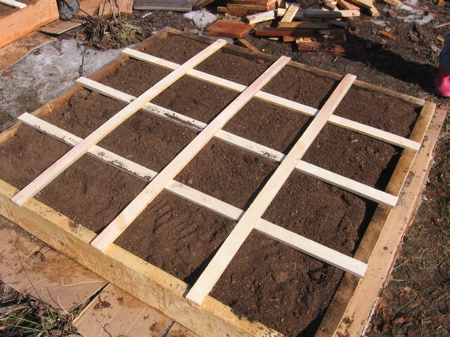
fromt albertahomegardening.com

For large plants like cabbages, broccoli, cauliflower, Brussels sprouts etc you would plant only 1 in the centre of the square. For smaller plants like carrots you would plant up to 16 depending on what it was and how big it grows. You can find out more from http://www.squarefootgardening.org/

So what would I recommend growing in your garden if you can?

Top 10 Vegetables And Herbs To Plant In Your Garden

1. Lettuces and greens like Romaine, butter lettuce,  red or green leaf lettuce, arugala, spinach, Swiss chard, kale, collard greens etc. Greens can cost $1.50-$3.50 a bunch depending where you buy them from and if they are organic, plus they take up a lot of room in the fridge. If you go through a lot of greens, it’s a good idea to plant some in the summer to at least supplement your needs and reduce your food budget and prevent spoilage by picking just what you need from the garden.

2. Thyme and Basil. Often these herbs cost $2.99 at the store (for organic) and can go to waste in the fridge as you only use a little bit for a recipe here and there.  I much prefer having fresh herbs over dried ones as the flavour is much better in homemade things like soups and sauces. I plant a LOT of thyme and basil because these are my two most used herbs. Another favourite is dill (which is great in raw blended salads, salad dressings, or potato salad). These herbs can planted be in container or separate herb gardens.

3. Cilantro (Coriander) and Parsley. These herbs might or might not be cheap at your local grocery store, but I find that they don’t last very long in the fridge and tends to get slimy and are a pain to clean as there’s always some old and bad leaves in there. It’s nice to have a steady supply of cilantro and parsley which I love to use as garnishes (they make food photos even prettier) and on top of soups, salsas and ethnic cuisines like Thai, Vietnamese and Indian food.

4. Tomatoes. Tomatoes are not something I enjoy eating raw on their own, but they are invaluable to raw and vegan cuisine. They are essential for delicious marinara sauces, stews, blended raw salads, raw salad dressings, salad toppings and sandwiches. Home grown tomatoes are much tastier, sweeter and fresher than store bought. Especially if you let them ripen on the vine.

5. Peas or Green Beans. Peas and beans are great to grow as often the store bought ones are not very fresh and can be a little bit bitter or too hard.  Fresh garden peas and beans are hard to match. They’re even delicious eating raw straight from the garden. I don’t usually cook mine as I eat through them quite quickly as healthy snacks and salad toppings but they’re something the whole family can enjoy! Kids especially love to munch on fresh picked garden goodies and it develops a good sense of healthy eating for them.

6. Beets and Turnips. Beets and turnips are great to grow in your garden because both the roots and the leaves are edible! Most people don’t eat the tops, but more and more veggie lovers are realizing the nutritional value of eating beet and turnip greens. There’s even more nutrition in them than the root, so don’t throw them away! They’re best eaten lightly steamed or sautéed as they can be a little strong tasting and tough to eat. The thick stems taste much better when lightly cooked as well. I love beets and turnips as they are both a starch and a green and make good use of garden space!

7. Onions, Green Onions and Leeks. Onions are something I go through like crazy, they are a staple to any homemade dish really whether it is raw or cooked as it adds a delicious flavour and aroma to the dish. If you plant onions and pick them early they will be green onions (also called scallions or spring onions) and these are great to use in raw salads, raw dressings, raw blended salads, salsas and garnishes. If you let them go to seed they will grow again next year so you’ll always have a steady supply of onions.

8. Cucumbers. Cucumbers are often fairly expensive at the store and a highly used item in raw and vegan salads, sandwiches and you can grow many varieties to be eaten fresh or to make pickles with. I even like to slice them on a mandolin and make little cucumber roll ups/sushi rolls with them. They are so beautiful and appealing as appetizers this way. Cucumbers grow on a vine and need a trellis or something to climb up onto so their fruits will not be laying on the grown and exposed to ground insects.

9. Zucchini. Zucchini is very easy to grow, provided you give it enough space. It’s a long and sprawling plant and one or two plants is all you need to get a ton of zucchini. Start picking them when they reach about a foot in size, and don’t let them grow too long or they become hard and woody inside. Young zucchinis are easy to use in salads, stir fries, Ratatouille and even make raw vegan spaghetti or fettuccine strands with.

10. Red potatoes or “new potatoes”. If you’re getting a late start you can always get potato seedlings at your garden centre, or plant some “seed” potatoes in early February or March for a spring harvest. These types of potatoes are called new potatoes because they are picked and sold immediately in the spring. They have paper thin skins and are best in salads or lightly steamed with seasonings. Fall potatoes have been grown longer and “cured” so their skins toughen up and they are able to be stored in a cool dark place through the winter. Potatoes can be grown fairly easily if you have a sunny place. They best way to grow is actually in a potato bag, as you will get many more potatoes as they can grow down as you roll up the bag and keep filling it with dirt and cover some of the leaves as they grow up. It gets a much higher yield this way than just planting in the garden. Check out potato bags here.

Other vegetables I’m growing this year are acorn squash, celery, kohlrabi, red bell pepper, eggplant, Brussels sprouts and carrots along with many other herbs like oregano, sage, tarragon, rosemary, sweet leaf and Thai basil.

What do you grow in your garden? What’s your favourite home grown vegetable?
Filed Under: Articles, Gardening, How To Tagged With: gardening, how-to

International Food Blogger Conference Portland 2012

June 14, 2012 by Veronica Grace 1 Comment

Fb-Button

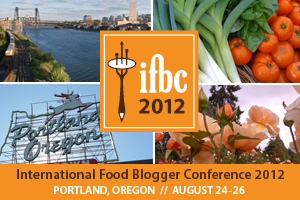
I’m going to be attending the International Food Blogger Conference in Portland Aug 24-26 2012. Vancouver, Canada is within driving distance to Portland, Oregon and I love visiting so I thought it would be a great opportunity to visit again and meet up with some great people in the food blogging world.

International Food Blogger Conference

I’m also open to finding sponsors who are happy to partner with me (for promoting an oil-free, low fat vegan diet) to help cover some of the expenses of going. So please let me know if you or your company is interested in partnering with me for this event!

The Conference is over 3 days, starting around noon on Friday Aug 24 and ending around noon on Sunday Aug 26th. The organizers say there will be food for those with dietary restrictions/allergies, and I was asked about my food preferences when I signed up and I selected vegan meals.  So hopefully there are more than a few vegans coming so there is some delicious food for us!

The ladies of Vida Vegan Con (Janessa Philemon-Kerp, Michele Truty and Jess Sconé) are going to be there as well doing a workshop on Friday Aug 24 from 4:30 to 5:45 pm on niche blogging, covering vegan, gluten free and kosher blogging.

Filed Under: Articles, Travel Tagged With: conferences

Fat Free Vegan Summer Harvest Soup With Butternut Squash, Sweet Corn and White Beans

June 12, 2012 by Veronica Grace 15 Comments

Fb-Button

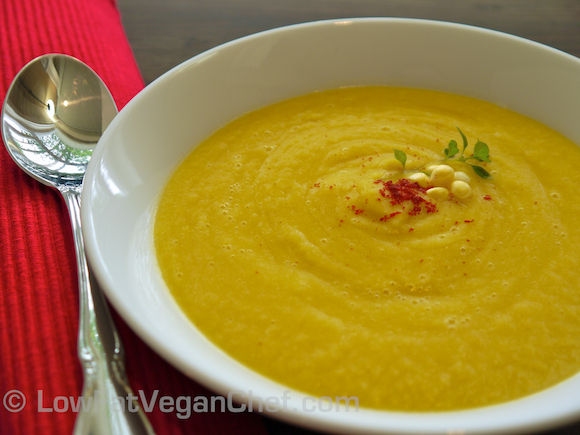
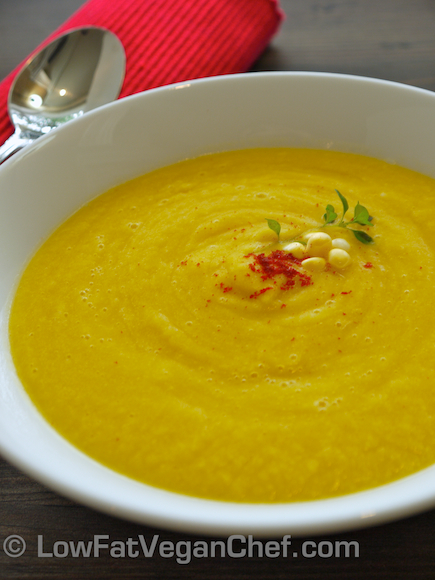
Ah summer… I think it’s everyone’s favourite month.  (At least mine as it’s the sunniest/warmest time in Canada.) I was looking around the freezer the other day and wanted to make up something quick and healthy and I saw I had some bags of frozen butternut squash and some fresh corn. I decided to put it together with onions and broth and make a soup out of it, but it wasn’t thick enough so I thought, hey why don’t I try some white beans to add some bulk and cream it up? It turned out to be a great idea and a totally delicious combination. This soup doesn’t need any butter or cream to make it creamy and delicious, the white beans work perfectly. It also needs very little seasoning since it’s so sweet naturally from the sweet corn.

In fact you could even eat this soup without any of the seasonings at all, it would be a great soup for fussy children, or even a good choice for toddlers.  Everyone knows children enjoy soft naturally sweet foods and butternut squash and corn is a favourite.

I decided to kick things up a bit with some smoked paprika which added a delicious smokey flavour to the soup.  Smoked paprika isn’t of the spicy variety, but sweet so it adds some nice flavour without being spicy.

Summer sweet corn goes really well in almost any dish.  It’s a great topping for salads, adds natural sweetness to soups and is great on it’s own, no seasonings required.

Give this soup a try! It’s super easy (especially if you have frozen squash already, available at most health food stores.)

Fat Free Vegan Summer Harvest Soup (Butternut Squash Sweet Corn and White Bean Soup)

Serves 4-5

Ingredients:

4 cups/1 qt./946 mL vegetable broth (homemade or low sodium)
1 large sweet onion, diced (such as Vidalia or Walla Walla)
5 cloves of garlic, minced
6 cups/25 oz./1.5 lbs butternut squash, peeled and cubed (fresh or frozen)
2 1/2 cups sweet corn (fresh, frozen or canned – no sodium)
16 oz./453 g can white beans or chickpeas, drained
1/2 tsp smoked paprika (or any other seasoning of choice)
3/4 tsp Herbamare or salt
1/2 tsp fresh ground pepper

Directions:

  1. Saute onions and garlic in a large pot over medium heat in 1/2 cup of vegetable broth until soft 5-6 minutes.
  2. Add squash, corn and beans and remaining broth and cover. Cook until squash is tender.
  3. Carefully spoon mixture into a blender or food processor and blend until smooth.
  4. Pour mixture back into pot, add seasonings and mix thoroughly. Taste test and adjust seasonings if desired.

What do you think of this summer soup? Have you ever tried smoked paprika before?

Filed Under: Cooked Vegan Recipes, Eat To Live - Dr. Fuhrman Recipes, One Pot Meals, Soups and Stews Tagged With: beans, corn, fat-free, gluten-free, nut-free, soup, soy-free, squash

Fat Free Vegan Indian Tarka Chana Dal (An Easy Oil-Free Curry Recipe)

June 4, 2012 by Veronica Grace 23 Comments

Fb-Button

Tarka Dal is also known as Dal Tarka or Tadka depending where you are in India. Like many Indian foods the names of dishes are phonetic so often you will see similar spellings of dal such as dhal or dahl. There is no right or wrong way to spell these dishes, I just use the most common spellings for ease of use.

Dal is a dish that is made with any variety of lentils including but not limited to split red lentils (most common in thin dal soups), black urad dal (used in creamy Dal Makhani), split urad dal (ground with rice to create Dosas which are Indian crepes) toor/tuvar dal which looks just like chana dal and yellow split peas but is smaller, and moong dal a small yellow split lentil that cooks faster than chana or yellow split peas also used in soups.

Cook’s Thesaurus has excellent descriptions and pictures of various lentils and how to tell them apart. This may sound quite confusing at first, but it’s unlikely that you will fully immerse yourself into using every type of lentil in Indian cuisine, so don’t worry. The most important thing is just to make sure you’re buying the right lentil and label what you buy if it’s coming from bulk bins. As they are all different sizes and thicknesses they can take different amounts of time to cook.

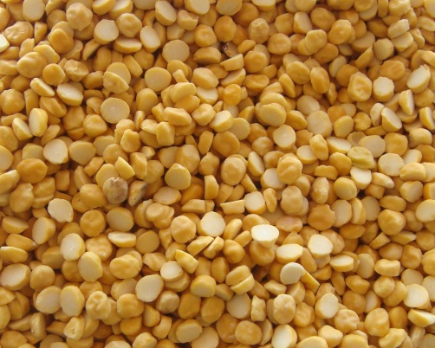
chana dal (skinless split chickpeas)

You can almost see that they look like little chickpeas/garbanzos split in half and are not fully rounded like yellow split peas. Toor/tuvar dal is also yellow and similar in size, but it is not the same.

Chana dal is used in East India and is widely available at Indian markets, bulk dry good sections at the health food store or ethnic market and online. Tarka is a method where spices are cooked/tempered in hot oil and added to the beginning or end of a dish being cooked. Since we’re going for oil free methods of cooking however, all of the ingredients are combined and cooked together in water instead. Tarka dal is usually cooked in 4 steps and can be quite complicated so I simplified the method. For this reason we have slightly increased some of the spices as the flavours will be subdued through cooking. Whole spices are best as they will retain more flavour, if you substitute all the whole spices with powdered spices you may have to reseason it to taste when it’s done cooking and it may not be as flavourful.

(Oil-Free) Simplified Indian Tarka Chana Dal

Serves 6-8 as a side

Ingredients:

2 cups chana dal (skinless split dried chickpeas, also spelled channa dal, dahl, or dhal)
1 large onion, diced finely
8-10 cloves of garlic, minced
2 inches of ginger, minced (or 1 tsp ginger powder)
1 14.5 oz/411 g can fire roasted crushed tomatoes (I use Muir Glen Organics)
7-8 cups/1.6-1.9 L of water (depending on how thick or thin you want it)
2 tsp turmeric
1 small cinnamon stick
3 black cardamom pods (or green)
8 whole cloves
4 bay leaves
3 tsp cumin seeds
2 tsp black mustard seeds
1-2 tsp red chili powder (or more to taste) I used Frontier Organic Chili powder blend
1 1/2 – 2 tsp salt
Fresh ground pepper to taste
handful of chopped fresh cilantro/coriander (to garnish)

Pressure Cooker Directions:

  1. Combine ingredients (except salt, pepper and cilantro), into a heavy bottomed pressure cooker, mix well, cover and heat over high heat (on gas stove) until a steady stream of steam escapes the pressure valve. Turn the heat down to medium high and cook for 20 minutes or until the dal is just tender (not mushy.)
  2. Season to taste with salt and pepper. Taste test and add additional chili powder if desired. (I added a 1/2 tsp of roasted cumin powder as it’s one of my favourite spices.)
  3. Garnish with fresh cilantro and serve with basmati rice or brown rice if desired.

Slow Cooker Directions:

Alternatively you can try cooking this in a slow cooker on high. Check on it between 4 and 5 hours. When chana is soft, season to taste with salt, pepper and additional spices such as chili powder if desired.

You can also probably cook this over the stove, but you will require more water as it will dissipate. I would guess this would take between 60-90 minutes of cooking time on a stove depending whether it was electric/gas and what temperature it’s cooked at. Make sure you stir it and check on the water level so it does not burn to the bottom of the pot.

Additional Tips:

If serving this to guests unfamiliar with Indian curries, you may want to take out all of the pieces of cinnamon stick, bay leaves, cardamom pods and cloves before serving. Be careful, the dal is hot! Generally we just pick these pieces out while we’re eating. But just make sure to warn people as a mouthful of clove or cardamom can be a little unpleasant!

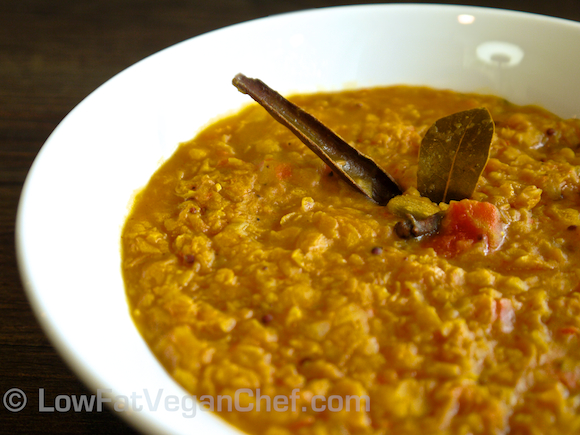
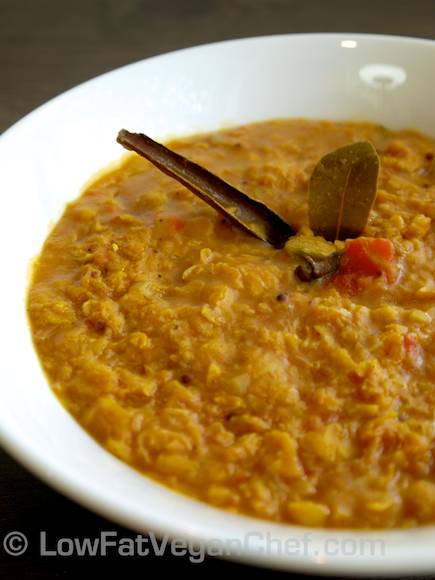
If you like your dal thick as pictured above you can use the lower amount of water. If you find your dal is a little too runny you can add some corn starch slurry to it to thicken it up. Use 1 tsp mixed in a 2 tablespoons of water at a time and heat through until you get the desired consistency.

You may want to serve this as a side dish, or even as a main meal with rice or Indian flat bread. For a main meal this will make enough to serve 4-6 people.

Refrigerate or freeze any leftovers for a quick healthy meal later on in the week.

Don’t use regular yellow split peas for this recipe. They take a really long time to cook and won’t be the same, despite looking almost like chana dal.

Have you ever had Tarka Dal before? Have you ever tried chana dal?

Filed Under: Cooked Vegan Recipes, Curries, Dinner, Eat To Live - Dr. Fuhrman Recipes, Indian Dishes, One Pot Meals, Side Dishes Tagged With: Curry, fat-free, gluten-free, Indian Dishes, Lentils, nut-free, savory, Spicy

What Is The McDougall Diet Or McDougall Program For Maximum Weight-loss?

June 2, 2012 by Veronica Grace 21 Comments

Fb-Button

What is The McDougall Program?


What is the McDougall Program?

The McDougall Diet is based on the guidelines of Dr. John McDougall, MD who is an American physician who teaches his patients that degenerative diseases can be reversed and prevented with a low fat, plant-based whole foods diet. His wife Mary is the chef in the family and creates an array of nutritious oil-free plant based dishes and has written several cookbooks. The staple foods for The McDougall Diet/Program are starch based foods like potatoes, rice, and beans, supplemented with green and yellow vegetables, leafy greens and fruit. Animal based foods, processed foods and vegetable oils are not part of the diet or recommended.

Dr. McDougall didn’t grow up eating a vegan or even vegetarian diet himself. Unfortunately in 1965 he suffered a massive stroke at the young age of 18, which he attributes to his then current diet that was high in animal foods. Between 1973 and 1976 he witnessed how a Standard American Diet (also known as S.A.D.) was negatively impacting the younger generations of his Asian immigrant patients on the Hamakua Sugar Plantation on The Big Island of Hawaii. He noticed that the less rice and vegetables each generation ate, and the more Americanized processed food including deep fried meat and junk foods like fries and potato chips the more unhealthy these people became. This seemed to fly in the face of what was taught to him in medical school and promoted to the American public. The Food Pyramid was telling people that animal foods that were high in protein (and fat) were key to a healthy diet and healthy body. Yet he saw just the opposite was happening. These people had the same family genetics, lived in the same location and did the same work, yet their health vastly differed only because of what they ate. The elders that continued to eat their traditional native Asian diets of white rice, vegetables, beans, and soups with very small quantities of meat (and NO dairy products) were much leaner, stronger and healthier than their children and grandchildren who ate a diet based on meat, dairy, bread, and deep fried junk foods and very little rice or vegetables. Dr. McDougall saw with his own eyes just how damaging a diet high in animal and processed foods was to the human body and he began teaching the benefits of a strict vegetarian diet.


For over 30 years Dr. McDougall has been teaching people all over the world the benefits of a low fat, oil-free, whole foods plant based diet with great success. He has two books based on his program called The McDougall Program: 12 Days To Dynamic Health and The McDougall Program For Maximum Weight-loss.  He also recently released a new book this year entitled The Starch Solution: Eat the Foods You Love, Regain Your Health, and Lose the Weight for Good!  which as the title hints at is a diet based on starchy foods.

Let’s take a look at the variety of foods that are included in the McDougall Program (this list is from McDougall’s website):

Starches (Main Source Of Calories)

Roots:

sweet potatoes
yams
white potatoes
celeriac (celery root)
tapioca
Jerusalem artichoke (sunchoke)
burdock
taro root
jicama
water chestnuts
parsnips
rutabaga
(Carrots, beets, turnips, daikon, and salsify are low in carbohydrates and calories and so are not considered starch staples.)


Winter Squashes:

butternut
acorn
Hubbard
banana
pumpkin
buttercup
turban squash
(Summer squashes usually cannot serve as the center of a meal because of their low calorie content. They are also lower in carbohydrates than winter squashes.)

Legumes/Beans:

aduki (azuki)
red kidney
black
mung
fava (broad)
navy
garbanzo (chick-peas)
pink
great northern
pinto
limas
white kidney (cannellini)
(Soybeans cannot be considered a starch staple because they are too high in fat to be allowed on the McDougall diet regularily.)


Lentils:

brown
red
green

Peas:

black-eyed
split yellow
split green
whole green

Whole Grains:

barley
oats
brown rice
quinoa (pronounced “keen-wa”)
buckwheat
rye
bulgur (cracked wheat)
triticale
couscous (refined wheat)
wheat berries
corn
wild rice
millet


Unrefined flours:

barley
rice
buckwheat
rye
corn
soy
garbanzo beans
triticale
lima bean
wheat
oat
whole wheat pastry
potato

Egg-Free Pastas:

Most of these are made from highly refined flours and therefore should play a small role in your diet.
artichoke pasta
tomato pasta
corn pasta (no wheat)
whole wheat pasta
spinach pasta
rice pasta (no wheat)


Oriental Noodles:

Most of these are made from highly refined flours and therefore should play a small role in your diet.

bean threads
somen
buckwheat soba
udon
rice noodles

Secondary Plant Foods (To Complement Starch Based Meals)

This is not an exhaustive list, just some examples.

Fruits:

apples
bananas
oranges
pineapple
pears
plums
peaches
nectarines
cherries
blueberries
raspberries
strawberries
blackberries
carambola
papaya
cherimoya
persimmon
guava
pomegranate
kiwifruit
passion fruit
kumquat
pummelo
loquat
quince
lychee
soursop
mango
etc.


Vegetables/Greens/Beans:

This is not an exhaustive list, just some examples.

zucchini/summer squash
broccoli
cauliflower
carrots
mushrooms
corn
iceberg lettuce/Romaine/leaf lettuce
spinach
asparagus
radishes
celery
cucumbers
tomatoes
aduki beans
jicama
arugula
kale
bok choy
kohlrabi
broccoli de rabe
radicchio
burdock
salsify
celeriac (celery root)
sprouts (alfalfa, lentil, mung bean, wheat)
chicory (curly endive)
Swiss chard
cocozelle
taro root
collard greens
turban squash
daikon
water chestnuts
endive
watercress
garbanzo beans (chickpeas)
Jerusalem artichoke (sunchoke)
etc.


Foods NOT Allowed On The McDougall Program

The following is a list of the foods that are not allowed, with ideas for possible substitutions.

Don’t Eat:                        Possible substitutes:

Cow’s Milk (for cereal or cooking)                     Lowfat soy milk, rice milk, fruit juice, water
Cow’s Milk (as beverage)                               None; drink water, juice, herb tea, or cereal beverages
Butter                                                           None
Cheese                                                 None; after 12 days you may substitute soy- and nut-based cheeses
Cottage cheese                                         None; after 12 days you may substitute crumbled tofu
Yogurt                                                       None
Sour cream None
Ice cream                                             Pure fruit sorbet, frozen juice bars; after 12 days you may substitute Lite
Tofutti
Eggs (in cooking)                                      Ener-G Egg Replacer
Eggs (for eating)                                      None or after 12 days, Tofu
Meat, poultry, fish                                    Starchy vegetables, whole grains, pastas, and beans; after 12 days tofu for
“meat”
Mayonnaise                                             Homemade Tofu based mayonnaise
Vegetable oils (for pans)                              None; use Teflon, Silverstone, or silicone-coated (Baker’s Secret) pot and
pans
Vegetable oils (in recipes)                            None; omit oil or replace with water, mashed banana, or applesauce for
moisture in baking
White rice (refined)                                   Whole grain (brown) rice or other whole grains
White flour (refined)                                  Whole grain flours
Refined and sugar-coated cereals                       Any acceptable hot or cold cereal
Coconut                                                         None
Chocolate                                                     Carob powder
Coffee, decaffeinated coffee, and black teas     De-caf herb tea, cereal beverages, hot water with lemon
Colas and un-colas                                     Mineral water or seltzer (flavored or plain)


In addition to eating an oil free starch based diet, Dr. McDougall recommends that people exercise (even if it’s just going for a walk) regularly to help maximize weight-loss, improve high blood pressure, lower high blood sugar, improve circulation and have more energy.

At www.LowFatVeganChef.com I try to present easy to make carb/starch based recipes that contain mostly whole foods and have no added oils that can be used as a part of the McDougall program. Occasionally I use things like light coconut milk or avocados in my recipes and those are not recommended for those in need of a strict diet to reverse disease, so keep that in mind. Quite often I eat simple starch based meals at home and a dinner of baked potatoes, boiled sweet corn (plain) and steamed greens is both satisfying and McDougall Program friendly. So give it a try.


The McDougall’s run a variety of events every year from 3 Day Study Weekends, a Full 10 Day Immersion Program to Adventure Travel Vacations With McDougall Meals. For more information on Dr. John and Mary McDougall check out their website here.


nejs?MarketPlace=US”>

Filed Under: Articles, McDougall Program Tagged With: McDougall Program, What is the McDougall Program?

Vegan Food Swap Canadian Edition May 2012 and Gourmet Salt Recipes

June 1, 2012 by Veronica Grace 1 Comment

Fb-Button

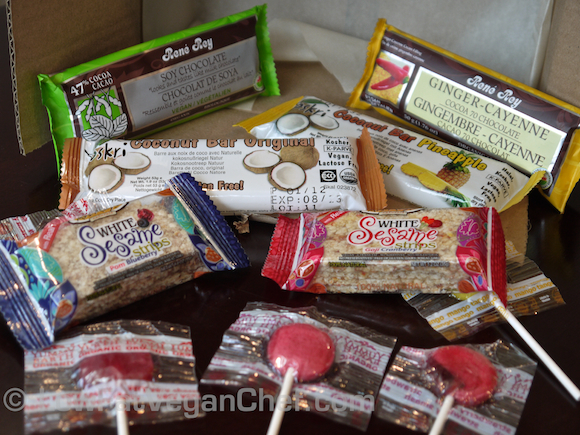
I received my first Vegan Food Swap (Canadian Edition) package yesterday from KimmiKillZombie in Ontario. I had sent my food swap package earlier to Fraser of Cashews Rule Everything Around Me who blogs from Victoria, Canada. Check out what he thought of my package here.

May was the first run of this swap in Canada and if you want more details on what it entails you can check it out here, (for Americans you can go here).

I received:

-Oskri Coconut Bar Original (264 calories, 16.9 g fat)

-Oskri Coconut Bar Pineapple (246 calories, 14 g fat)

-Rene Rey Soy Chocolate Bar (295 calories, 24 g fat)

-Rene Ret Ginger-Cayenne Chocolate Bar (267 calories, 20 g fat)

-Mrs. May’s White Sesame Strips Goji Cranberry (160 calories, 10 g fat)

-Mrs. May’s White Sesame Strips Pom Blueberry (160 calories, 10 g fat)

-5 organic suckers

Kimmi told me after she sent the package that she’d been sick for 2 weeks so that’s why her box isn’t as creative, so I understand but I must say I was a little disappointed. I’d asked her for oil free, light on the nuts items and explained that i teach people about how to eat a low fat diet. So these items are not something I would would buy/eat myself as they’re so rich in fat. (We were to list any dietary restrictions/allergies along with only sending vegan food items.)

I have tried a few of the fruit-only Oskri bars and liked them but stayed away from the coconut ones because they are so high in fat. (These bars contain 14g and 17g of fat and I look for ones around the 0-3g range.)

The other two bars are straight up chocolate bars. The ginger cayenne chocolate bar sure sounds interesting, but I really don’t like cayenne or hot peppers but that’s just me. (I know I’m a baby, I like mildly spiced food…)

This was a fun experiment though and I enjoyed putting my box together and waiting for my box to arrive. Everyone is matched with a different person each month and the person you receive from is not the person you send to so it’s random. I was paired with someone in Victoria so it was quite close to Vancouver and I could send some fresh baked goods as they arrived the next day. My package coming from Ontario though surprisingly took about 2 weeks to arrive so this is why Kimmi wouldn’t have sent fresh items.

I already shared my recipe for Oil Free Vegan Fudgey Blackberry Brownies that I sent to my swapee and I thought I’d share 2 other neat recipes with you that I sent off as well. Most people buy gourmet salts but never make them (and you can pay a hefty price for a tiny amount). I found that it’s actually much cheaper to make your own salt blends and surprisingly I already had all of these ingredients at home, so it was very easy.

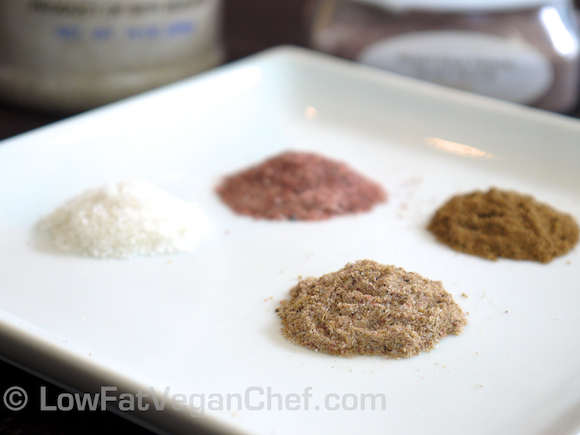
Pictured above is coarse sea salt, Kala Namak (“black” Indian salt), and garam masala mixed together to create Spicy Black Indian Salt in the foreground.

Spicy Black Indian Salt Recipe

I just bought some Kala Namak from Amazon and haven’t used it yet and found a recipe for a gourmet Indian salt so I thought I’d try it out. Use this to sprinkle on roasted vegetables, add to curries or even scrambled tofu for a spicy egg-like flavor.

Ingredients:

2 tbsp Garam Masala
2 tbsp Kala Namak (Indian Black Sulphur Salt)
¼ cup fine sea salt

Directions:

Mix together. Store in a tightly sealed jar for up to 1 year.

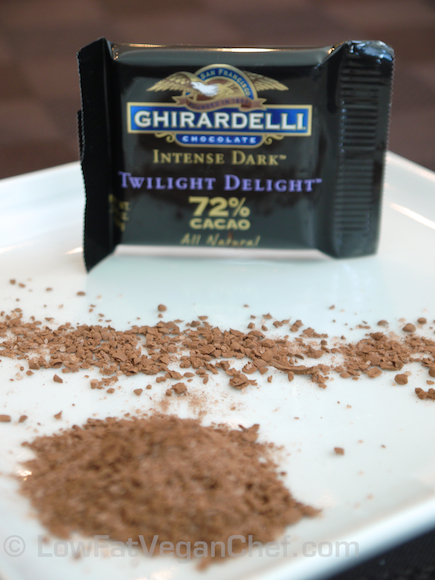
It’s often hard to find plain vegan chocolate nowadays as they put milk products into most chocolates to give them a creamier texture and make them more addicting, but this is the one type of Ghiradelli squares I’ve found that don’t contain any milk. You can also use another dark chocolate of choice.

Chocolate Himalayan Crystal Salt

Use in baking or to sprinkle on top of baked goods for a chocolate salty contrast.

Ingredients:

2 squares Ghiradelli 72% Dark Chocolate
3 tbsp Himalayan Pink Salt
1 tbsp unsweetened cocoa powder

Directions:

Use a fine grater to grate the chocolate squares into curls. Combine with salt and cocao. Store in a tightly sealed jar for up to 6 months. Best in a refrigerator or cool dark place.

——————

I have yet to actually use these salts myself, but I plan to use the Spicy Indian Black Salt in some curries and tofu scramble and the Chocolate Himalayan Salt I put into my Oil Free Vegan Fudgey Blackberry Brownies

Filed Under: Articles, Vegan Food Swap Tagged With: salt, seasonings, spices, vegan food swap

Oil-Free Vegan Fudgey Blackberry Brownies

May 30, 2012 by Veronica Grace 29 Comments

Fb-Button

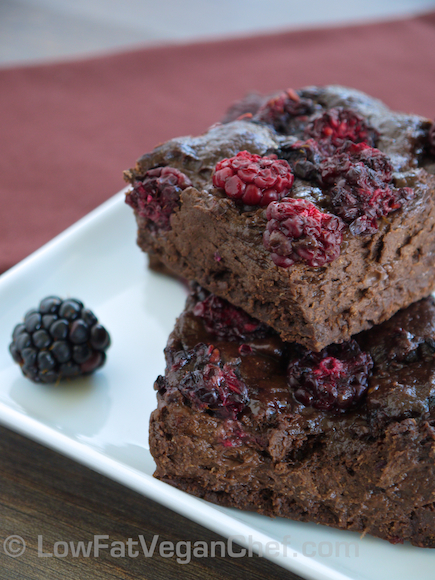
So these brownies are a little “healthier” for you than the standard recipes (as it avoids added oils, butter and eggs) but they’re not completely sinless. Brownies are treat, let’s face it and sometimes you want to have a better-for-you treat for yourself or your loved ones. I have tried fat free brownies with just cocoa powder, flour, sugar and applesauce but they weren’t really brownies, more like dense little cakes and ended up being just ok and nothing to rave about. These brownies however are delicious!

This recipe is inspired from the Post Punk Kitchen’s Raspberry Truffle Brownies, but I changed the recipe around. I made a big double batch of these brownies because we had a lot of fresh blackberries on hand and I was thinking of something to make for my friend’s birthday and the Canadian edition of Vegan Food Swap.  (If you have a vegan food blog in the USA or Canada and are interested in swapping goodies every month with fellow vegans check it out!)

These vegan fudgey brownies feel a lot more decadent when you eat them than they really are. You may have noticed I try to cram as much fresh fruits and vegetables as I can into my recipes as I don’t enjoy eating a dish without them.

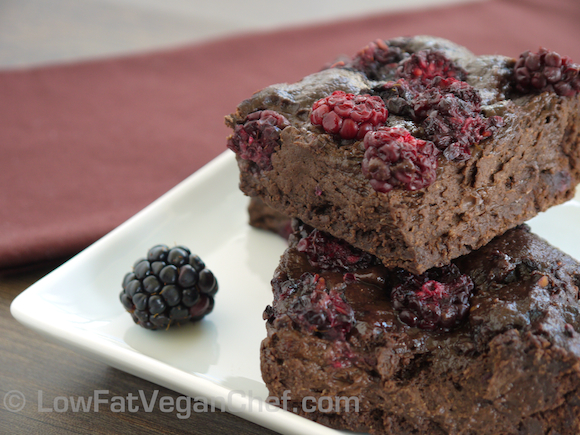
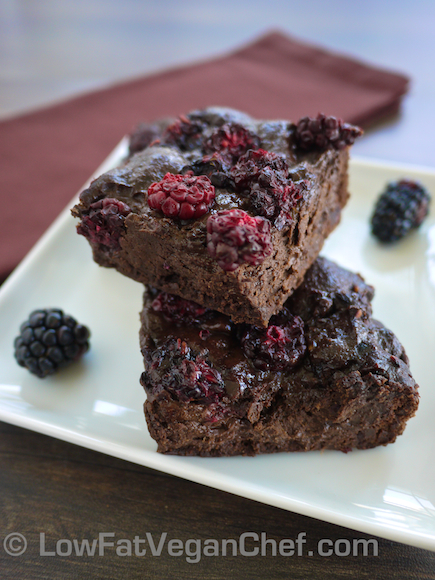
I think you’ll have a lot of fun making these and enjoy them too. You can impress your guests or make them as a little treat for yourself and freeze any leftovers in individual plastic wrapped pieces. The pieces shown below are the size you get if you cut into 9 pieces. You can of course cut them smaller as well.

I even put some extra blackberry pieces on top and it made these turn out very pretty looking, so you don’t need any frosting either.

Oil-Free Vegan Fudgey Blackberry Brownies

Serves 9

Ingredients:

1/4 cup/3 oz./85 grams semi sweet chocolate chips or semi sweet baking chocolate
1/4 cup/59 mL blackberry or mixed berry jam/preserves
3/4 cup + 2 tbsp/~210 mL sweetened apple sauce (plain) (you could probably try adding ripe mashed banana as well)
2 teaspoons pure vanilla extract
1/2 teaspoon almond extract
1 1/2 cups whole wheat pastry flour (or AP white flour. Do NOT use regular whole-wheat or whole grain flour)
1/4 cup cocoa powder (unsweetened)
1/4 tsp baking powder
1/2 tsp baking soda
1/4 tsp salt
1 cup fresh or frozen blackberries, blueberries or raspberries
2 tbsp semi sweet chocolate chips (1.5 oz./43 g)

Directions:

  1. Preheat oven to 350 F/177 C. Line an 8 inch square pan with parchment paper and lightly coat with non-stick cooking spray.
  2. If using fresh blackberries you can chop them in half. Put in the freezer to firm up while preparing brownies. If using frozen ones keep in freezer until ready to use.
  3. Melt the chocolate chips using a double boiler or in a dish carefully in the microwave. Set aside to cool slightly.
  4. In a large mixing bowl, mix together the jam and applesauce. Stir in the vanilla and almond extract and the melted chocolate.
  5. Sift in the flour, cocoa powder, baking powder, baking soda and salt. Mix very well until a stiff batter forms. Fold in the blackberries and chocolate chips.
  6. Spread the mixture into the prepared pan if you can. You may need to use your hands as it’s very thick. Crush some of the berries on top of the brownies if you are having a hard time mixing them in.
  7. Bake for 16-18 minutes for gooey brownies, bake for 20 minutes for slightly drier brownies. (Tinfoil pans will be done at 15-16 min.) A toothpick will NOT come out clean when inserted in centre, this is normal.
  8. Let the brownies come to room temperature and refrigerate for at least 3 hours to firm up and become fudgey inside. Do not serve right from the oven.

Additional Tips:

If you want to use unsweetened chocolate and unsweetened applesauce you will need to add some granulated sugar (don’t use liquid sweetener). Use 1/4-1/2 cup depending on preference. If you like your brownies really sweet you may want to add another 2-3 tbsp of sugar to the existing recipe.

Whole wheat pastry flour or white all purpose flour works best for a lighter brownie (as they are already pretty dense). If you use straight whole wheat or another whole grain flour it will be way too heavy and too dense and have a grittier texture. Make sure you use the suggested flour for best results. Pastry flour is made from soft wheat, white flour is also softer than hard whole wheat or whole grain flour. If you can’t find pastry flour you can try this: To make two cups of pastry flour, combine 1 1/3 cups (185 grams) all-purpose white flour with 2/3 cup (90 grams) white cake flour.

Sifting in the dry ingredients is essential so you don’t get any uneven lumps. Using a large fine mesh strainer to sift works well. (Pour your powders through the strainer and shake. Discard any rough particles that don’t go through.)

For these brownies to be fudgey in the middle they WILL NOT be baked all the way through like a cake or muffin. If you bake them until a toothpick comes out dry in the centre they will be rather dry and like a very dense cake, and thus not fudgey. In the pictures you can see that the center is not baked and has solidified. Once they’re refrigerated they will become fudge-like in the middle and be ready to eat.

FYI I don’t often make desserts or treats, so don’t get all angry and freakout if this recipe isn’t for you. I made these for friends and thought I’d share the recipe in case others were interested in healthier alternatives for those not on strict dessert free diets. 

Filed Under: Cooked Vegan Recipes, Desserts Tagged With: baking, blackberries, chocolate, cooked, desserts, nut-free, soy-free

80/10/10 Recipe: Raw Vegan Pineapple Mango Delight Smoothie

May 23, 2012 by Veronica Grace 12 Comments

Fb-Button

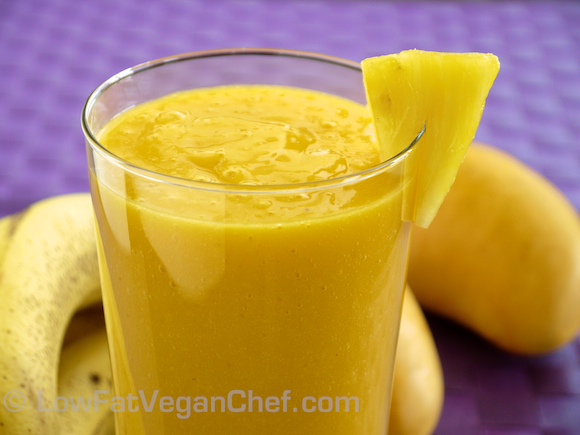
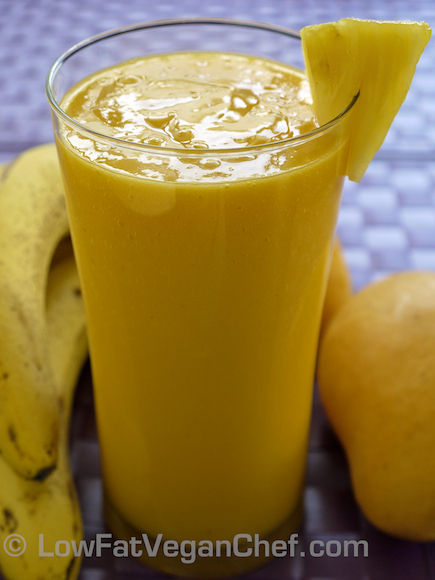
Low Fat Raw Vegan Pineapple Mango Banana Smoothie

This delicious breakfast smoothie kind of reminds me of a Pina Colada but gets it’s creaminess from bananas instead of coconut. I was going to throw some other fruit into it, but once I tasted it, it was too delicious to mess around with so I left it with just 3 simple ingredients and it’s definitely one of my favourite smoothies.

The best smoothies are made with fresh ripe produce, so I always make sure to select the best sweetest pineapples, (See my video on How To Select and Cut A Pineapple) and let my mangoes fully ripen on the counter until they are soft and wrinkly (this is when they are at their peak flavour and sweetness).

My favourite mangoes are ataulfo mangoes and right now they are in season until June or so. Generally April-June is prime ataulfo mango season so I always pop down to China Town and get a case or two as these are my favourite. They’re stringless, creamy and the best. You can see part of one in my picture above, it’s on the right. Ataulfo mangoes also have some cousins called the champagne mango, Filipino mango, Thai mango or Indian/Pakistani honey mango. So wherever you are keep an eye out for these yellow skinned (orange inside) mangoes they have a much better flavour than the red and green Tommy mangoes and frozen mango at the store.

We’re actually moving today to a new place today changing from an apartment to a bigger house (in the suburbs), so I wanted to post a recipe on the blog before I get really busy this weekend. I still have some packing to do! So I should get on that…. (who likes packing? I think it’s one of my least favourite things…)

On to the recipe!

Low Fat Raw Vegan Pineapple Mango Banana Smoothie

Raw Vegan Pineapple Mango Delight Smoothie (Fat Free Pina Without The Colada!)

Serves 1

Ingredients:

1 ripe ataulfo mango
1 1/2 cups fresh pineapple (or frozen if needed)
1 medium ripe banana
handful of ice cubes (or none if using frozen fruit)
1/3-1/2 cup water to blend

Directions:

Place ingredients into blender in the order listed and blend until smooth. Serve with a pineapple wedge if desired and enjoy!

Wow that was easy wasn’t it! For variations you could also scoop in some fresh young coconut meat, or add some coconut water instead of the water for a really raw Pina Colada!

Filed Under: 80/10/10, Raw Breakfast, Raw Smoothies, Raw Vegan Recipes Tagged With: banana, fat-free, gluten-free, mango, nut-free, pineapple, raw, soy-free, vitamix

Fat Free Vegan Cabbage Soup (Cabbage Soup Diet Recipe For Weight Loss)

May 22, 2012 by Veronica Grace 72 Comments

Fb-Button

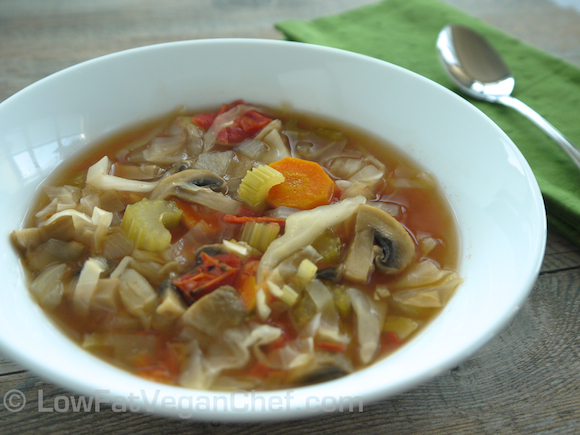
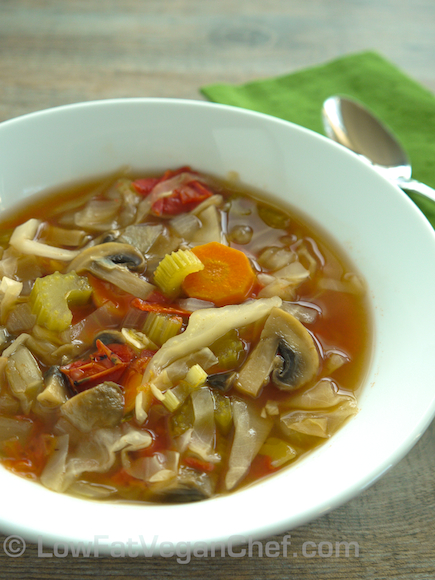
Fat Free Vegan Low Calorie Cabbage Soup Diet Recipe

Today I have a really healthy and easy recipe for you, especially if you’re interested in losing some weight, feeling better and eating more home cooked food. It’s a delicious spin on cabbage soup.  No this is not the recipe from the Cabbage Soup Diet (which after looking at makes me think it kinda sucks…) Mine features whole homemade ingredients without any packages of soup seasoning, V8 or chemical flavour enhancers.

The point of the cabbage soup in the cabbage soup diet is to fill you up on broth and vegetables in place of one meal a day so that you can lose weight fairly easily without crash dieting or being hungry.

A Healthier Alternative To The Cabbage Soup Diet

If you wanted a healthy guideline to lose some weight a safe and manageable way it would be to just eat fruits, lots of vegetables (even baked potatoes, sweet potatoes and squash are ok) and homemade vegetable soup (should be oil/cream free). You want to fill up on lower calorie high fibre nutrient dense foods. You could also have some beans or homemade hummus to go with your meals if desired as well. People gain weight because they eat too many rich foods like fried foods, meat, cheese, cream, butter, pastries, and bread products with oil in/on them. Even eating a diet of just potatoes wouldn’t cause you to gain weight, but if you slathered every potato in butter, sour cream and bacon it would become far too rich to achieve weight loss.

Actually I put a friend of mine on a fat free (and also no bread or flour products) diet back in September and she’s lost 50 lbs already just by eating more homemade meals and making sure they were based on foods like potatoes, vegetables and even rice instead of meat, bread, pastries and dairy products. She’s doing great and still enjoys eating this way every day.

One thing people think when it comes to alternative “healthier” lifestyles it that they will always hate it, never be able to do it or even starve to death (maybe even get bored to death too!). Let me tell you that is not the case. I started eating more raw and vegan for health reasons, not because I didn’t like how steak or chicken tasted.  (Hey I’m being honest!) But now I’ve been eating vegetable based dishes for so long that I actually don’t miss or crave any animal foods at all. I really couldn’t imagine eating them again. I actually enjoy the food I eat now even more than the food I used to eat. (Whatever you do most often now, you tend to like even more than what you used to do back then. It’s just the way the brain perceives things. Recent events tend to be better than past events a lot of the time because their more clear in our minds.) I like vegetables so much that if I go to a regular restaurant and get a pasta dish or soup that has hardly any vegetables in it, I get sad and want more vegetables! I could never just eat a big plate of plain spaghetti and sauce anymore, I love putting vegetables or lentils in it to give it more flavour.

People may think all vegans eat are carrots, broccoli and celery, but that is simply not true. In fact I eat a much wider variety of ALL plant foods now than I ever did before. I can’t even say I have a favourite fruit or vegetable. I love many of them like cherries, mangoes, watermelon, white peaches, Hawaiian papayas, pineapple, blackberries, blueberries, raspberries, eggplant, sweet potatoes, butternut squash, Thai pumpkin, broccoli, asparagus, mushrooms and more. I wouldn’t be able to choose any of those as my favourite.  I eat an even bigger variety than these, but these are some foods I really enjoy eating regularly and never get sick of eating. (This doesn’t even includes all the beans, legumes and whole grains I enjoy as well!)

I made 2 batches of vegetable broth and 2 batches of this cabbage soup last week, it was that good. One day I had 3 bowls of it for dinner! At 108 calories a bowl there’s really nothing to worry because you couldn’t possibly gain weight by eating this soup.

Fat Free Vegan Low Calorie Cabbage Soup Diet Recipe

Fat Free Vegan Cabbage Soup Recipe

Serves 8

Ingredients:

2 medium sweet onions, diced (like Vidalia, Walla Walla etc. They have light coloured skin and a slightly flattened top and bottom)
5 cloves of garlic, minced
10 oz./283 g package of mushrooms, sliced
2 tsp fresh thyme (or 1 tsp dried)
6 large stalks of celery, leaves removed and sliced
4 large carrots, peeled and sliced
1 lb/454 g (1/2 head) of green cabbage, shredded or cut with mandolin
28 oz/793 g (or 2 16oz cans) fire roasted diced tomatoes (I use Muir Glen Organics)
10 cups/2.5 qtss/2.3 L fresh vegetable broth (my recipes are here) or low sodium packaged vegetable broth
Herbamare/Sea salt and pepper to taste

Directions:

  1. Saute onions, garlic and mushrooms in 2-3 cups of vegetable broth for 5-6 minutes until the onions are tender. (Mushrooms take longer to cook than the rest of the veggies, so we’re cooking them first.)
  2. Add the rest of the vegetables, the thyme, the canned tomatoes, and the vegetable broth.
  3. Cook the vegetables over medium heat for 30-40 minutes or low heat for 1.5-2 hours until the vegetables are tender.
  4. Season to taste with Herbamare or salt and pepper. Add a little cayenne or chili pepper if you like the soup spicy. If you like your soup a little thinner you can add a little more vegetable broth or water if desired. But don’t add too much or you will dilute the flavour.
  5. Serve!


Additional Tips:

This soup is almost like a cabbage stew because it’s so full of vegetables. I prefer to have lots of veggies in my soup and a little less broth. You can add a little more broth if you like really watery soups. (But this is already so low calorie you don’t really need to water it down if you’re looking for a diet-friendly meal.)

I found I didn’t need to add much salt to my soup as I made homemade broth that was naturally sweet from the sweet onions, carrots and thyme and the fire roasted tomatoes have enough salt in them already.

This is a great recipe that you can use for a soup base and just change out some of the veggies for different ones for variety. You can also experiment with different salt free seasoning blends. Just make sure you always add a little, let it cook for a few minutes and taste test before adding more, so you don’t end up with an over seasoned soup!

If you use a bowl or two of this soup with some fruit or a salad every day instead of your normal meal it will help you lose weight just like any other meal replacement plan.  But this is much more nutritious because it’s homemade and packed full of vitamins and minerals from the veggies. Even more so if you make your own vegetable broth.  There is no comparison for me between store bought and homemade broth, so give it a try sometime and you will enjoy homemade soups even more!

Even if you changed a few of the vegetables in this soup it would be around the same calories. Overall it’s a very low calorie nutrient dense soup.

Nutrition Facts
  Servings Per Recipe: 8
  Serving Size: 1 serving
Amount Per Serving
  Calories 104.0
  Total Fat 0.4 g
    Saturated Fat 0.1 g
    Polyunsaturated Fat 0.2 g
    Monounsaturated Fat 0.0 g
  Cholesterol 0.0 mg
  Sodium 254.9 mg
  Potassium 562.3 mg
  Total Carbohydrate 17.8 g
    Dietary Fiber 6.3 g
    Sugars 7.8 g
  Protein 3.8 g
 
  Vitamin A 97.3 %
  Vitamin B-12 0.0 %
  Vitamin B-6 9.9 %
  Vitamin C 69.2 %
  Vitamin D 6.7 %
  Vitamin E 2.0 %
  Calcium 10.3 %
  Copper 9.9 %
  Folate 12.6 %
  Iron 10.5 %
  Magnesium 5.5 %
  Manganese 9.9 %
  Niacin 10.4 %
  Pantothenic Acid     7.9 %
  Phosphorus     7.1 %
  Riboflavin 11.7 %
  Selenium 6.2 %
  Thiamin 6.6 %
  Zinc 3.3 %


 Have you ever made cabbage soup before or tried the Cabbage Soup Diet?

Filed Under: Cooked Vegan Recipes, Eat To Live - Dr. Fuhrman Recipes, One Pot Meals, Soups and Stews Tagged With: cabbage, Carrots, celery, fat-free, gluten-free, mushrooms, nut-free, soup, soy-free, stew, weight-loss

Sinless Fat Free Vegan Chocolate Banana Shake Recipe

May 10, 2012 by Veronica Grace 12 Comments

Fb-Button

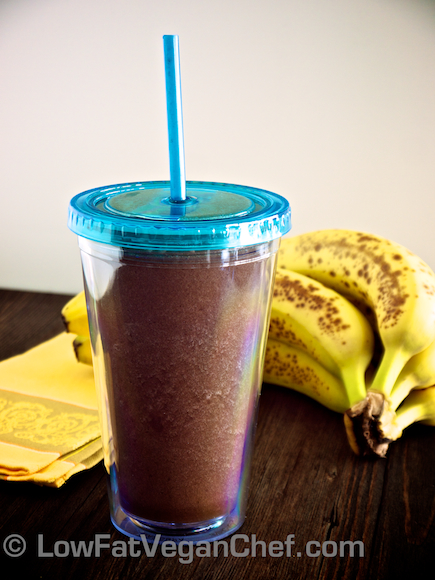
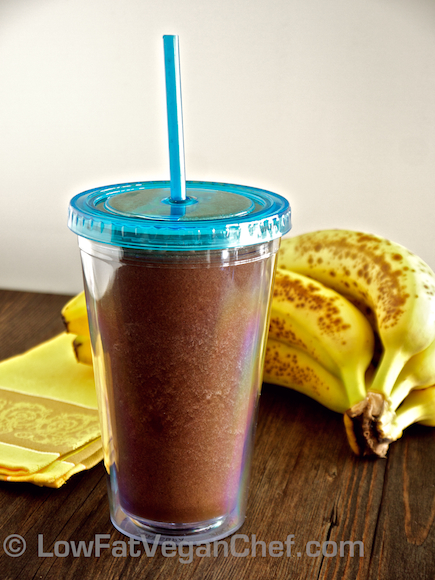
Low Fat Vegan Chef Chocolate Banana Shake

I don’t usually eat a lot of chocolate or use cocoa or cacao in my smoothie recipes, but I’m sure some of you out there have cravings for a chocolate milk shake or smoothie once in a while and I thought I’d make a little treat for us!

There are few things more delicious than the combination of bananas with chocolate and even without the traditional ice-cream, this shake is still delicious. The key to making it creamy and naturally sweet is to use fully ripe (lots and lots of spots) bananas. To make this recipe truly fat free I just use a little water, but you can use some soy or almond milk if desired instead.

Although the bananas in my smoothie picture do have lots of spots on them, I still prefer mine slightly riper (by a day or two with even more spots) and no green at all on the stems of my bananas for the absolute best tasting smoothie recipes. The bananas are still firm (not mushy or over ripe) and are even sweeter this way  and then you don’t need to add any additional sweetener. The best smoothies always start with quality fully ripe fruit, so it’s best to taste test things before tossing them in a smoothie if you are unsure if they are sweet or tart.

Low Fat Vegan Chef Chocolate Banana Shake

Fat Free Vegan Chocolate Banana Shake

Serves 1

Ingredients:

2 ripe bananas (see my post on ripe bananas)
1/4 cup water or as needed for your type/size of blender
1 tbsp cocoa powder
Handful of ice cubes (or sub 1 fresh banana for a frozen banana)

Directions:

Place ingredients into Vitamix or Blendtec or other blender in the order listed aboove and blend until smooth. If your bananas aren’t quite sweet enough add a teaspoon or two of liquid sweetener of choice and blend again.

Serve in your favourite smoothie cup or in a glass with a glass straw!

Variations:

If you’d prefer raw cacao powder you can use that instead. I find I don’t like it as much as cocoa personally and I find it less stimulating. You can also substitute carob powder if you’re looking for a caffeine/chocolate-free option.

To get some greens in this recipe you can throw in a handful or two of fresh spinach.

What’s your favourite chocolate smoothie or shake recipe?

Filed Under: Breakfast, Cooked Vegan Recipes, Raw Smoothies, Raw Vegan Recipes, Snacks Tagged With: banana, cacao, chocolate, fat-free, gluten-free, nut-free, raw, smoothie, soy-free, vitamix

  • « Go to Previous Page
  • Page 1
  • Interim pages omitted …
  • Page 18
  • Page 19
  • Page 20
  • Page 21
  • Page 22
  • Interim pages omitted …
  • Page 28
  • Go to Next Page »

Primary Sidebar

Follow Us:

Newsletter

Get The Low Fat Vegan Starter Kit

natural organic skin care line

Free Skincare Samples

Earn Free Crypto At Binance

Earn Free Bitcoin on Gemini Exchange

Earn $10 in Bitcoin With Gemini Exchange
Dr. Fuhrman
Dr. Fuhrman
Dr. Fuhrman

Tags

80/10/10 apple avocado banana blueberries breakfast broccoli Carrots celery chickpeas cilantro corn cucumber Curry dill dinner easy Eat To Live fat-free gluten-free how-to Indian Dishes lemon low-fat mango mexican mushrooms nut-free oil-free pasta pineapple plant-based raw raw vegan rice smoothie soup soy-free spinach tofu tomato tomatoes vegan vegetarian vitamix

Secondary Sidebar

Recipes:

  • Cooked Vegan Recipes
  • *My Recipe Books
  • Breads and Baked Goods
  • Breakfast
  • Brunch
  • Burgers
  • Casseroles
  • Curries
  • Desserts
  • Dinner
  • Dips for Veggies or Chips
  • Eat to Live-Dr. Fuhrman Recipes
  • Engine2Diet
  • Ethiopian Dishes
  • Greek
  • Green Dishes
  • Holiday
  • Indian Dishes
  • Mexican
  • One Pot Meals
  • Pasta
  • Pizza
  • Quinoa
  • Salads
  • Sandwiches and Wraps
  • Raw Vegan Recipes
  • 80/10/10
  • Raw Breakfast
  • Raw Desserts
  • Raw Dips
  • Raw Dressings
  • Raw Entrees
  • Raw Juices
  • Raw Salads
  • Raw Smoothies
  • Raw Snacks
  • Raw Soups
  • Sauces
  • Side Dishes
  • Slow Cooker Recipes
  • Snacks
  • Soups and Stews
  • Spices/Seasonings
  • Sushi
  • Thai
  • Vietnamese

Copyright © 2026 · Foodie Pro & The Genesis Framework