• Skip to primary navigation
  • Skip to main content
  • Skip to primary sidebar
  • Skip to secondary sidebar

Plant Based U

Fat-Free and Low Fat Vegan Plant Based Recipes

  • Home
  • Recipes
    • Raw Vegan Recipes
    • Cooked Vegan Recipes
    • Eat to Live Dr. Fuhrman Recipes
  • Products
  • Coaching
  • Videos
  • Articles
  • About
    • What Is Low Fat Vegan/Whole Foods Plant Based
    • Resources
  • Contact

side dish

Fb-Button

Vegan Quinoa Chickpea Pilaff

November 26, 2012 by Veronica Grace 18 Comments

Fb-Button

Quinoa is all the rage now, and so are quinoa salads and pilaffs. There are hundreds of ways to season quinoa and you don’t have to just eat it plain on the side. If you find cooking quinoa properly still a challenge, check out my post How To Cook Quinoa Perfectly to make sure your next batch turns out amazing.

This time I decided to mix things up and make my quinoa a little different. A heartier side filled with chickpeas, carrots, onions and celery. This would work as a warm side dish, a cold salad, or you can make it a meal by adding some sautéed tofu, tempeh or soy curls on top as well.

To get those pretty colours I used both white and red quinoa in this dish. Feel free to use either, I just like the look of multicoloured quinoa for some variety. This recipe makes a lot so it’s great for leftovers you can keep in the fridge or freezer for a quick meal or snack later on as well.

Quinoa Chickpea Pilaf

 
Serves 6

Ingredients:

1 1/2 cups quinoa (I used 1 cup white and 1/2 cup red)
3 cups/709.76 ml low sodium vegetable broth
1 large onion, diced
2 cloves of garlic, minced
1 large carrot, diced
1 stalk of celery, diced
1 15 oz./425g can of chickpeas
2-3 tbsp low sodium soy sauce (or GF tamari)
2 tsp roasted cumin (ground)
1/2 tsp roasted coriander (ground)
1/4 tsp chipotle chili powder
2 tsp Trader Joe’s 21 Seasoning Salute (or other salt free seasoning mix) *optional

Directions:

1. Sauté the onions, carrots and celery in 1/2 cup of broth for 5 minutes. Add the garlic and sauté for a minute and add the chickpeas.

2. Add remaining broth to a medium pot, quinoa, seasonings and saucepan ingredients. Bring to a boil and then reduce heat to medium low (about 3 on the burner) and cook covered for 25 to 30 minutes until quinoa is cooked. (If you put it on very low, or 1, it probably won’t have enough heat to cook the quinoa because of the other ingredients.)

3. Stir as required to prevent sticking at the bottom.

4. Fluff with a fork before serving.

Have you ever had a quinoa pilaff? What’s your favorite way to season quinoa?

Filed Under: Cooked Vegan Recipes, Dinner, Eat To Live - Dr. Fuhrman Recipes, McDougall Program, Side Dishes Tagged With: Carrots, celery, chickpea, fat-free, gluten-free, pilaf, quinoa, salad, side dish, soy-free, sugar-free

How To Bake A Russet Potato Without Oil For Baked Jacket Potatoes

March 27, 2012 by Veronica Grace 16 Comments

Fb-Button
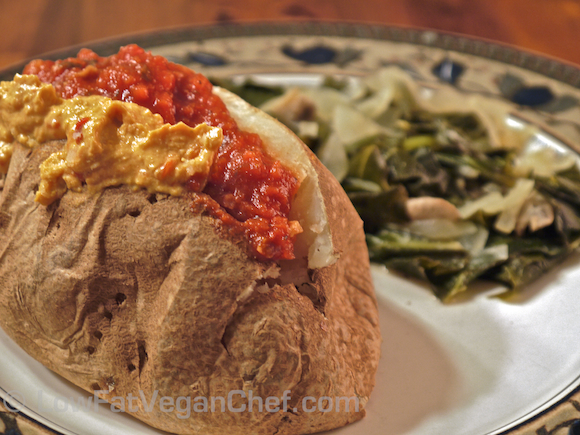
Oil Free Vegan Baked Potato Hummus Salsa

Oil Free Vegan Baked Potato with Red Pepper Hummus and Salsa

Just a reminder that my Comfort Soups To Keep You Warm recipe eBook is out! I’m already getting lots of great feedback on how delicious the soup recipes are!

Today I’m going to show you how to bake healthy baked potatoes in the oven without all the oil and fat!

I  think baked jacket potatoes are something that most people love or have fond memories of eating.  It’s a comfort food for them and I know Dr. John McDougall is certainly very fond of them as well! Potatoes can be healthy, or unhealthy depending what you put on them though. If you’re on the McDougall Program you might be interested in baking russet potatoes regularly and without oil of course.


Or maybe you just really like having something warm and filling for dinner, either way baked russet potatoes are a good way to go for a low fat, satisfying meal or side.

The baked potato above is topped with roasted red pepper hummus (that’s oil free and low fat) and salsa and is served with a side of my Low Fat Vegan Tangy Collard Greens With Coconut Milk and Mushrooms . (It’s also delicious to pour some of the coconut cooking liquid on top of your baked potato.)

So the main reason people like to oil and salt their potato skins before baking them is because it makes the skin all crispy and taste, well salty! The other reason is that it cooks it a bit faster but it raises the temperature it cooks at. Baking in oil at such high temperatures can create carcinogens and adding excess oil to a potato skin is not the best for health.


It’s also not beneficial to your health if you load your baked potato or potato skins with bacon, cheese, butter and/or sour cream. These things are far too rich and the negative effects of these toppings outweigh all the health benefits of eating a baked potato for vitamins and fibre. If you’re watching your weight, cholesterol or salt intake, please don’t add those things to your baked potato. There are many healthier alternatives.

While leaving their rich potato toppings out won’t make it taste exactly the same, it will be healthier for you and you can dress up your potato skins with some healthy low fat vegan alternatives like:

  • Fat free salsa (homemade or jarred)
  • Tobasco sauce
  • Hummus (original or roasted red pepper, low fat of course. Look for oil free or make your own.)
  • Baked beans (homemade or canned)
  • Salt and Pepper
  • Fresh chives or green onions (scallions)
  • Nutritional yeast
  • Fat free vegan queso or “cheezy” sauce
  • Steamed veggies like broccoli or kale

What Potato Do I Use For Baked Potatoes?

Use the dark brown rough skinned russet potatoes you find at the grocery store. They make the best baked potatoes and are also good for mashed potatoes. Don’t use the smooth waxy skinned yellow or red potatoes for baked jacket potatoes, these are better suited for potato salad, mini roasted potatoes, steamed or boiled potatoes and used in stews and soups.


Make sure that you select russet potatoes that are about the same size so they cook at the same time. If you bake medium and large ones together the large ones will not be done when the medium ones are ready.

Should I Cover My Russet Potato In Tinfoil For Baking?

No. I have no idea why people think they should do this, much less why some grocery stores sell russet potatoes in tinfoil. Maybe if you want to barbecue them, but when you put tinfoil on it you are STEAMING the potato from the inside out and not BAKING it. So it is not going to turn out like a baked potato and be all dry and fluffy inside. It will be more watery and dense like potatoes steamed in water. Don’t do this. Bake them uncovered for best results.

How To Bake a Russet Potato Without Oil

from Comfort Foods From Around The World 

Step #1: Preheat your oven to 400 F/ 205 C  (375 F on a convection oven)

Step #2: Wash your russet potatoes well and cut out any “eyes” or bad spots in the potatoes.

Step #3: Use a fork and poke a lot of holes all over your potatoes. This stops them from cooking unevenly and possible exploding in the oven.

Oil Free Baked Oven Roasted Potatoes

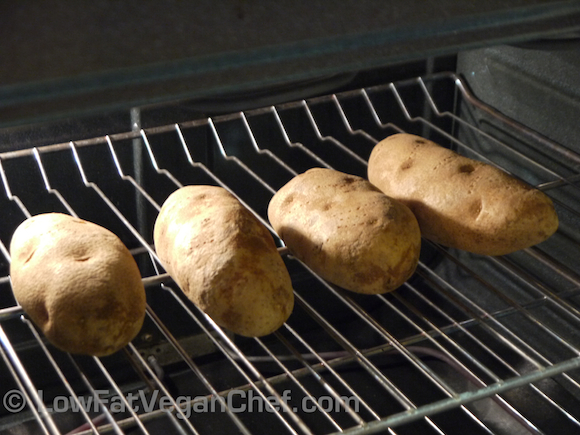
Step #4: When your oven has come up to temperature, place them directly on the rack in the middle of the oven. Leave enough space between them that they are not touching.


Step #5: Bake your potatoes for 50-70 minutes (depending on size) and check on them between 50 and 60 minutes. Using a pot holder or oven mitt, you want to gently squeeze the potatoes and see if they give. If they seem soft all the way through to the middle they are done. If you are not sure you can cut one in half and check. If they need more time, continue to bake, or you can microwave for a few minutes more to finish them off if you’re in a hurry. (Once you know the exact cooking time for your oven and this size of potato, write it down or remember it so you don’t have to check on it and guess next time. Usually they will be done within 60-70 min).

Step #6: To fluff your potato you’re going to make a slit across the top of it, and using pot holders or oven mitts gently squeeze the bottom of the potato together (like how a crab would close it’s claws) and this will push the insides up and open it for filling. (This is something I learned when I worked in a restaurant and had to plate food.)

Step #7: Fill your potato with your (hopefully healthy and vegan) seasonings and serve.

When I bake giant potatoes like this it become a whole meal when served with a side of greens. So this makes it a really easy AND cheap vegan meal!

Time Saving Tip:

You can bake multiple potatoes and keep them for future meals in the fridge and just reheat them for a quick lunch or side dish the next night.

I know a lot of Americans like to “nuke” their raw potatoes, but I really don’t like this. They can get all hard on the bottom and be a different texture. I prefer to bake mine and only reheat if necessary and not to use the microwave to cook anything that was raw.


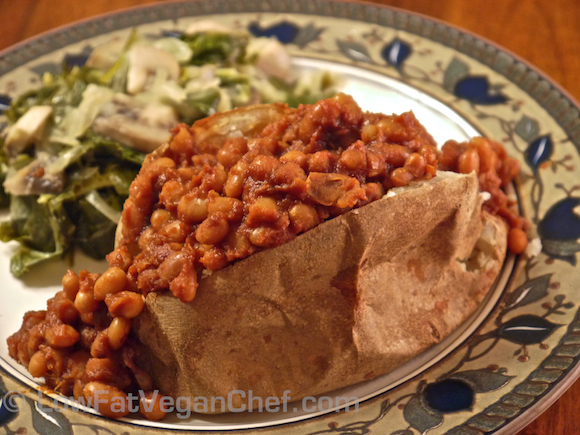
Oil Free Vegan Baked Potato With Baked Beans

Oil Free Vegan Baked Potato With Baked Beans

Here’s another oil free baked potato served with homemade baked beans. The baked beans recipe will be in my upcoming “Comfort Dinner Recipes From Around The World” eBook.

What do you like putting on your oil free baked potatoes?


Filed Under: Articles, How To, Side Dishes Tagged With: Cooking Tips, fat-free, gluten-free, how-to, nut-free, potato, side dish

Low Fat Vegan Tangy Collard Greens With Mushrooms, Onions and Coconut Milk

January 17, 2012 by Veronica Grace 31 Comments

Fb-Button
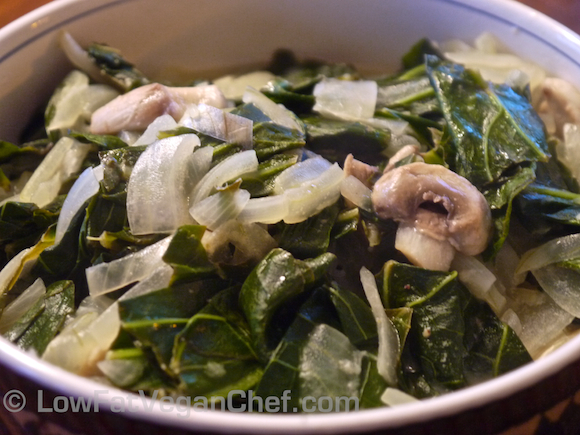
Low Fat Vegan Tangy Collard Greens With Mushrooms, Onions and Coconut Milk

Tangy Collard Greens with Mushrooms, Onions and Coconut Milk

Here is my delicious low fat vegan collard greens recipe!

Reminder: Make sure to subscribe to my bi-weekly newsletter on the right to receive my newest raw and cooked vegan recipes each week! You can also follow me on Facebook, Twitter and Youtube. Link icons are above!

This is an easy oil free and super delicious side dish that you can prepare to accompany any meal! A lot of people know of collard greens, but have no idea how to prepare them healthily, or at all. Generally in the southern United States, it is fried or deep fried and this pretty much negates the benefits of eating collards for health, because your body is dealing with all the denatured carcinogenic fats and free radicals from the oil slathered on it.

To get the health benefits of greens they should be prepared simply. Some of them like baby spinach and tender lettuces can be eaten in raw salads. Collards can be used in raw sandwiches (burrito style rolls) or steamed or sautéed gently.

Depending where you live it may be easy or difficult to find collard greens. I’m in Texas right now, and they are abundant, it only costs about 88 cents (USD) for a giant bunch of them! In Canada, I can only get them in Whole Foods and it costs about $2.99 (CAD) per bunch. So we’re loading up on them here!

Collard Greens Lower Cholesterol Better Than Kale or Broccoli!

“In a recent study, steamed collard greens outshined steamed kale, mustard greens, broccoli, Brussels sprouts, and cabbage in terms of its ability to bind bile acids in the digestive tract. When this bile acid binding takes place, it is easier for the bile acids to be excreted from the body. Since bile acids are made from cholesterol, the net impact of this bile acid binding is a lowering of the body’s cholesterol level. It’s worth noting that steamed collards show much greater bile acid binding ability than raw collards.” Ambrosone CB, Tang L. Cruciferous vegetable intake and cancer prevention: role of nutrigenetics. Cancer Prev Res (Phila Pa). 2009 Apr;2(4):298-300. 2009.

Brief History of Collard Greens

Like kale, cauliflower and broccoli, collards are descendents of the wild cabbage, a plant thought to have been consumed as food since prehistoric times and to have originated in Asia Minor. From there it spread into Europe, being introduced by groups of Celtic wanderers around 600 B.C. Collards have been cultivated since the times of the ancient Greek and Roman civilizations. While collards may have been introduced into the United States before, the first mention of collard greens dates back to the late 17th century. Collards are an integral food in traditional southern American cuisine.

How to Select and Store Collard Greens

Look for collard greens that have firm, unwilted leaves that are vividly deep green in color with no signs of yellowing or browning. Leaves that are smaller in size will be more tender and have a milder flavor. They should be displayed in a chilled section in the refrigerator case to prevent them from wilting and becoming bitter.

Place collard greens in a plastic bag, removing as much of the air from the bag as possible. Store in the refrigerator where they should keep fresh for about three to five days.

Cooking Collard Greens

It is very important not to overcook collard greens. Like other cruciferous vegetables overcooked collard greens will begin to emit the unpleasant sulfur smell associated with overcooking. To help collard greens to cook more quickly, evenly slice the leaves into 1/2-inch slices and the stems into 1/4-inch pieces. You may boil or steam them up to 5 minutes and then season.

For more information on collard greens check out this website http://whfoods.org/genpage.php?dbid=138&tname=foodspice


Oil Free Baked Potato With Tangy Oil Free Collard Greens

Giant baked potato with salsa, hummus and "Tangy Collard Greens"

Low Fat Vegan Tangy Collard Greens with Mushrooms, Onions and Coconut Milk

This collard greens recipe is much lower in fat than traditional collard green recipes that call for frying onions in oil first and then adding the greens. I serve these with giant baked potatoes for a completely filling meal. (Yes, dinner can be this simple and delicious!)

Serves 2

Ingredients:

1 large bunch collard greens, washed
1/2-1 cup of sliced mushrooms of choice
1 medium onion, sliced thinly
1/2 cup light unsweetened coconut milk (So Delicious SugarFree Original is excellent for this, don’t use vanilla or sweetened for this recipe)
1/4 – 1/2 tsp herbamare or salt
1 tbsp of lemon juice (or more if desired)
1/2 tsp sugar or sweetener
1/2 tsp dijon mustard
1 tbsp nutritional yeast
fresh ground pepper to taste

Directions:

1. Take the stems off of the collard greens by turning them upside down and making a small circle with your pointer finger and thumb and squeezing the leaves down and off from the stem. Like you would straighten a pipe cleaner. Cut the remaining parts of the stem off the top if you miss any bits.

2. Bunch all the collards up together on a cutting board and cut into chunks.

3. In a large pot, bring salted water to a boil. When boiling, add the collard greens and cook for 2-3 minutes. Drain well.

4. In a large non stick skillet, turn to medium heat. When it’s hot add the onions and sauté dry for 5 minutes. (TRUST ME, it will NOT burn if you use a non stick pan, and no oil is necessary!) Add the mushrooms, collards, coconut milk and seasonings except for pepper and sauté for 8-10 minutes until collards are at desired tenderness.

5. Taste test and add fresh ground pepper and any additional seasonings like more lemon if desired.

6. Serve as a side dish with your meal. (I love serving these with baked jacket potatoes, beans, or rice.)

Variations:

You can also try this recipe with other greens like kale, mustard greens, turnip greens, beet greens etc.  If you use baby spinach, DO NOT boil it, you can just wilt it in the pan with the coconut milk in a few minutes. Make sure your onions and mushrooms are cooked first before adding the spinach.

If you don’t want to use coconut milk, feel free to use a low fat almond or soy milk instead. The coconut flavour is very mild in this and not essential to the overall taste.

Try other seasonings as well, add some spices like paprika, chili, cumin etc instead of the dijon and nutritional yeast.  Mix it up!

*If you don’t want to use a non stick pan, you can put the collards, onions and mushrooms into a steamer basket, steam for 5 minutes over boiling water and then drain. Season to taste with the coconut milk and seasonings and stir to combine.

See non stick pans – are there safety concerns http://lowfatcooking.about.com/od/healthandfitness/a/nonstickpans.htm  You should NOT worry about cooking oil free over medium heat in a non stick pan. If nothing is flaking off, or food is not being burned onto the pan on high heat for a few minutes this is not a concern.

Have you ever cooked collard greens before? What do you think of this recipe?

Filed Under: Cooked Vegan Recipes, Green Dishes, Side Dishes Tagged With: coconut milk, collards, gluten-free, greens, mushrooms, nut-free, onions, side dish, soy-free

Primary Sidebar

Follow Us:

Newsletter

Get The Low Fat Vegan Starter Kit

natural organic skin care line

Free Skincare Samples

Earn Free Crypto At Binance

Earn Free Bitcoin on Gemini Exchange

Earn $10 in Bitcoin With Gemini Exchange
Dr. Fuhrman
Dr. Fuhrman
Dr. Fuhrman

Tags

80/10/10 apple avocado banana blueberries breakfast broccoli Carrots celery chickpeas cilantro corn cucumber Curry dill dinner easy Eat To Live fat-free gluten-free how-to Indian Dishes lemon low-fat mango mexican mushrooms nut-free oil-free pasta pineapple plant-based raw raw vegan rice smoothie soup soy-free spinach tofu tomato tomatoes vegan vegetarian vitamix

Secondary Sidebar

Recipes:

  • Cooked Vegan Recipes
  • *My Recipe Books
  • Breads and Baked Goods
  • Breakfast
  • Brunch
  • Burgers
  • Casseroles
  • Curries
  • Desserts
  • Dinner
  • Dips for Veggies or Chips
  • Eat to Live-Dr. Fuhrman Recipes
  • Engine2Diet
  • Ethiopian Dishes
  • Greek
  • Green Dishes
  • Holiday
  • Indian Dishes
  • Mexican
  • One Pot Meals
  • Pasta
  • Pizza
  • Quinoa
  • Salads
  • Sandwiches and Wraps
  • Raw Vegan Recipes
  • 80/10/10
  • Raw Breakfast
  • Raw Desserts
  • Raw Dips
  • Raw Dressings
  • Raw Entrees
  • Raw Juices
  • Raw Salads
  • Raw Smoothies
  • Raw Snacks
  • Raw Soups
  • Sauces
  • Side Dishes
  • Slow Cooker Recipes
  • Snacks
  • Soups and Stews
  • Spices/Seasonings
  • Sushi
  • Thai
  • Vietnamese

Copyright © 2026 · Foodie Pro & The Genesis Framework