• Skip to primary navigation
  • Skip to main content
  • Skip to primary sidebar
  • Skip to secondary sidebar

Plant Based U

Fat-Free and Low Fat Vegan Plant Based Recipes

  • Home
  • Recipes
    • Raw Vegan Recipes
    • Cooked Vegan Recipes
    • Eat to Live Dr. Fuhrman Recipes
  • Products
  • Coaching
  • Videos
  • Articles
  • About
    • What Is Low Fat Vegan/Whole Foods Plant Based
    • Resources
  • Contact

How To

Fb-Button

How To Cut And Prepare Leeks For Recipes

March 9, 2012 by Veronica Grace 1 Comment

Fb-Button

Leeks are something many people have heard of, but have no idea how to use or what they taste like. You can use leeks just like you would onions in a recipe, they are part of the allium family. They have a nice mild creamy taste and are great in blended soups.

They usually come in sets of 3 from the grocery store and have big long green tops on them. You can slice off the top 3-4 inches and throw that away or save the tips to use in vegetable stock along with any other cleaned vegetable trimmings.

How To Cut and Trim Leeks For Sautéing

Step 1: Cut off the very top of the leeks and set aside.
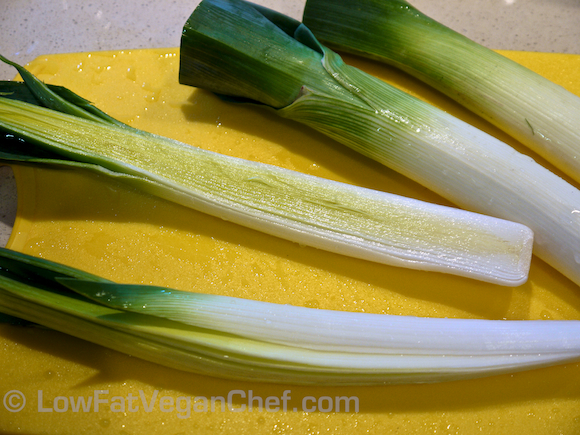
How To Cut, Trim And Chop Leeks For Sautéing Or In Recipes

Step 2: Slice the leeks in half lengthwise.
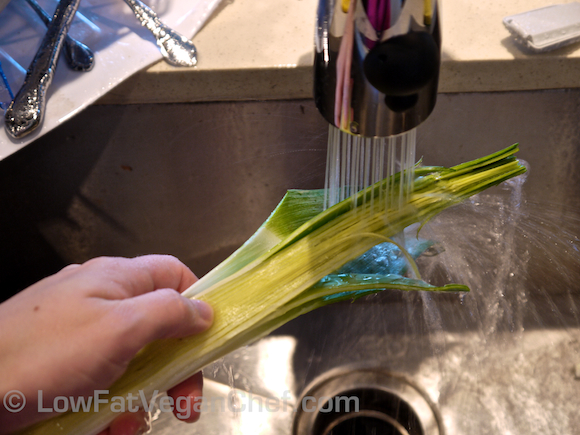
How To Cut And Wash Leeks For Recipes

Step 3: Carefully wash in between each leaf of the leek. They usually have a lot of dirt trapped between the layers.
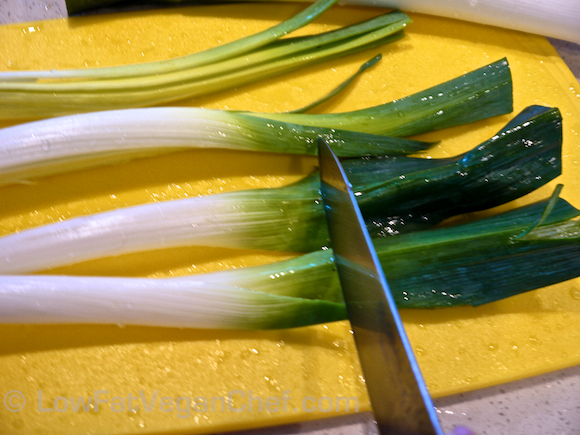
How To Cut And Chop Leeks For Sautéing and In Recipes

Step 4: Take off the large outer layers.
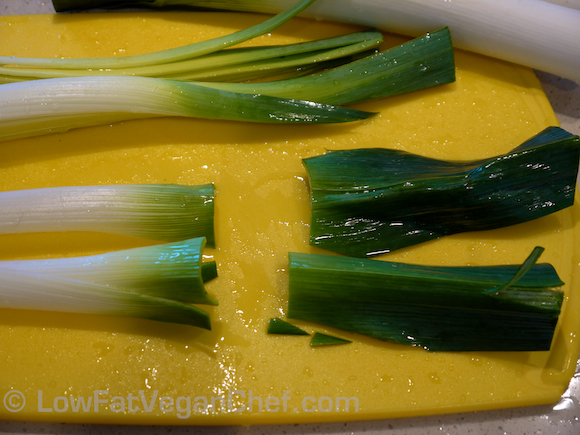
How To Cut And Chop Leeks For Sautéing and In Recipes

Slice off the dark green parts of the leeks and set those aside. You want to use the light green parts and the white parts only for your recipe.
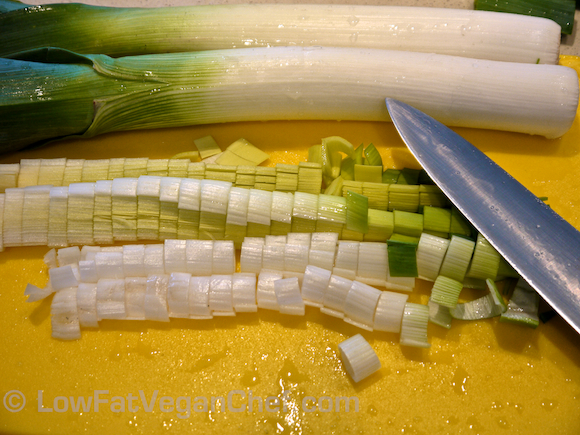
How To Cut And Chop Leeks For Sautéing and In Recipes

Step 5: Slice the light green parts and white parts like you would slice celery.

Now you are ready to cook your leeks, just like you would cooked diced onion.  Just sauté it in a pan or pot with some vegetable broth and when they are soft you can add the rest of your ingredients and continue cooking your dish.
Filed Under: Articles, How To Tagged With: Cooking Tips, how-to, Leeks

How To Make Homemade Vegan Vegetable Stock Easily On The Stove Or In A Pressure Cooker Without Oil

March 9, 2012 by Veronica Grace 49 Comments

Fb-Button

Homemade Vegan Vegetable Stock Broth Low Sodium Recipe

Oil-free vegetable stock is something most people don’t make, but it is pretty easy to do (aside from chopping the veggies) and it’s worth it because it’s fresh, tastes better and is cheaper than buying it if you cook like I do. I use my vegetable stock for sautéing onions and garlic in (instead of oil) and as a base for my (oil free) vegan soup recipes.

For my Low Fat Vegan Comfort Soups Recipe eBook I had to make A LOT of stock. Often the store bought stock is only 1 quart or 1 liter and often I needed more than that. It can cost up to $2.99 a pop and that can add up when you use stock as much as I do.

So once a week or maybe twice a week I’ll make some fresh vegetable stock in my pressure cooker. It’s a great way to use up some leftover carrots or celery and some herbs like thyme or parsley that you don’t need for any other recipes.

When compared to the store bought low sodium vegetable broths mine taste MUCH better and have a nice light flavour and a natural sweetness. I find the store bought ones are a little too strong and bitter and are not something you’d want to drink a cup of.

You can use homemade vegetable broth or stock for soup, sautéing, risotto and more. And this way you get to control the flavour and the amount of sodium in it.

So here are my recipes. I have one for a 9 cup recipe and a large one for a 14 cup recipe. Sometimes you just need a lot, and sometimes you just need a little.

Homemade Vegetable Broth/Stock Recipe (smaller recipe)

Yields about 9 cups/2.25 qts/~2.12 L of broth

Ingredients:

8 cups/2 quarts/~1.9 L of filtered water
2 large onions, diced
4-6 cloves of garlic, minced
4 large carrots, peeled and sliced
3 large stalks of celery, sliced
Mushroom stems and ends *optional
1/2 bunch of parsley and a few sprigs of fresh herbs like thyme
2 bay leaves
1/4 tsp. whole peppercorns
Dash of salt *optional

Pressure Cooker Method:

1. Place the vegetables, water and seasonings into a pressure cooker. Fill with water and bring to high pressure and cook for 5-6 minutes until vegetables are very tender. Use the quick release method (putting in the sink and pouring water over the lid until it releases) and let it cool until you can open the lid.

2. Strain vegetables from broth in a large mesh strainer and use a ladle, nested measuring cup or bowl to press out the excess liquid from vegetables through the strainer to yield the most broth.

Stovetop Method:

1. Place vegetables, water and seasonings into a large pot and bring to a boil. When it’s boiling turn it down to low and simmer for an hour. Don’t let your vegetables overcook and completely fall apart, check on them after 45 minutes or so.

2. Strain vegetables from broth in a large mesh strainer and use a ladle, nested measuring cup or bowl to press out the excess liquid from vegetables through the strainer.

Additional Tips:

Use the broth right away or let it cool and store in a sealed container(s) in the fridge for up to 3 days. You can freeze any extra you won’t use in that time. Use in recipes or for daily sautéing for onions and garlic.
For the pressure cooker, I chop the vegetables a little smaller. For the stovetop you can cut them into bigger chunks and keep the garlic whole, as they will cook longer.

This recipe is really flexible, if I need more for a soup recipe I’ll just add a little more water and dilute it. When I’m making it, I will use what vegetables I have but the main important ones are onions, carrots and herbs. The point is you want the water to taste like vegetables and not like plain water and homemade broth gives the best flavor for soup.
You can also use any other vegetable tops or skins if you like, but leave out the celery leaves, as they can be too bitter. I suggest that the vegetable peels be organic if you do use them. You can also add leeks, green/spring onions, other root vegetables, already cooked beans etc. to add more depth to the flavor.

Things You Do Not Want To Add To Vegetable Broth

Don’t add cruciferous vegetables as they contain sulfur and can make the broth bitter and smell unpleasant. No kale, collards, cabbage, broccoli, cauliflower, Brussels sprouts or leafy greens aside from fresh herbs.  You’d get more out of eating or juicing the greens than adding them to your broth. It won’t make it taste better for your recipes. Please do not add raw beans, grains or pasta to your vegetable broth either.

Homemade Vegan Vegetable Stock Broth Low Sodium Recipe

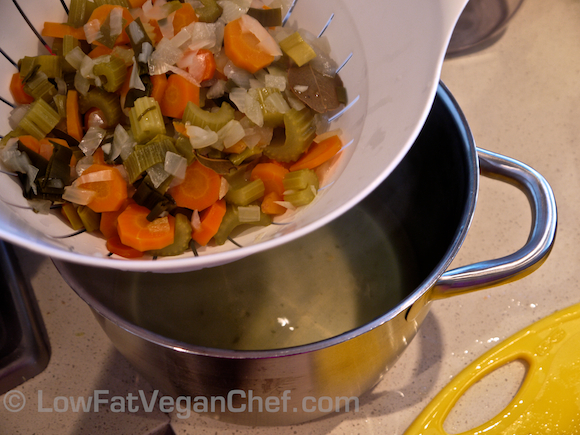
My stock is done cooking so I open the lid.

Straining Homemade Fresh Vegetable Stock Broth

I ladle it out into a strainer/colander that is over another pot or bowl.

Straining Homemade Fresh Vegetable Stock Broth

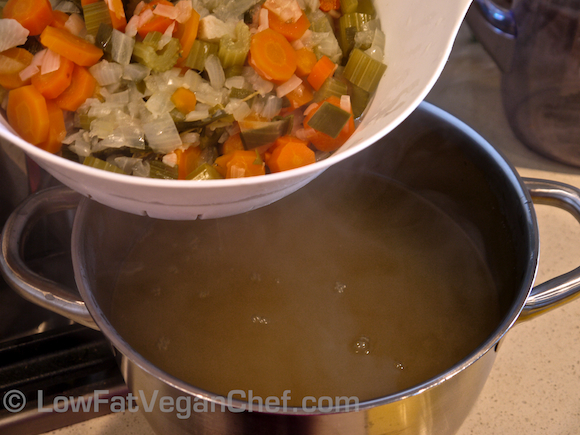
Pick up the strainer/colander filled with cooked vegetables and strain it.

Straining Homemade Fresh Vegetable Stock Broth

I push the juices out the veggies to get any extra broth.

Fresh Homemade Vegetable Stock Recipe

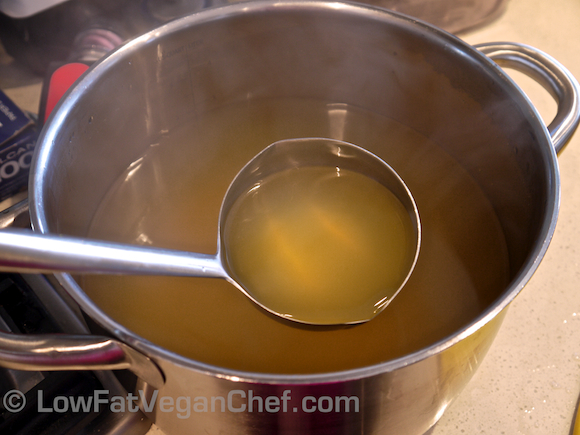
Now my vegetable broth/stock is ready to be used in my recipes!

Fresh Homemade Vegetable Stock Recipe

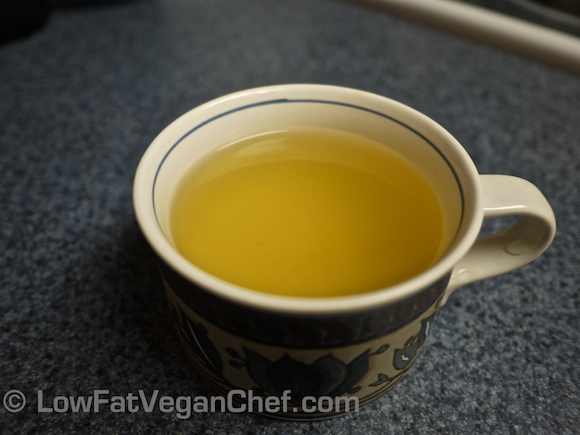
How about a cup of fresh vegetable broth?

Larger Vegetable Soup Stock Recipe

Yields 14 cups of broth

Ingredients:

12-13 cups/~3 qts./2.9 L of filtered water
2 large onions, diced
6 cloves of garlic, minced
8 large carrots, sliced
10 stalks of celery, sliced
Any other vegetable leftovers like the tops of leeks or ends of mushrooms
3 bay leaves
3 sprigs of fresh thyme
Pinch of salt
1/4 tsp whole peppercorns

Pressure Cooker Method:

1. Place the vegetables, water and seasonings into a pressure cooker. Fill with water and bring to high pressure and cook for 5-6 minutes until vegetables are very tender. Use the quick release method (putting in the sink and pouring water over the lid until it releases) and let it cool until you can open the lid.

2. Strain vegetables from broth in a large mesh strainer and use a ladle, nested measuring cup or bowl to press out the excess liquid from vegetables through the strainer to yield the most broth.

Stovetop Method:

1. Place vegetables, water and seasonings into a large pot and bring to a boil. When it’s boiling turn it down to low and simmer for an hour. Don’t let your vegetables overcook and completely fall apart, check on them after 45 minutes or so.

2. Strain vegetables from broth in a large mesh strainer and use a ladle, nested measuring cup or bowl to press out the excess liquid from vegetables through the strainer.

Filed Under: Articles, Cooked Vegan Recipes, How To, Soups and Stews Tagged With: Cooking Tips, how-to, soup

How To Cut, Prepare and Cook An Artichoke For Recipes or Stuffed Artichokes

March 4, 2012 by Veronica Grace 8 Comments

Fb-Button

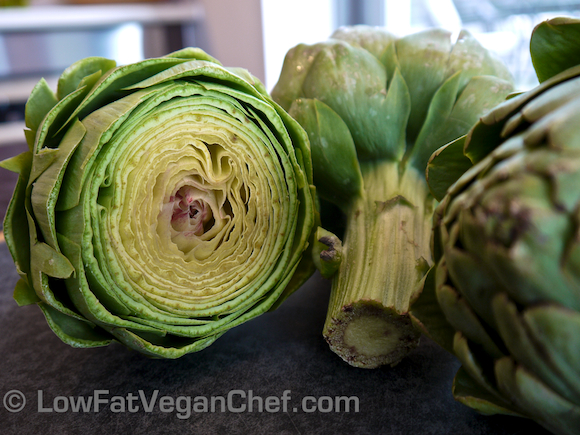
How To Cut And Prepare An Artichoke For Steaming Or Stuffing

I have to admit that artichokes are something that always sounded weird and a little frightening to me at first.

Before I was vegan, I had never had an actual artichoke. I had tried Spinach Artichoke dip at Moxie’s before, but it’s filled with cream cheese, and let’s be honest, most vegetables covered in cream cheese probably taste good anyway. So this was not a good indication for me whether I would like them or not!

How To Cut And Prepare An Artichoke For Steaming Or Stuffing

The first time I ever had artichokes in their vegetable form was on one of Amy’s cheese-less pizzas and it was a new experience. I wasn’t sure I liked them at first.

I’ve tried marinated artichokes in oil and brine, and now steamed artichokes on their own and even in soup. I have to say I am a BIG fan of fresh made artichokes. The canned/jarred ones are seasoned a little too much and the ones in oil are just gross to me.

When you prepare them yourself they have this nice creamy taste (the artichoke heart) and you can do so many things with these delicious morsels it’s not even funny…

How To Cut And Prepare An Artichoke For Steaming Or Stuffing

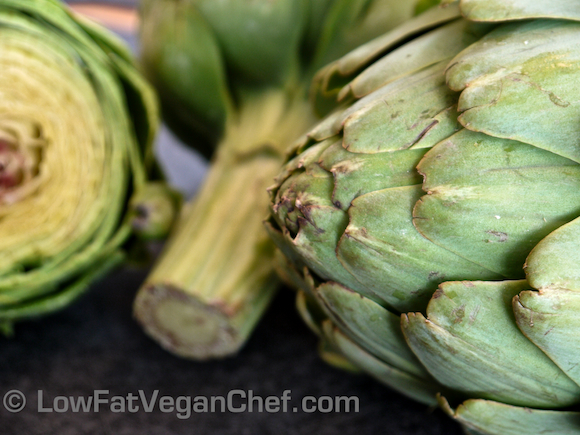
So in case you’ve never tried an artichoke or were seriously intimidated by these beastly looking vegetables I want to show you how to cut and prepare them yourself.

If you’re just doing one or two for a snack or for stuffed artichokes, it’s not that much work. I did 4 and it took a little longer. Mostly because I had to keep photographing every step!

How To Cut And Prepare An Artichoke For Steaming Or Stuffing

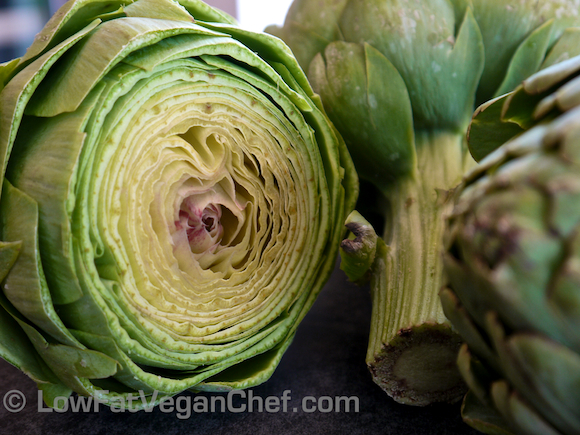
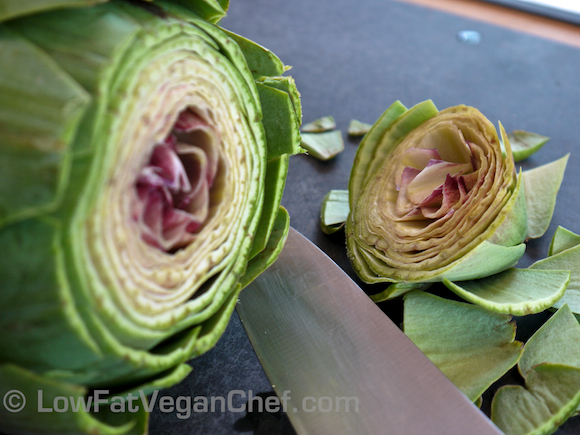
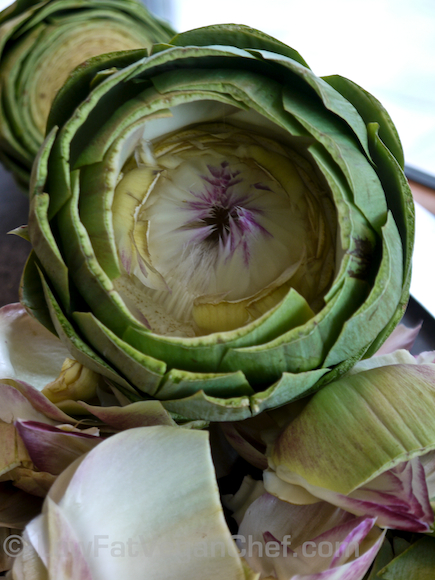
I love how pretty the purple centre is.

How To Cut, Prepare and Cook An Artichoke

for Recipes or Making Stuffed Artichokes


How To Cut And Prepare An Artichoke For Steaming Or Stuffing

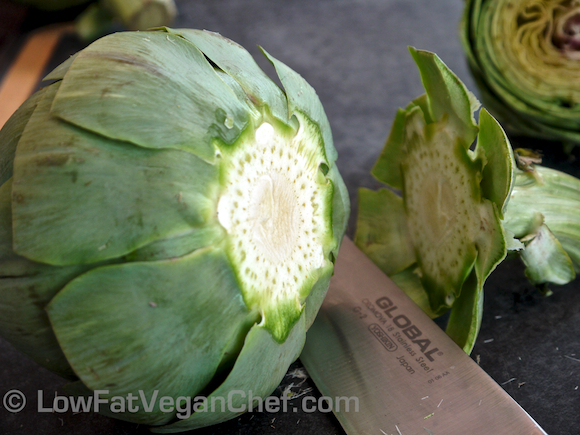
Step 1: Using a very sharp knife, cut the top point off of the artichoke. Get about the first 2 inches. These tips are prickly and you’re not going to eat it anyway.

How To Cut And Prepare An Artichoke For Steaming Or Stuffing

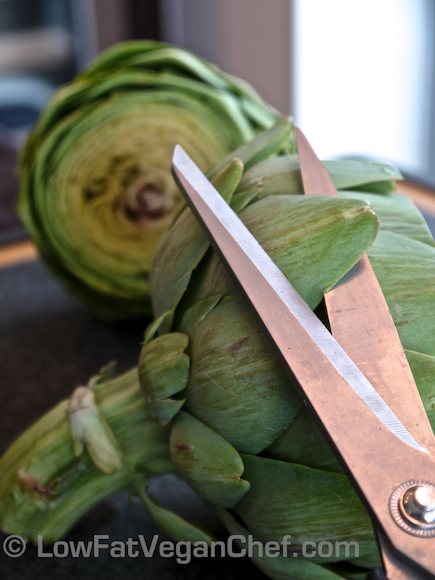
Step 2: Using a very sharp pair of scissors, cut off the pointy tips of each leaf all the way around on all the remaining tips. These are sharp and pokey and you don’t want them.

How To Cut And Prepare An Artichoke For Steaming Or Stuffing Purple Center

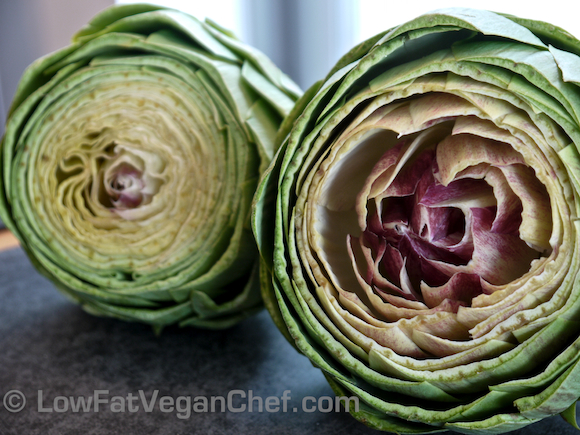
Step 3: Grasp the bottom of the artichoke in your hands and using your two thumbs, fan out the centre of the artichoke so that it is separated. The one on the right has been fanned out, the one on the left has not been.

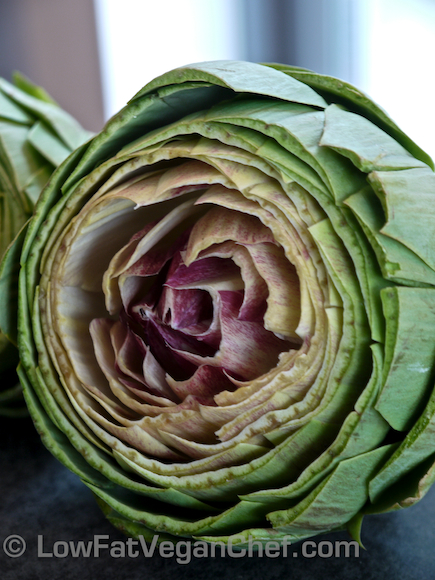
How To Cut And Prepare An Artichoke For Steaming Or Stuffing Purple Center

(Close up.)

How To Cut And Prepare An Artichoke For Steaming Or Stuffing Purple Center Leaves

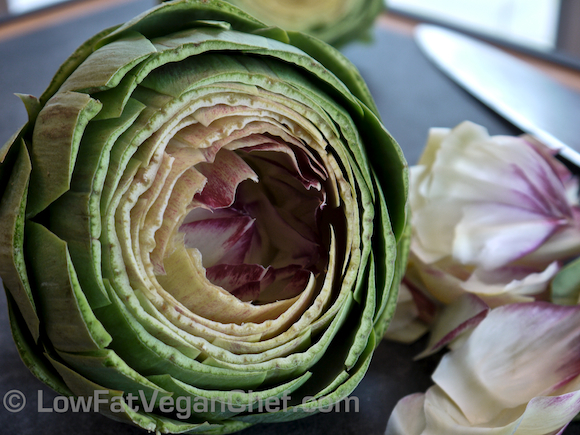
Step 4: If you want to make stuffed artichokes you can pull out the inner leaves that are light green with purple tips (Being careful not to poke yourself of course.) Go slowly one or two leaves at a time. (If you don’t care and are just going to cook the whole thing to eat it petal by petal, you can skip this step. It will just take longer to cook)

How To Cut And Prepare An Artichoke For Steaming Or Stuffing Center Of Artichoke

This is what it looks like when you start pulling the inner petals out. The inside part can be a little sharp.

How To Cut And Prepare An Artichoke For Steaming Or Stuffing Scooping Out Center Of Artichoke

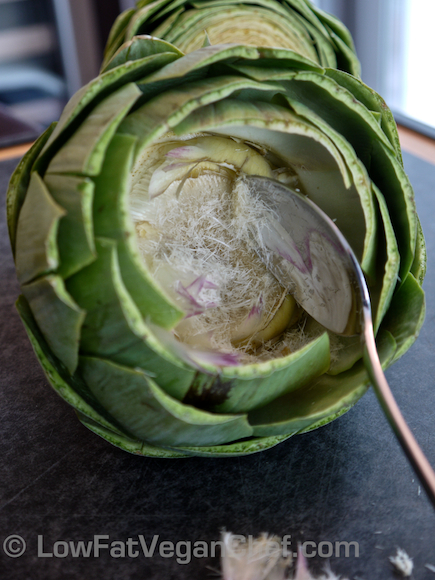
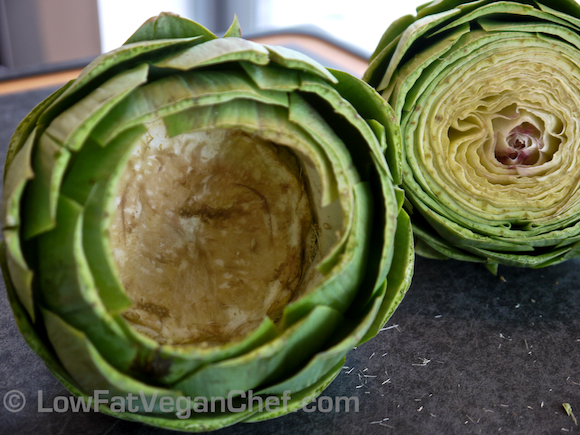
Step 5: (If you’re pulling out the centre petals) Get a spoon and start scraping out the fuzzy “choke” of the artichoke. Make sure you get all the way around the sides. Some artichokes are easier or harder to clean. I had 3 easy and 1 hard one.

How To Cut And Prepare An Artichoke For Steaming Or Stuffing Stuffed Artichoke

Step 6: Now that your artichoke “heart” is revealed you want to dribble some fresh lemon or lime juice on it to keep it from oxidizing too badly and give it some flavour.

Chopping Off Stem Of Artichoke To Cook

Step 7: Slice off the bottom stem from the artichoke close to the root. You can discard, or cut off the hard green exterior and steam the light green/white interior to use in your recipe.

Steaming Artichokes In A Steamer Basket

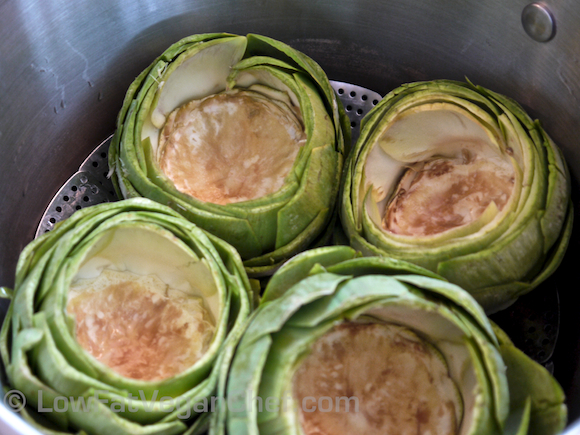
Step 8: Steam or pressure cook your artichokes. Steam them for 20-30 minutes. Check on them after 15-20 minutes. It depends on the size of them and how hard they are as well.  I pressure cooked mine. Because the inside choke was taken out they will cook MUCH faster than if you leave it in. So it’s up to you if you want to save on cooking time by doing this step or not. Pressure cook for 7-8 minutes just until tender. You don’t want your artichoke to fall apart.

What To Do With Steamed Artichokes?

When your artichokes are done you can let them cool and either fill them with dip or stuffing, or cut out the interior “hearts” to put on pizza, sandwiches, blend into soup etc. The leaves you can peel off one by one and put the inside portion into your mouth and scrape off the thin layer of tasty flesh. A lot of people like to dip these in mayo (I don’t do this) but you could make like a tahini or peanut dip or just eat them plain.
If you want to make a vegan spinach artichoke dip you can look for some Tofutti Better Than Cream Cheese vegan cream cheese at Whole Foods or your local health food store. I haven’t made one yet, but I’m sure it would be good. I just try to stay away from the really fatty vegan dairy alternatives myself.

I used my artichokes for a Cream of Artichoke Soup that is in my Comfort Soups To Keep You Warm recipe ebook. It will be available soon, I’m just finishing writing the intro and doing the layout and metric conversions. I will let you know when it’s ready! None of the recipes in it are on the blog here, they are all secret so far…

Alternatively, if you have a recipe that calls for artichokes you can buy an 8 oz can of artichoke hearts in water or brine (skip the oily ones, even rinsing won’t get rid of the oil) or you can find frozen artichoke hearts at a lot of grocery stores.

Filed Under: Articles, How To Tagged With: artichoke, how-to

How To Peel Ginger Quickly and Easily With A SPOON!

March 4, 2012 by Veronica Grace 7 Comments

Fb-Button

So how do you peel ginger easily? This is a neat little trick that you may not know about. You can actually save all of your ginger by peeling it with a spoon instead of cutting it or paring it with a knife. It’s really easy and safe too. When you cut it with a knife you can loose a bunch of it and then it can be all uneven and choppy.

I am using this peeled ginger here to put in some celery-apple juice. It’s really good. Even juicing this much isn’t that strong when you juice a whole head of celery.

How To Peel Ginger Using a Spoon

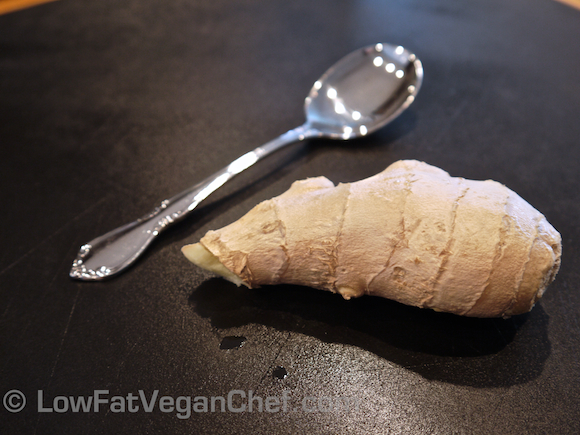
How To Peel Ginger With A Spoon

Step 1: Get out a large soup spoon or something other than a narrow teaspoon. It should be metal, not plastic or you may snap it.

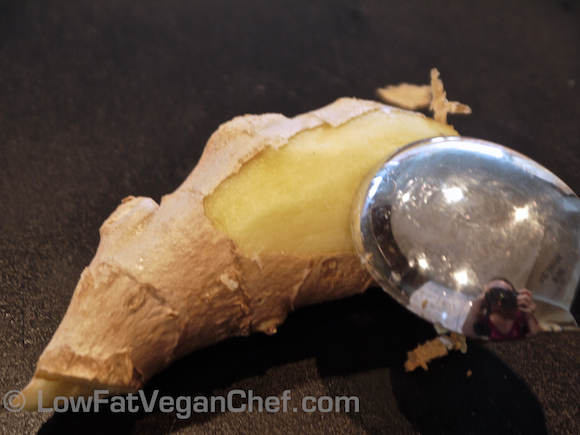
How To Peel Ginger With A Spoon

Step 2: Start scraping the outer peel off of the ginger with your spoon. This way it is safe and if you slip or have any weird nooks or crannies to get into you won’t cut yourself!

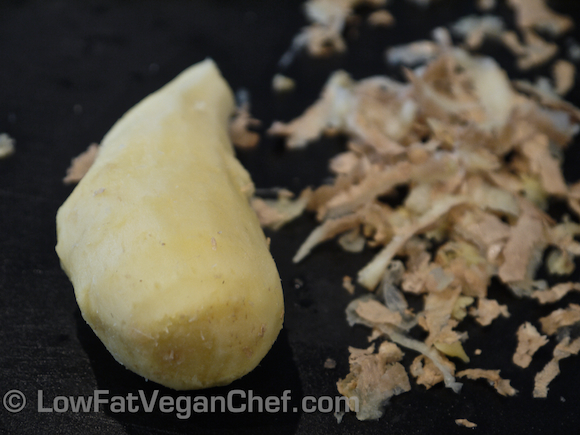
How To Peel Ginger With A Spoon

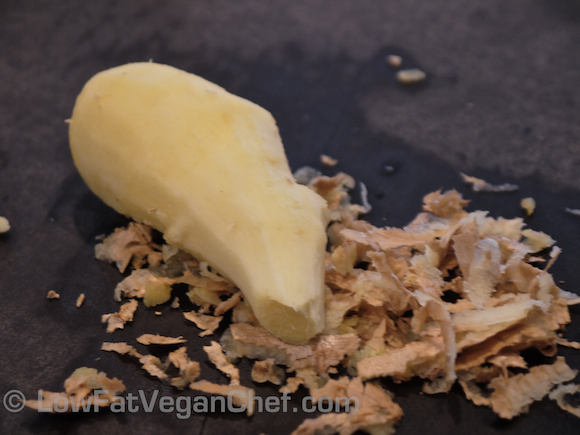
Go all the way around the ginger until all the skin is gone.

How To Peel Ginger With A Spoon

Wow that was easy! Now your ginger is ready to be used.

I know some people find  chopping or mincing ginger regularly a pain so they do up a bunch and freeze it so that it’s ready to use. I don’t do this as my freezer is always jammed full of frozen fruit, but you an and then it’s ready to grate or use in your mini garlic chopper (after you let it sit on the counter for a bit first) and you can use it in recipes quickly.

Ginger is essential for Asian and Indian dishes, so I use it quite often. It’s also dirt cheap so I always make sure to have some in the fridge. It’s definitely an essential ingredient like onions and garlic for vegan recipes or even raw vegan salad dressings.

Filed Under: Articles, How To Tagged With: ginger, how-to

How To Roast Garlic In The Oven Without Oil: Fat Free Roasted Garlic

February 29, 2012 by Veronica Grace 20 Comments

Fb-Button

Yes you can make roasted garlic without oil! There’s actually no real need to use oil when roasting garlic in the oven. When you add oil to oven baked foods it makes them cook faster and at a hotter temperature and the oil does retain a little moisture so they don’t dry out. But when you are putting your garlic in tin foil anyways to steam, it’s unnecessary. It might take a few more minutes to roast, but it will be calorie free and still delicious.

I’ve seen some peoples’ directions recommend a teaspoon or two of oil for each head of garlic! Holy calories! Let’s skip that shall we?

My roasted garlic turns out perfectly fine without any oil in my convection oven. Just watch!

How To Roast Garlic In The Oven Without Oil

Or Make Roasted Garlic Without Oil For Recipes

Step 1: Preheat oven to 400 F / 205 C (or 375 F on a convection oven).

How To Roast Garlic In The Oven Without Oil For Roasted Garlic

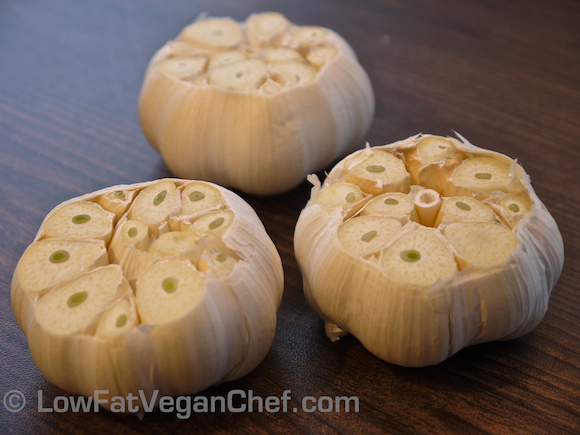
Cut off the tops of the garlic cloves

Step 2: Slice off a good chunk off the top of the head of garlic. Make sure all of the cloves are exposed so you will be able to get them out. (It’s best to have garlic with no green sprouts in it, but mine had some as they sat for a while on the counter. I used them anyway.)

How To Roast Garlic In The Oven Without Oil For Roasted Garlic

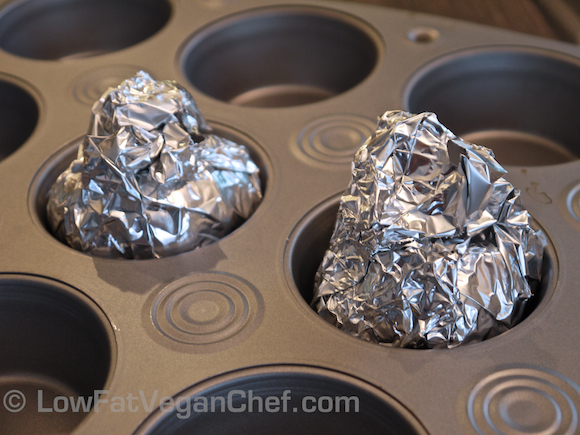
Wrap the garlic cloves in tinfoil

Step 3: Wrap the garlic cloves individually in tinfoil and place on a baking sheet or in a muffin tin. If using a muffin tin you can add some water to the muffin holders you are using. I think this will help with the moisture of your garlic and help it cook faster. It seemed to cook faster for me than usual.

Step 4: Bake in the oven (when it’s up to temperature) for 35-45 minutes until the cloves are soft. They will be very hot, so you need to use oven mitts to squeeze them gently to see if they are done.

How To Roast Garlic In The Oven Without Oil For Roasted Garlic

Cool and gently unwrap to see the caramelized roasted garlic cloves inside

Step 5: Let the garlic cloves cool before touching. Unwrap the tinfoil.

How To Roast Garlic In The Oven Without Oil For Roasted Garlic

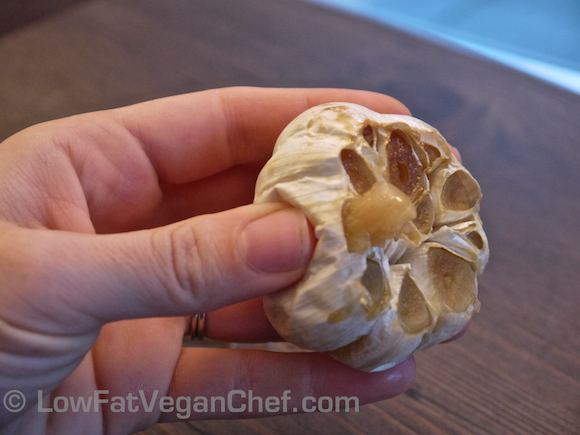
Squeeze out the roasted garlic for your recipe

Step 6: You can either squeeze each clove of garlic out one at a time (careful to not let hot garlic burn you, or slip out of the bottom) or you can peel the cloves and remove them one by one if you are stickler for maximizing your garlic output! How do you know if your roasted garlic is ready? It will be a golden brown color and be very soft inside. If it’s still white and not fully soft, it’s not ready yet.

Step 7: Your (oil-free) roasted garlic is ready to use in soups, mashed potatoes, dips, or just to spread on bread. Save any leftovers in a container in the fridge.

Enjoy!

How did you like my tutorial for how to roast garlic without oil?


Filed Under: Articles, How To Tagged With: fat-free, gluten-free, how-to, nut-free, roasted garlic

80/10/10 Recipe: Banana Cherry Pineapple Green Smoothie, Green Smoothie FAQ and How To Make Your Green Smoothie Look More Appetizing

February 28, 2012 by Veronica Grace 22 Comments

Fb-Button

80/10/10 Banana Cherry Pineapple Green Smoothie

Today I thought I’d share another fat free raw vegan smoothie recipe with you  (this one includes cherries and pineapples) and go over some questions some of you may have on green smoothies. If you’re looking for the recipe, you can scroll to the bottom of the post.


What is a Green Smoothie?

A green smoothie is basically just a raw fruit smoothie with some raw greens added to it for more nutrition. It can look green, red, purple or even brown coloured depending on what the ingredients are.

Why Would I Want To Add Greens To My Smoothie?

Most of us don’t eat giant raw salads or plates and plates of green vegetables every day and when we do eat greens we often don’t chew them well enough or even that long at all. A green smoothie is a great compromise for those who want to get more fresh greens in their diet with little fuss. It’s also great for those who don’t like the taste of leafy greens or want to eat all their greens raw.  Eating heads and heads of leafy greens every day can be tough too.

What Kind Of Greens Should I Put In My Green Smoothie?

If you’re just starting out and not sure what would be a “safe bet” to have your first green smoothie or you’re making one for someone else who is really skeptical, you should try something mild like a cup or two of baby spinach, mâche (lambs lettuce/corn salad) or a few leaves of lettuce.

If you’re already used to green smoothies you can use the above, or also try adding celery stalks, kale, Swiss chard, dandelion greens, turnip greens, beet greens, etc.


If you’re really adventurous and can stand bitter/strong greens like mustard, baby spring mix and collards you can try a little of those to start.

How Do I Make A Green Smoothie Then?

I would recommend to start with ripe bananas, a little bit of water, your favourite frozen fruit (pineapple, mango, peaches, berries etc) and a cup or handful or two of greens. Blend it and then taste test it before deciding if it needs more fruit or greens to your liking.

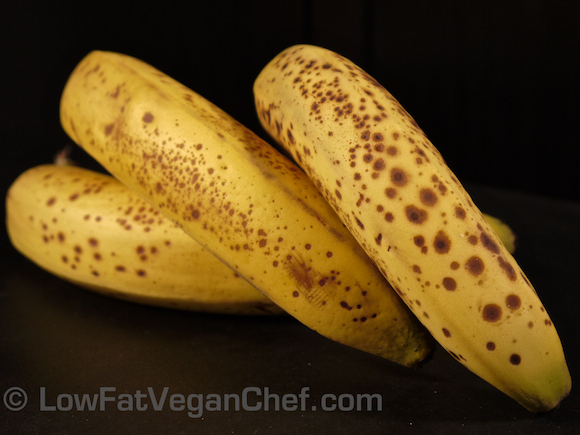
BTW, these are ripe bananas. Please DO NOT use anything less ripe than these or you could end up with s starchy (dry and pasty) bland smoothie and not enjoy it. Note the one on the right is the ripest and will taste much sweeter than the two on the left.

Ripe Spotted Bananas Turned Ripe

Your first green smoothie might look like this:

2-3 ripe bananas
1-2 cups baby spinach
1 cup fresh or frozen blueberries
1/2 cup water

Green Smoothie Troubleshooting FAQ:

80/10/10 Banana Cherry Pineapple Green Smoothie

My Green Smoothie Tastes Awful/Bad! What Did I Do Wrong?

The first suspect is that you used unripe/sour fruit for the base of it. Unripe bananas, sour peaches, sour nectarines, sour mango etc. Your fruit should be soft and give to the touch. I made a youtube video about How To Tell If Fruit Is Ripe if you want to check it out.

If your smoothie is really bitter/smelly/awful tasting you probably used too strong of a green or too much of it. I would scale back to a handful or two and blend and then taste test before deciding if you want to add more greens to it.


If you did not add unripe fruit or too many greens, you probably added some kind of bitter powder to your smoothie and the taste is overpowering the flavour. Omit or reduce this amount.

My Green Smoothie Is All Gritty And Has A Weird Texture! What Did I Do Wrong?

If your smoothie has a weird texture like you are drinking juice with the fibre put back into it and  it’s lumpy and not smooth you used fruit with mostly insoluble fibre.

Apple skins have insoluble fibre (think hard to digest and sweeps through your digestive tract) and some soluble fibre inside their flesh. Same with pears, pineapple, berries, grapes and greens. If you just make a pear/apple + greens smoothie or a berries + greens smoothie you are going to have a really BAD smoothie. It’s not going to be very nice to drink and the fibre will sink to the bottom.

Fruit that makes smoothies “stick” together (because of higher amounts of soluble fibre) and have a creamy taste are bananas, mangoes, papaya, peaches, nectarines etc. You want to make sure you add at least 1 or 2 large pieces of these fruits for the base of your smoothie to have an even texture.

What Should I Not Add To My Green Smoothie?

Most importantly, please do not add anything like oil (flax oil, olive oil, coconut oil, coconut butter, fish oil etc) to your green smoothie. These are refined products and are 100% fat at 120 calories per tablespoon. If you are trying to lose weight or eat for health you do not need to add a 100% refined product to your otherwise healthy smoothie. If you want some “good fats” you can try a tablespoon or two of ground chia, ground flax seed (linseed) or hemp seed (hearts). Getting your omega 3 essential fatty acids from a whole food and not a processed (and possibly rancid) source like oil is preferred. Also, you would probably enjoy a tablespoon of oil much more over a salad or steamed greens than hidden in a smoothie (if you chose to eat it).

I also don’t recommend adding any raw animal products (like raw eggs) to smoothies because of the potential health hazards. I don’t recommend animal products for health anyways, but it is especially hazardous to eat animal products raw mixed into something as you won’t be able to tell if it was “off” or contaminated.


Other things I find unnecessary in smoothies are: yogurt, sugar, sorbet, ice-cream, artificial sweeteners, pop/soda etc.  These foods are not health foods and aren’t necessary for a healthy diet, and they just add more processed food and sugar to your smoothies anyway.  In the case of yogurt, I am against dairy for health reasons. Non-dairy yogurts are more of a treat food. Often they contain a lot of sugars, fat, chemicals and preservatives so it’s not something I would recommend to eat daily for health. Probiotics can offer health benefits without excess chemicals or calories as well. If you want to make your own yogurt this is certainly much healthier than store bought too.

Green powders like wheat grass or barley grass are pretty strong. If you add them to your smoothie, it’s going to taste like grass! And Possibly make you gag… (that’s me anyway) And unless you REALLY love the taste of grass in your smoothie, I wouldn’t recommend doing it.

Raw cacao and cocoa should be avoided, or used only occasionally.  They have a lot of caffeine are highly addicting. If you are doing so already you might notice that you can’t wait to have your daily chocolate hit and could eat more than just one chocolate smoothie given the chance. I also don’t like using cacao to mask bitter tasting raw powders and protein powders as it tricks you into drinking something you otherwise would not eat and can lead to overeating as well. I found banana cacao smoothies far too addicting and had to cut it out.

Raw vegetables especially ones like carrots or beets, they are really hard and gritty and will not add a nice flavour or texture to your smoothie. Celery I find works ok if it’s 2-3 stalks and you add some bananas to it. This is just personal preference. If you’re a beginner or serving someone else try a few fruit and green smoothies first before adding any veggies. Something that is a little safer would be raw cauliflower, cucumber, celery, zucchini because they are super mild tasting. I don’t recommend blending raw broccoli because it’s so strong tasting.

A smoothie should be a healthy meal, not a witchy concoction of fragmented processed food you would never eat on it’s own. In the sense where you wouldn’t open up a jar of powder or pills and eat it with your meal. A smoothie is for getting healthy food into you easier if you don’t have time to chew, not to be your own “vitamin water” to dump all kinds of junk into.

If you want to add some supplements or powders to your diet, it’s best to know if you need them or not. Get a blood test and test for any deficiencies and then if you add something use one thing at a time, and not half a dozen different things.  If one is giving you benefits, another negative reactions and the rest are doing nothing, you won’t really know, you’ll just have wasted a lot of money on supplements. It’s much better to experiment with one thing at a time on your body if you are unsure if it is good or bad for you to include in your diet. (This does not pertain to fruits and vegetables, unless you suspect an allergy towards a specific one)


Other things I don’t add to smoothies are milks or ice. Milks are not really necessary in that I prefer to get most of my calories from whole foods like fruit and I use milks more in dressings or creamy soup recipes, so there’s no need to double up and add them to my smoothies and make them fattier.  Ice is also unnecessary as it waters down your smoothie and if you have a cheaper blender it makes it really hard to blend and gives it a gritty texture as well. I prefer to add frozen fruit if I want to cool my smoothie down.

How Do I Make My Green Smoothie Look More Appealing/Appetizing and Not So Ugly?

This is especially important for those new to green smoothies and children and/or spouses that would probably refuse to drink a smoothie with greens or “vegetables” in it. How dare you try to sneak in healthy veggies into their breakfast right?

It’s fairly easy. Basically start with a base of something white or yellow like bananas, mangoes, peaches etc. and then add your greens and pick a purple, red, or blue fruit or berry to add to your smoothie.

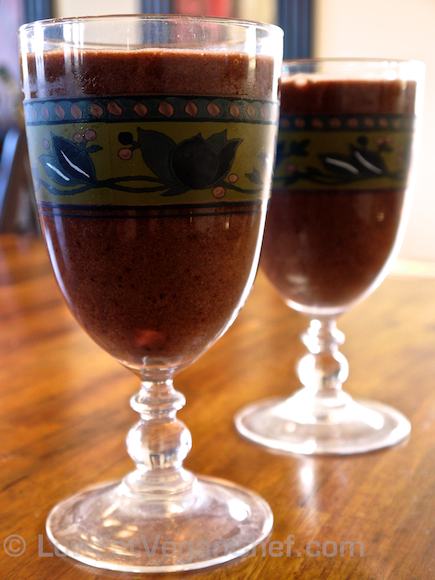
This smoothie below has greens in it, but you would never know.  It just looks like a red smoothie and is pretty “normal” looking.

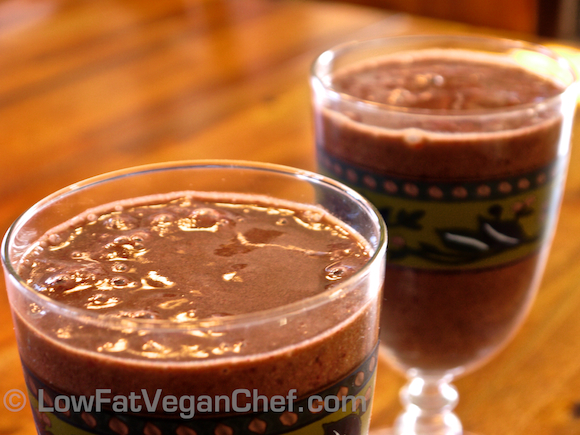
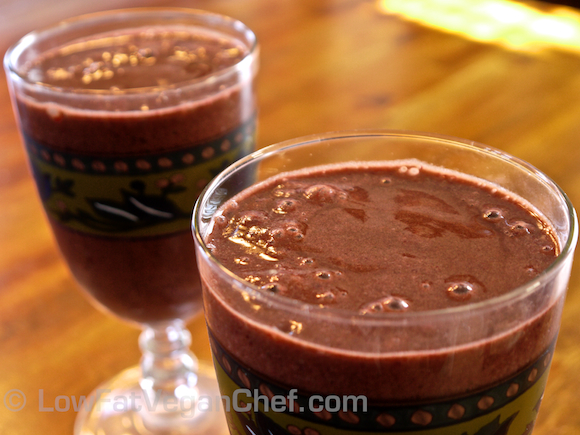
If you add something like black kale and some berries to your smoothie it may end up looking more brown. For yourself you may not mind but for newbies to smoothies prettier always gives a more positive reaction to it.

I used to get teased constantly at my old job for bringing in “monster green concoctions” for breakfast every day and my boss would stop the meetings and ask me what I was drinking it freaked him out so much.  As soon as I started putting blueberries in it, people stopped caring! lol

80/10/10 Banana Cherry Pineapple Green Smoothie

80/10/10: Banana Cherry Pineapple Green Smoothie

Serves 1-2

Approx: 506 calories

Ingredients:

3 ripe bananas
2 cups packed baby spinach
1 cup frozen or fresh pineapple
1 cup frozen black cherries (or fresh) (or berries of choice)
1/2-1 cup filtered water (optional to thin or blend)

Directions:

Place ingredients into Vitamix in order listed and blend until smooth. If you have a cheaper blender you may want to add the water and bananas first and blend and then add the other ingredients and blend.

Additional Tips:

I get my black frozen cherries from Costco in Canada. I don’t know if they just started carrying them, but I was pleased as cherry and pineapple go together so well and is one of my favourite combos. If you’re in the USA I know that H-E-B (in Texas) and Dole have black cherries in the frozen fruit department of many grocery stores. You can also use frozen raspberries if you don’t have cherries. It just adds more seeds to the smoothie, so get out your dental floss!


What do you think of this recipe? Did you learn something about green smoothie making today?


Filed Under: 80/10/10, Articles, How To, Raw Breakfast, Raw Smoothies, Raw Vegan Recipes Tagged With: 80/10/10, banana, cherry, pineapple, raw, Raw Food Tips, smoothie

How To Make Dr. Fuhrman’s Eat To Live “Anti Cancer Soup” With Step By Step Photos

February 27, 2012 by Veronica Grace

Fb-Button

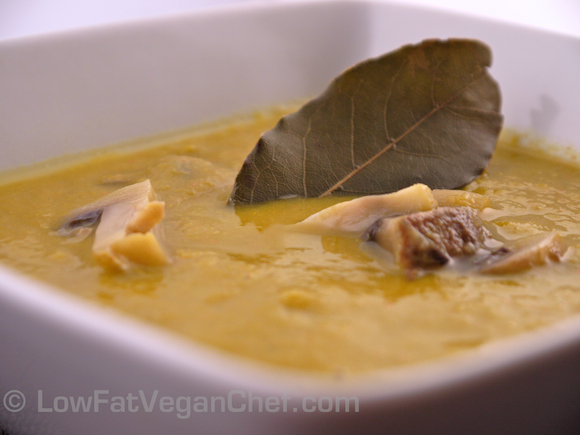
Dr. Joel Fuhrman's Eat To Live Anti Cancer Soup

FTC Notice: This post contains affiliate links that go towards supporting the blog.

Holy mackerel this “Anti Cancer Soup” recipe makes a ton of soup! You can eat for a whole week off of this one recipe. I decided to try and document Dr. Fuhrman’s famous “Anti Cancer Soup” as it seemed like a fairly intensive recipe and I took it as a challenge to make a soup an entirely new way. For this recipe you’re going to need a good juicer that can handle juicing a lot of carrots and celery. This is the one I use, it’s a medium priced Breville juicer and it does the job.

I met Dr. Joel Fuhrman last February (2011) at Dr. John McDougall’s 3 Day Advanced Study Weekend and he mentioned in his lecture about chopping onions, cooking them and then blending them into the soup for some additional nutritional benefits on how everything combines together. I do NOT remember the exact processes going on, he had a very scientific explanation for this. I will have to watch the recording of the lecture again to get it straight. But all you need to know is, this soup is HEALTHY for you and highly recommended by Dr. Fuhrman as a nutrient dense soup that’s crammed with veggies. Might I just add that Dr. Fuhrman is totally ripped and in amazing shape and his “Disease Proof” diet is definitely working well for him. I saw some pictures of his wife and daughters and they are all very slim and quite beautiful too. He should be very proud to have such a happy and healthy family setting such a great example on a oil free plant based diet.

I just finished up a low fat vegan recipe book of my own called Comfort Soups To Keep You Warm, so I’ve made quite a bit of soup these past few months. I have actually nicknamed myself the “Vegan Soup Queen”  I’ve made so much soup lol! Dr. Joel Fuhrman’s “Anti Cancer Soup” recipe comes from his book Eat To Live (which is actually less than $10 on Amazon right now so check it out.) One thing about this anti cancer soup is that you can definitely tell it was designed by a man without any need for great culinary skills. It is very simple in presentation as everything is pretty much just blended together, and it’s something that you start cooking while you continue to prep the rest of your veggies as you go. So this seems very practical, albeit because of the amount of soup this recipe makes it can be a bit of work. What I like most about Dr. Fuhrman’s recipes is that they are oil free and really healthy, so this is right up my alley and I am happy to be able to make his recipes without any major modifications.


Dr. Fuhrman recommends that you make a big pot of this once and then eat it for the rest of the week, or freeze portions of it. It does take much more time and effort than my other soup recipes, but it makes a ton of soup and if you’re only doing this once or twice a month on a Sunday afternoon it’s no big deal. Better yet, get a helper to help you prep the veggies and then you can relax in between cooking steps! I really wish I had had a helper… haha Since his “Anti Cancer Soup” is such a big recipe with so many ingredients I wanted to estimate the cost of making it. Now just FYI this is approximately what I paid in Canada at a discount grocery store in 2012, and none of these items were bought in bulk. If you live in the USA and/or buy in bulk it will probably be a bit cheaper. But if you buy all organic produce it will definitely cost more.

Split peas ~$0.50
Raw cashews ~$5
Onions ~$5
Zucchini ~$4
Carrots ~$3
Celery $2.60
Leeks $3.49
Mushrooms $4.50

Total Cost: ~ $28.09

Divided by 12 servings:

$2.34 a serving

Dr. Joel Fuhrman's Eat To Live Anti Cancer Soup

So when you divide the “Anti Cancer Soup” costs out by the number servings (and you will get at least 12 servings) it’s not too expensive. It’s a little less than the price of an organic canned soup and definitely less than buying lunch somewhere else. If I had to describe the taste of this anti cancer soup I would say that it mostly tastes like mild split peas with leeks and mushrooms. It’s not very strong tasting or in any way offensive. You can definitely eat it as is, or add some more herbs or spices to it. When I make soup I like to add things like thyme, bay leaves or other seasonings. I like really flavourful soups.


Now on to my step by step (with photos!) instructions on how to make this soup. My soup recipes have way less directions btw, I just wanted this to be clear as even I was scratching my head at all the steps when I made it the first time. It also looked very strange while cooking, so I didn’t want anyone else to be afraid or discouraged and not know what to expect! I took over 100 pictures of this recipe preparation! I hope you enjoy it. 🙂 Dr. Fuhrman also likes to add a cruciferous leafy green to his soup now too. So you can add a bunch or two of kale (stems removed) or collard greens if you desire.

Dr. Fuhrman’s Anti Cancer Soup (From Eat To Live) With A Low Fat Vegan Chef Twist

Total Time: 1 h 30 min

Serves 12

Ingredients:

1 cup dried split peas (green)

4 cups/1 L filtered water

4 large onions

4 large zucchinis or 8 small

3 medium leeks

leafy greens, broccoli or cauliflower (optional, about 2 bunches)

5 lbs./2.26 kg carrots

2 bunches of celery

1 cup raw cashews (un-roasted, unsalted)

1 lb/454 g mushrooms

2 tsp granulated garlic powder (his recipe has 2 tbsp VegiZest)

2 bay leaves (my addition)

1- 1 1/2 tsp Herbamare or salt (my addition)

Directions:

How To Make Dr. Joel Fuhrman's Eat To Live Anti Cancer Split Pea Mushroom Soup

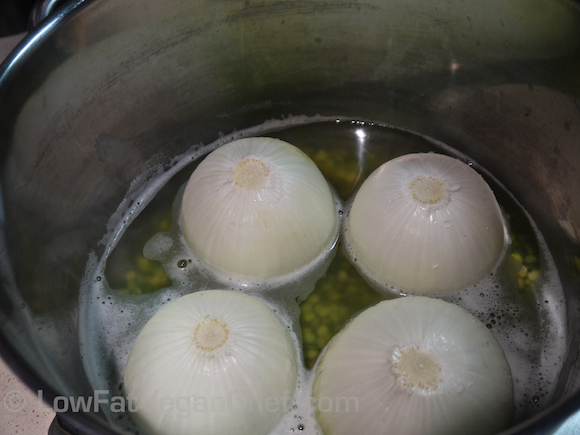
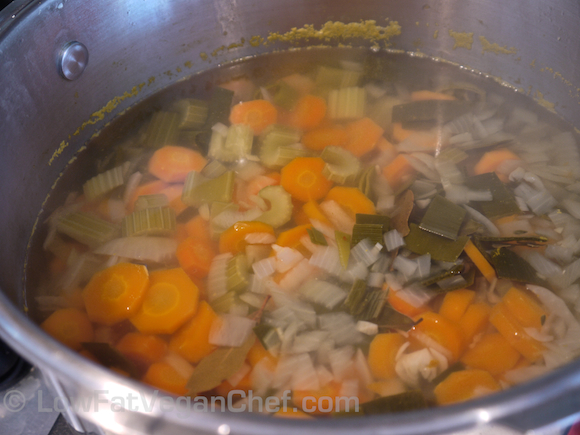
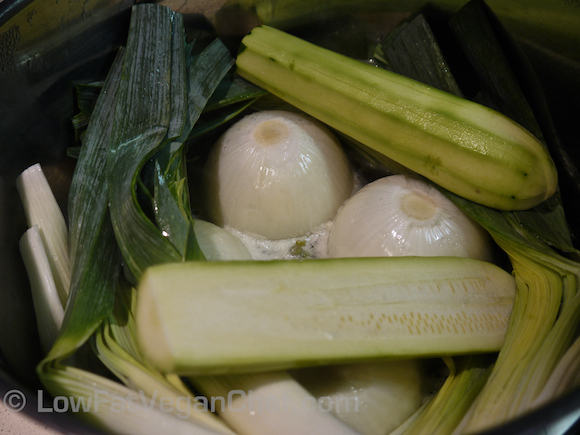
In a large 6 qt soup pot add 4 cups/1 L of water and the split peas and bring to a boil. Slice off the tops of the onions, shave off the roots and peel the outer skins and place them into the pot whole. (Update: Fuhrman now recommends cutting the onions up so their enzymes can react while cooking as this increases their nutrition.) Cover with a lid to start the steaming process. Once at a boil reduce  heat to medium low.


How To Make Dr. Joel Fuhrman's Eat To Live Anti Cancer Soup

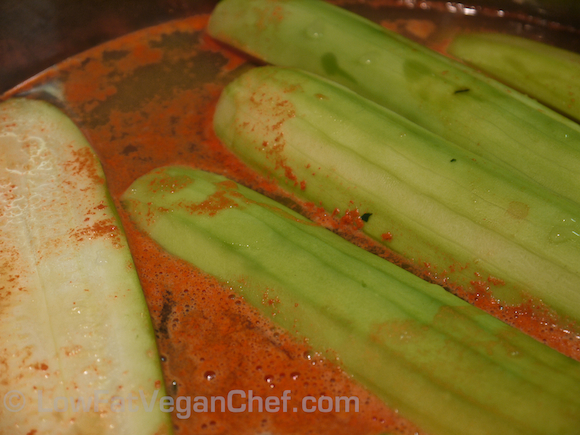
Peel the zuchinnis, and place in the pot uncut. (If they are large cut them in half lengthwise). Cut the bottom roots off the leeks and slice them up the side so each leaf can be thoroughly washed, because leeks have lots of dirt hidden inside. (This is a good tip, I found a little worm in one of my leaves. Gross.) Cut off the top inch of the leeks and discard. Then place the entire leek (leaves uncut) into the pot and cover again.

How To Make Dr. Joel Fuhrman's Eat To Live Anti Cancer Split Pea Mushroom Soup Peel and Juice Carrots

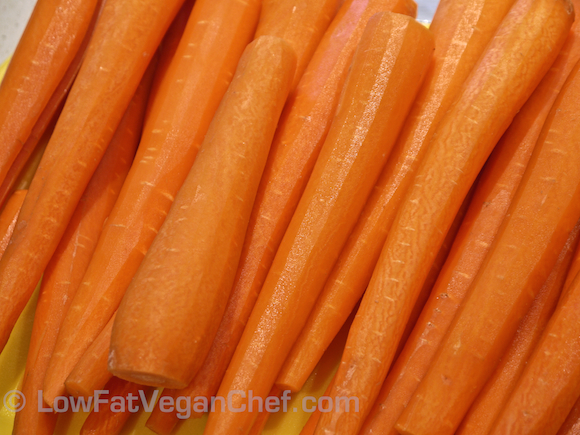
Oh, so THAT’S what 5 pounds of carrots look like…

How To Make Dr. Joel Fuhrman's Eat To Live Anti Cancer Split Pea Mushroom Soup Peeled Carrots

Peel the carrots. (If they are organic, this is optional) Whew that was hard…


How To Make Dr. Joel Fuhrman's Eat To Live Anti Cancer Split Pea Mushroom Soup Carrot Juice

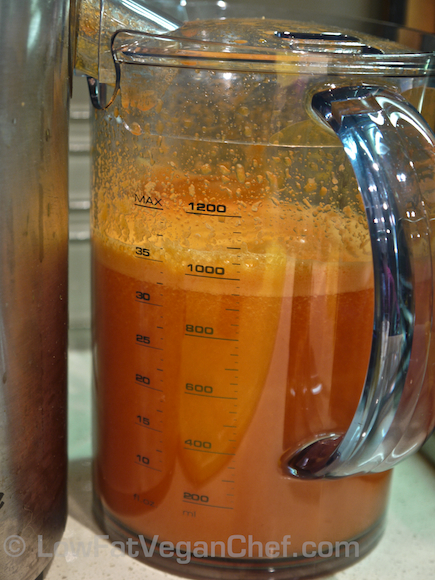
That’s a lot of juice! About 32 ounces worth

Juice the carrots in a juicer.

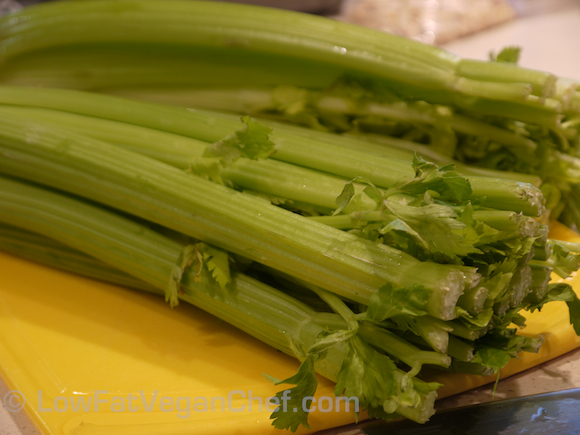
How To Make Dr. Joel Fuhrman's Eat To Live Anti Cancer Split Pea Mushroom Soup Celery

Wash the celery and cut off the tops and bottoms.

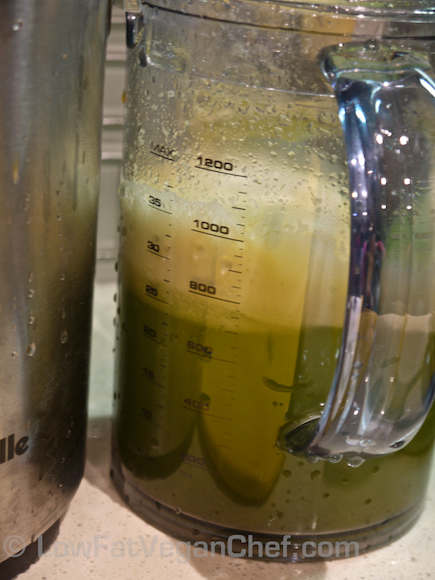
How To Make Dr. Joel Fuhrman's Eat To Live Anti Cancer Split Pea Mushroom Soup Celery Juice

Makes about 22-23 ounces

Juice celery in a juicer.


How To Make Dr. Joel Fuhrman's Eat To Live Anti Cancer Split Pea Mushroom Soup

(Ok now this is starting to look like witches’ brew….)

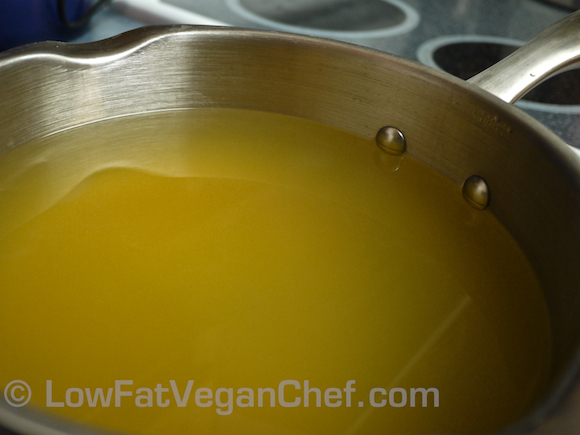
Add the juices to the pot.

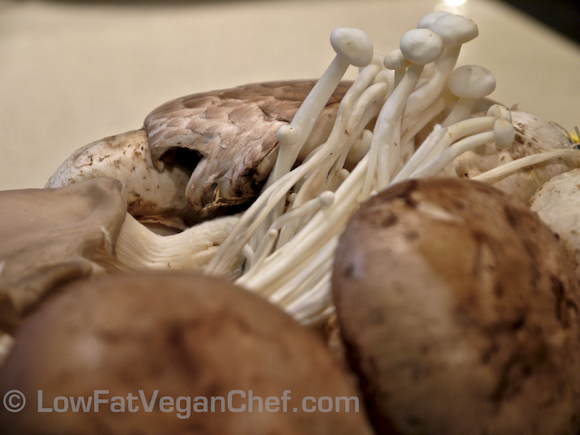
How To Make Dr. Joel Fuhrman's Eat To Live Anti Cancer Split Pea Mushroom Soup Mixed Mushrooms
I got a 1 lb pack of mixed mushrooms for variety. Really it was just a few different mushrooms on top of a layer of dirty white mushrooms… Marketing can be deceptive!
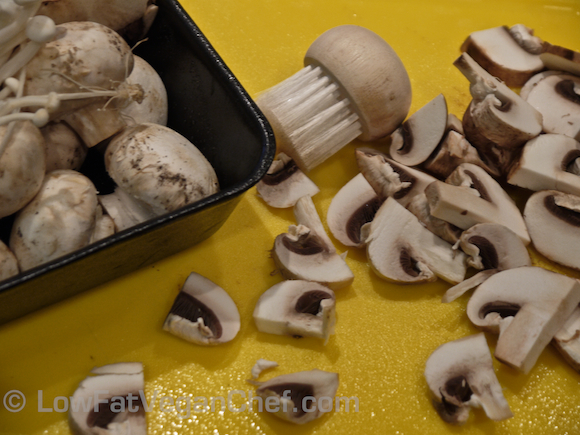
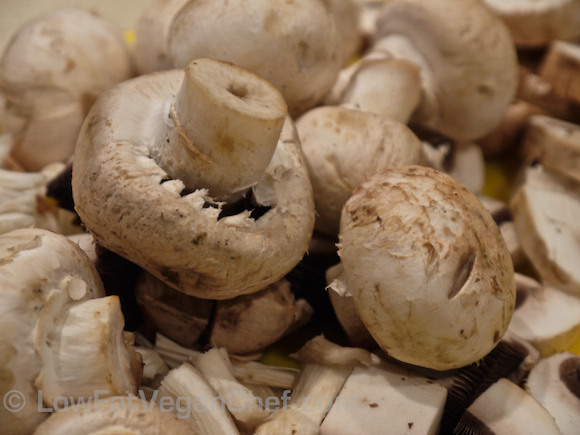
How To Make Dr. Joel Fuhrman's Eat To Live Anti Cancer Split Pea Mushroom Soup Cleaning And Chopping Mushrooms

While the soup is simmering, clean the mushrooms with a mushroom brush. Cut and slice up the mushrooms. By the time you get to this stage, the zucchini, leeks, onions should be soft. If they aren’t just keep cleaning and chopping the mushrooms.

How To Make Dr. Joel Fuhrman's Eat To Live Anti Cancer Split Pea Mushroom Soup Cleaned Mushrooms

Pretty mushrooms…

How To Make Dr. Joel Fuhrman's Eat To Live Anti Cancer Split Pea Mushroom Soup Blending Soup in Vitamix


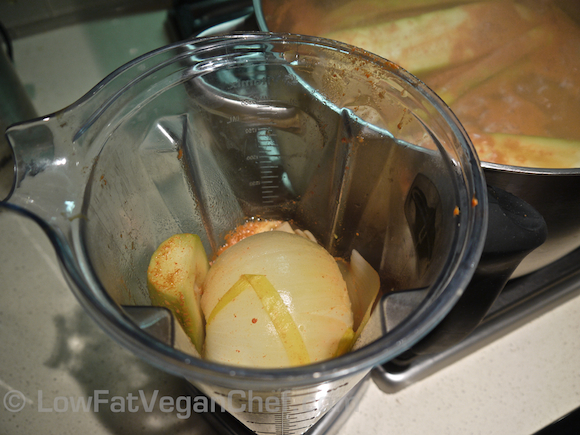
Ladle some of the liquid from the pot into a Vitamix or food processor. Use tongs to remove the soft onions, zucchini, and leeks. Be careful to leave the split peas or beans in the bottom of the pot.

How To Make Dr. Joel Fuhrman's Eat To Live Anti Cancer Split Pea Mushroom Soup Blending Soup In Vitamix

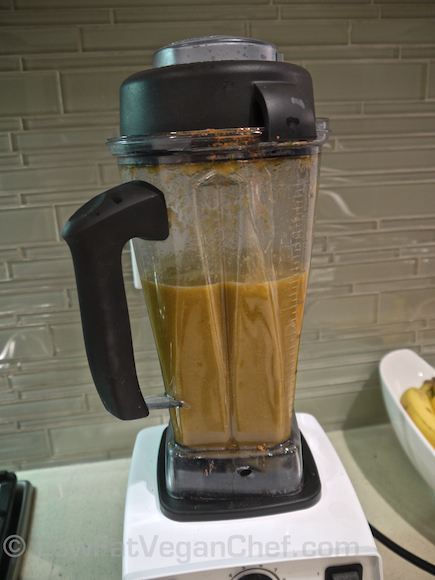
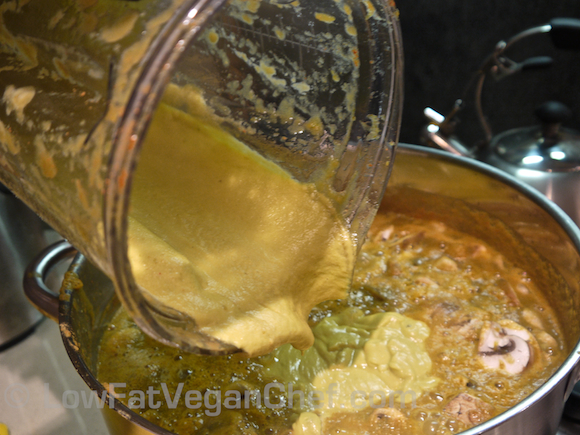
In a few separate batches, completely blend together the onions, zucchini, and leeks. Pour the blended mixture back into the pot.

How To Make Dr. Joel Fuhrman's Eat To Live Anti Cancer Split Pea Mushroom Soup Blending Soup In Vitamix

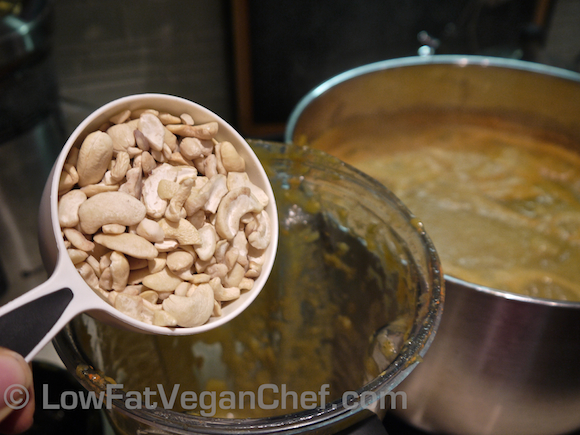
How To Make Dr. Joel Fuhrman's Eat To Live Anti Cancer Split Pea Mushroom Soup Adding Cashews To The Soup

Add a lot of liquid to blend the cashews, don’t make the same mistake I did or it will become thick like cashew butter.


Add more soup liquid (lots) and cashews to the mixture, and blend in.

How To Make Dr. Joel Fuhrman's Eat To Live Anti Cancer Split Pea Mushroom Soup Adding Cashews To The Soup

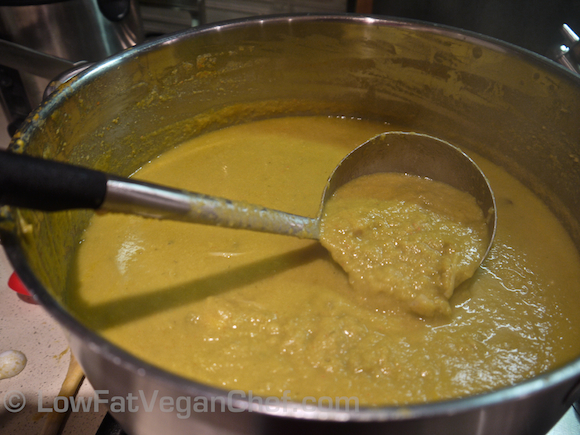
Return the blended, creamy mixture back to the pot.

How To Make Dr. Joel Fuhrman's Eat To Live Anti Cancer Split Pea Mushroom Soup Adding The Mushrooms

Add the sliced mushrooms and bay leaves. Simmer another 20-30 minutes until mushrooms are tender.

(This time I used to cleaned my kitchen, which now looked like a soup bomb went off in it! The funny part is, this is EXACTLY what Dr. Fuhrman and his wife do too. See how this recipe is obviously designed by a man? Very practical. haha)

How To Make Dr. Joel Fuhrman's Eat To Live Anti Cancer Split Pea Mushroom Soup Blended


Season to taste with granulated garlic and Herbamare or other salt free seasonings if desired.

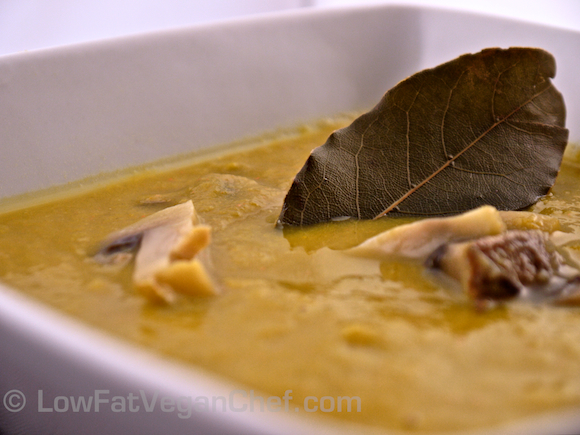
How To Make Dr. Joel Fuhrman's Eat To Live Anti Cancer Split Pea Mushroom Soup

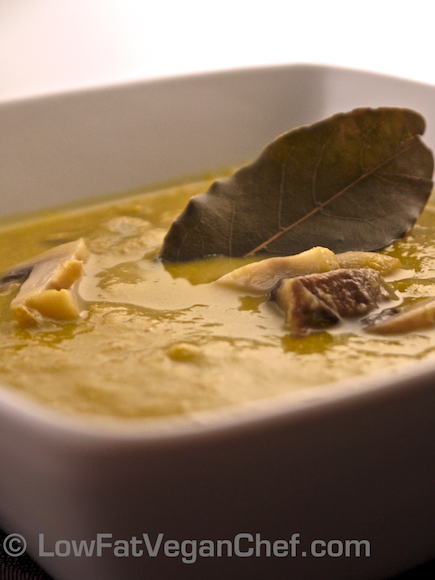
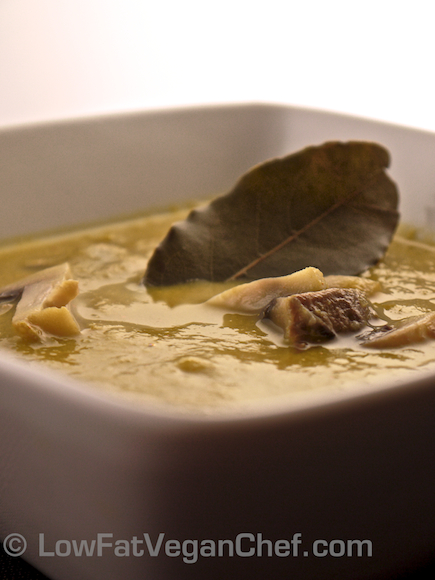
Remove bay leaves and serve. (Now that your kitchen is clean you can sit down, relax and enjoy!)

How To Make Dr. Joel Fuhrman's Eat To Live Anti Cancer Split Pea Mushroom Soup

If you LOVED this recipe you’ll love my new ebook Comfort Soups To Keep You Warm:

You WILL have lots of leftovers from Dr. Fuhrman’s “Anti Cancer Soup”. Save the rest in containers and use for lunches for the next week. Might I add that this was probably the hardest soup I’ve had to make look delicious in a photo. I tried really hard. It tastes better than it looks!

Nutritional Information: 12 Servings

Amount Per Serving: Calories 179.2 Total Fat 1.0 g Sat. Fat 0.2 g Poly Fat 0.5 g Mono Fat 0.1 g Cholesterol 0 g Sodium 593 mg Potassium 1,577.9 mg Carbs 40.0 g Fiber (unknown due to carrot and celery juice data unavailable) Sugars 12.7 g Protein 7.1 g


Filed Under: Eat To Live - Dr. Fuhrman Recipes, How To, One Pot Meals, Soups and Stews Tagged With: Carrots, celery, Eat To Live, Fuhrman, gluten-free, Leeks, mushrooms, soy-free, split-peas

Fat Free Vegan “Clean Out The Refrigerator Fuhrman Soup” or How To Make Homemade Soup From Scratch Easily

February 15, 2012 by Veronica Grace 27 Comments

Fb-Button

Low Fat Vegan Clean Out The Refrigerator Vegan Vegetable Soup Nutrient Dense Soup

FTC Notice: This post contains affiliate links that go towards supporting the blog.

This recipe is featured in my Comfort Soups To Keep You Warm recipe ebook along with 29 other AMAZING vegan soup recipes, vegetable stock recipes, and all the tips and tricks to making ANY kind of soup. It’s going to teach you basically to be a soup making expert and be able to cook delicious healthy meals at home, very easily from what you have around.

Somedays you just don’t know what to make for dinner, or only have odds and ends leftover from previous recipes. You look in your refrigerator and see a few carrots, an onion, some celery, some greens and maybe some mushrooms that have seen better days.


What do you do with it all?

You make homemade vegetable soup of course! This is what I do when I feel creatively drained or uninspired to make a new recipe from scratch.

This is also a great way to eat a “Nutrient Dense” or “Eat To Live” style vegan meal like Dr. Joel Fuhrman recommends. (Check out his books Super Immunity, or Eat To Live, if you already haven’t) Lots of low calorie, high antioxidant plant foods, gently cooked together are wonderful. In Feb 2012 I was at the McDougall 3-Day Advanced Study Weekend, and Dr. Fuhrman was telling us the benefits of eating just 1/2 an onion a day, about 1 tomato and just 1 mushroom and how nutritious these are to add to your diet regularly. He has an amazing wealth of knowledge, and I am definitely going to be making more nutrient dense, low calorie green vegetable based dishes from now on.

This soup is a great way to get more of these antioxidants and phytochemicals into your diet in a fairly easy no-fuss way. It’s also a great vegan cabbage soup recipe that is low calorie and packed with veggies.

It is also especially handy to keep some vegetable broth on hand (low sodium is always preferable) for just such an occasion, so you don’t have to make your own vegetable stock as well when you’re short on time. (When I do have time I like to make fresh vegetable stock every week and keep it in the fridge for daily sautéing and making soup with)


Making your own nutrient dense vegan homemade soup from scratch is quite easy. The hard work is only peeling and chopping your veggies. Basically use what you have and always start cooking the onions and the hardest vegetables first (so peel and prepare those first) and they can start cooking while you finish peeling/washing and slicing the other veggies.

It also helps to have some fresh herbs on hand. My top picks would be thyme, dill, basil, cilantro or parsley. These can easily be used up in soup recipes if you have any stray or wilting bits left, so don’t throw them away.

And as with making almost any homemade soup, I always throw in a few bay leaves. They really add a lot of flavour and are great for seasoning soup, vegetable stock or dried beans.


Basic Ingredients For Making Your Own Homemade Nutrient Dense Soup

  • Low sodium vegetable broth (water and salt is not a good enough substitute for this, low salt bouillon and water will do in a pinch)
  • Any vegetables such as carrots, celery, mushrooms, potatoes, yams/sweet potatoes, golden beets, turnips, broccoli, cabbage, spinach, kale, swiss chard, peas, corn, etc
  • Beans or grains (if desired) white beans, lentils, chickpeas, pinto beans, black beans, barley, rice, pasta, etc (make sure beans are pre cooked, or canned before adding)
  • Fresh herbs/dried herbs like thyme, bay leaf, dill, basil, rosemary, cilantro, parsley, Italian herb seasonings, Herbs De Provence etc
  • Base flavor enhancers like canned tomatoes, tomato paste, coconut milk or almond milk (depending whether you want a tomato-ey or creamy soup) *This is optional
  • Seasonings like salt, pepper, lemon juice, lime juice, sweetener (to balance acidity from tomatoes or lemon if desired) cumin, chili pepper, cayenne, smoked paprika, etc

If you add some things from each category (especially ones that you personally like…) and can season to taste and balance out blandness by kicking it up with some lemon, salt and a little sweetener if desired you will have a great soup on your hands.

Also a trick I have for bringing out sweetness to tomato based soups is to add golden beets to it. Golden beets can be found at your health food store, and some grocery stores or farmers markets. They are becoming more popular nowadays. They look almost like small yellowish turnips, but they are beets! (For one thing they don’t turn your hand red and make a mess) They contain natural sugars that leak out into the vegetable broth, so it balances out the harsh acidity of tomato based vegetable soups and goes really well with beans or barley as well. Just make sure you cut the pieces into little cubes, and start cooking them right away with the onions in broth. They take the longest to cook, so you don’t want them to be crunchy while the rest of your vegetables are soft.


Additional Pointers For Cooking Homemade Soup

If you want a fast soup, cut all your veggies (especially potatoes and beets) into smaller cubes so they cook faster. Always add these first to the pot along with carrots and celery. Fresh hard herbs like thyme or rosemary need to go in at the beginning of the soup. Dried or tender herbs like basil, cilantro or parsley can go in near the end of cooking to retain their flavour. Quick cooking veggies like greens, broccoli, asparagus or cauliflower should be added 3-5 minutes before your soup is done so they don’t fall apart and go mushy. Canned corn is very forgiving and can go in at the beginning of cooking and will hold it’s firmness. Canned beans should go in the last 10 minutes or so of cooking as they are fairly soft already and you don’t want them to be mushy and overcooked. Always salt and pepper your soup at the end. Don’t just keep adding salt every time you stir it. When some of the water dissipates you can be left with an over salted or over spiced soup. Always reserve taste testing for the end when everything’s cooked and you can doctor up the flavour from there. Start with a little salt, pepper, spice, or sweetener and keep tasting and adding until you get it right to your liking. Always use low sodium, sodium free and sugar free canned foods so you can control the salt and sugar content of the soup. Read labels! *Note about adding pastas to soup. I really prefer cooking most pastas separately and then putting it into serving bowls and pouring the soup over it. This makes your soup nice and clear and pretty and reduces the risk of over cooking it. If you do cook the pasta in the soup, it’s going to use up some of the water and make it murky with the starch. Check the cooking time of your pasta and add it part way through the soup when the vegetables are starting to be almost soft enough.


And now my made up on the spot “throw it all in a pot” and cook it soup. This is a great way to get more greens into your diet or use up any extras that you don’t have a recipe planned for. This soup is packed with green vegetables, but is light and refreshing. We ate this by itself and basically ate the whole pot because it’s very low in calories. This is a great first course or “weight-loss soup” as well. Fill up on healthy vegetables!

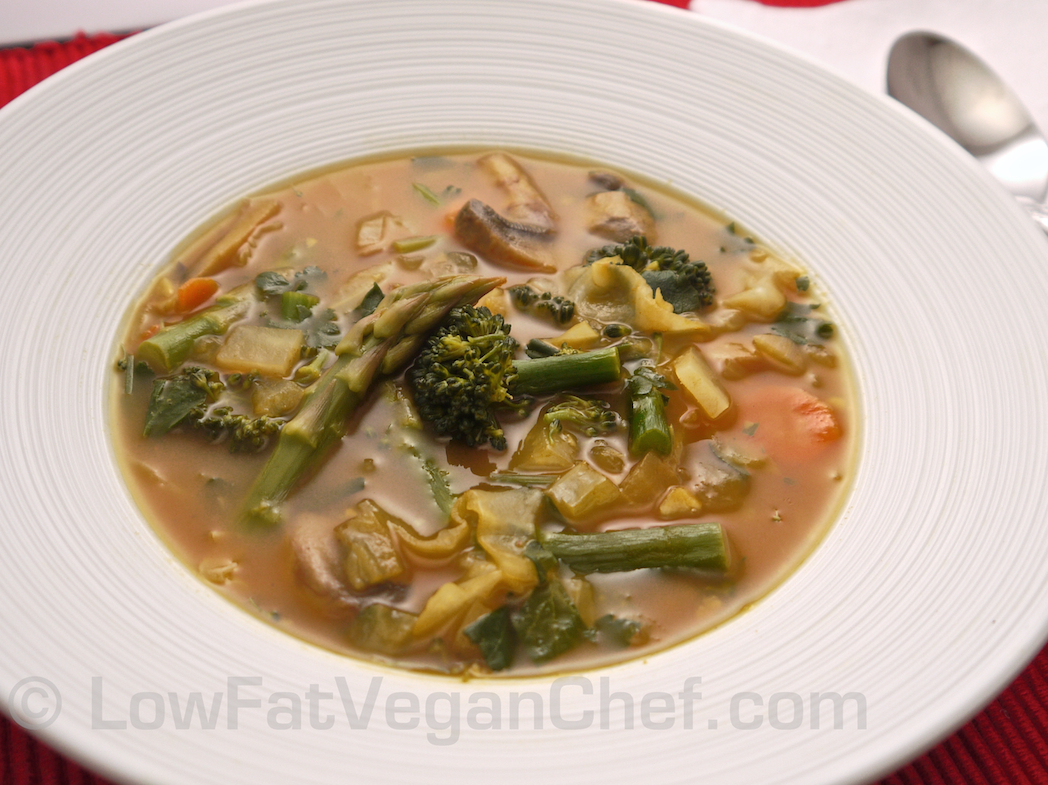
Low Fat Vegan Clean Out The Refrigerator Vegan Vegetable Soup Nutrient Dense Soup

“Clean Out The Refrigerator” Homemade Vegetable Soup

Featured in Comfort Soups To Keep You Warm by Veronica Grace

Serves 6

Ingredients:

2 litres/quarts vegetable broth, (low sodium or homemade)
1 large onion, diced
4-6 cloves of garlic, minced
1-2 bay leaves
1 tbsp fresh thyme, or 1 tsp dried (or favourite herbs, like dill, basil, etc)
2 carrots, sliced
2 stalks of celery, sliced
1 medium golden beet or turnip, diced small (smaller is better)
1-2 cups of sliced mushrooms
6-8 asparagus spears, ends trimmed and cut into thirds (or other green vegetable of choice like zucchini)
2 cups broccoli or broccolini florets
2 cups sliced green cabbage, or other greens like kale or Swiss chard
handful of parsley, chopped
juice of half a lemon
Herbamare or sea salt and fresh ground pepper to taste


Directions:

1. Add 1 cup vegetable broth to a large soup pot and turn onto medium heat. Add bay leaves, thyme, onions and beets and sauté for 5-6 minutes. Add more broth if necessary to beets until they are almost covered.  (While this is cooking you can continue peeling/slicing your other veggies)

2. Add the mushrooms, garlic, carrots, celery, cabbage and the rest of one carton of vegetable broth. Stir and let it keep cooking over medium-medium high heat for about 10-15 minutes. Add more vegetable broth if needed from the other carton. You want your vegetables to be almost done before adding the broccoli and asparagus. Check on the beets, if they are still too hard keep cooking until they are almost done.

3. Add the remaining vegetable broth and bring it up to a boil. When it’s boiling, turn it back down to medium-medium high and add the asparagus, broccoli and parsley (and any spinach if using). Cook for 2-4 minutes (depending on the size you cut them) and test the broccoli and asparagus for doneness. You don’t want them too wilted or mushy. When done immediately take off heat.

4. Add lemon juice, salt and pepper and season to taste. Adjust seasonings if desired.

5. Serve!


What do you think of this “Eat To Live” style recipe? Have you ever made homemade soup before? What do you do with your leftover vegetables?


Filed Under: *My Recipe Books, Cooked Vegan Recipes, Eat To Live - Dr. Fuhrman Recipes, How To, One Pot Meals, Soups and Stews Tagged With: asparagus, broccoli, cabbage, Carrots, celery, Eat To Live, fat-free, gluten-free, mushrooms, nut-free, soup

How To Cook Steel Cut Oats (Irish Oats) In a Rice Cooker Or On The Stove

January 29, 2012 by Veronica Grace 52 Comments

Fb-Button

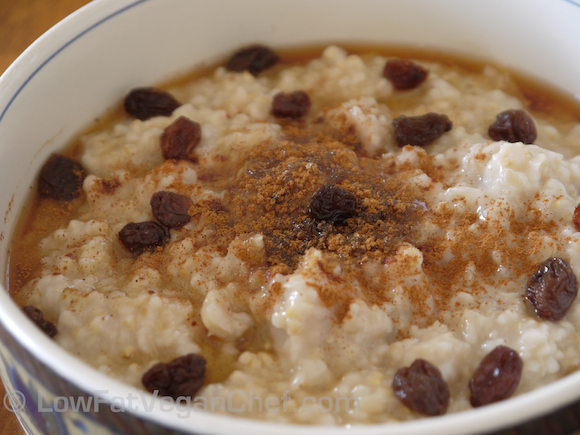
How To Make Steel Cut Oats In A Rice Cooker Or On The Stove with cinnamon, brown sugar and raisins

What Are Steel Cut Oats/Irish Oats?

Steel cut oats are whole grain oat groats (the inner portion of the oat kernel) which have been cut into only two or three pieces horizontally. They are golden in color and resemble mini rice particles and are cylinder-like.

LivingPrepared has a good picture of rolled oats vs steel cut oats. Rolled oats are on the left, steel cut are on the right.

How do steel cut oats differ from rolled oats (old fashioned oats)?

Rolled oats a.k.a. old fashioned oats, are flake oats that have been steamed, rolled, re-steamed and toasted. Due to all of this additional processing they have lost some of their natural taste, nutrition and texture. They are just a more refined form. Most people get confused and think rolled oats are unprocessed and naturally come this way, and that instant oatmeal is the only oat that is processed. This is not quite correct. Rolled oats are still pretty processed and have undergone many treatments.

What is oatmeal or instant oatmeal then?

Instant oats are very processed compared to steel cut oats, they are pre cooked, dried and partially powdered with some flakes left. All you do is add hot water since they are already cooked and broken down. They usually come in packets with sugar and seasonings already in them.

This is why some people choose to eat only steel cut oats, or Irish oats as they are like the whole grain version of oats and the least processed.

Oatmeal Helps Lowers LDL (Bad) Cholesterol

Oatmeal is full of soluble fiber, which we know lowers LDL levels. Experts aren’t exactly sure how, but they have some ideas. When you digest fiber, it becomes gooey. Researchers think that when it’s in your intestines, it sticks to cholesterol and stops it from being absorbed. So instead of getting that cholesterol into your system — and your arteries — you simply get rid of it as waste.

In a study published in the American Journal of Clinical Nutrition, researchers tested cholesterol-lowering drugs against cholesterol-lowering foods in a group of thirty-four adults with high cholesterol. Oat products were among the chosen foods. The results were striking. The diet lowered cholesterol levels about as well as cholesterol drugs. WebMD

Even if you’re not eating cholesterol containing foods (all animal products contain cholesterol because only animals produce cholesterol, not plants) you can still lower your LDL (bad) cholesterol by eating oatmeal, which is helpful for some who still have high cholesterol on a vegan diet. The main reason some vegan diets don’t completely save you from having high cholesterol, is because of the amount of rich plant fats we tend to eat when compensating for a lack of meat and cheese. Salad dressing oils, battered or fried vegetables, fried snacks, vegan pastries and cakes, cookies, crackers etc. When you eat a lot of fatty foods this raises the amount of cholesterol you produce yourself, which is not good. So switching a high fat vegan meal to a low fat meal of oatmeal can make a big difference in your cholesterol numbers and health.

How much oatmeal do I need to cook for one person?

Steel cut oats can expand up to 4 times their dry size. For one person you can make about 1/4 cup for a single serving. When I’m making steel cut oats for my family, I usually make at least 1-1 1/2 cups because then there’s enough for everyone to have a satisfying breakfast. You can also save any leftovers and store it in the fridge for a quick breakfast the next day.

How To Cook Steel Cut Oats (Irish Oats) In a Rice Cooker

(For stovetop or microwave directions scroll down to the bottom)

To make your oats, you have to decide how thin you like them. I personally like mine a little thick, like in the picture, as opposed to a thin porridge, so I use a ratio of 3 parts water to 1 part oats. You can use a 4:1 ratio of water to oats if you like it thinner.

I have used several different types of rice cookers. At home I have a Zojirushi 5 1/2 cup rice cooker which has a lot of functions like white rice, brown rice, mixed rice, porridge and even a cake setting! It works awesome and I use the porridge setting for steel cut oats on it. What’s great about the Zojirushi is it has an internal programmable clock and you can tell it EXACTLY what time you want your rice/grain/porridge ready. So if you want to eat breakfast at 7 am, you set it for 7 am (in military time 07:00) and it will be ready to go at that time. Just do the process below, put the oats and water in and press start the night before and your breakfast will be hot and ready with no hassle the next day. If you’re a single or a couple they have a smaller version the Zojirushi 3 cup rice cooker as well.

I’ve also used this Hamilton Beach Digital Deluxe Rice Cooker that is great for a family on a budget, it has a white rice and a whole grain setting. I use the whole grain setting on this rice cooker for steel cut oats. It works a little differently, it has a delay timer. So what I do is set it so that it starts while I’m sleeping. If I go to bed at 11 pm and want to eat at 7 am, I would set the delay timer for about 5-6 hour delay. 5 hours for a large portion, 6 hours for a smaller portion (single size) and then it will start cooking when the delay timer hits zero and your oats will be ready for breakfast.

(Please do NOT put anything like dairy or animal products that should be refrigerated into a rice cooker overnight as this is a health risk. Only use water and dry grains when using a delay or programmed timer. So don’t add milk or cream to your oats and let it sit out all night, you can stir it in in the next morning before eating)

This is great for when you don’t have time to cook steel cut oats on the stove and want a quick breakfast.

Step 1: Measure out 1 cup of steel cut/Irish oats (or your desired amount). Pour it into a mesh strainer. Give it a rinse to clear any dust or debris. Pour it into the rice cooker.

Step 2: Measure out 3-4 cups of water (or your desired amount) and pour it into the rice cooker.

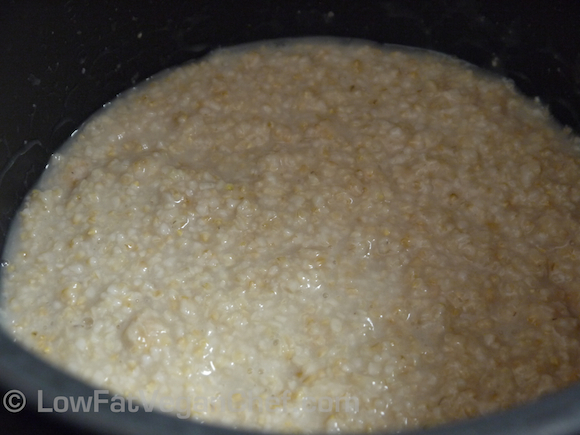
Step 3: Press the porridge/whole grain/brown rice setting (whichever setting your rice cooker has) and let it cook. It’s going to take a while to cook, similar to cooking brown rice. It should take about an hour to hour and a half depending how much you put in.

How To Make Steel Cut Oats In A Rice Cooker Or On The Stove with cinnamon, brown sugar and raisins

Step 4: Your steel cut oats are done and ready to season. You can add more water to thin if desired, add almond milk, maple syrup, brown sugar, cinnamon, raisins, sliced bananas, granola etc. Whatever you’d like to dress it up. This way you can control the amount of sugar in your oatmeal instead of eating the prepackaged instant oatmeal.

Step 5: Serve!

How To Make Steel Cut Oats In A Rice Cooker Or On The Stove with cinnamon, brown sugar and raisins

How To Cook Steel Cut Oats (Irish Oats) On The Stove:

Add your 1 cup of oats to 3-4 cups of water to a large pot and bring to a low boil over medium high heat. When it’s boiling, reduce the heat to low and simmer for 20 minutes and stir every few minutes to prevent sticking. Season as desired and serve.

Time saving tip: Boil 4 cups of water the night before and add 1 cup of dry steel cut oats. Stir and let it soak over night. In the morning put it into a pot and cook over low heat for 9-12 minutes until the oats are tender. Season as desired and serve. (If you use this method, disregard the method above)

How To Cook Steel Cut Oats (Irish Oats) In a Microwave:

I have not tried this method personally, but it should be really easy. Place 1/2 cup of steel cut oats into a large (at least) 8 cup microwave safe bowl (not metal) and pour 2 cups of water into it. Make sure you use a large bowl to prevent it from boiling over in the microwave. Microwave on high for 5 minutes. Remove and stir and microwave on high for another 5 minutes. (Microwave times might vary depending on strength) Season as desired and serve.

What if I don’t have time to make steel cut oats every day?

The solution is pretty easy, just make a big batch and save the leftovers in individual portions in the fridge. If it’s for one person, multiply your recipe by 5 so you have enough for each day of the week. So you might use 1 1/4 cups to 2 cups of dry steel cut oats, depending if you’re a woman or a really athletic man. And then you cook it with 3-4 times the amount of water. Season it and then separate into containers. Then all you have to do is reheat it in the microwave the next day and add any additional water or non-dairy milk to thin it out, stir and eat. It’s a great time saver if you want to eat more whole foods, without having to rely just on instant oatmeal.

What do you think of this recipe? Have you made steel cut oats before? Are you going to try now?

Filed Under: Breakfast, Eat To Live - Dr. Fuhrman Recipes, How To Tagged With: easy, fat-free, gluten-free, nut-free, oats, soy-free

How To Make Raw Vegan Veggie Stuffed Collard Wraps

January 24, 2012 by Veronica Grace 21 Comments

Fb-Button
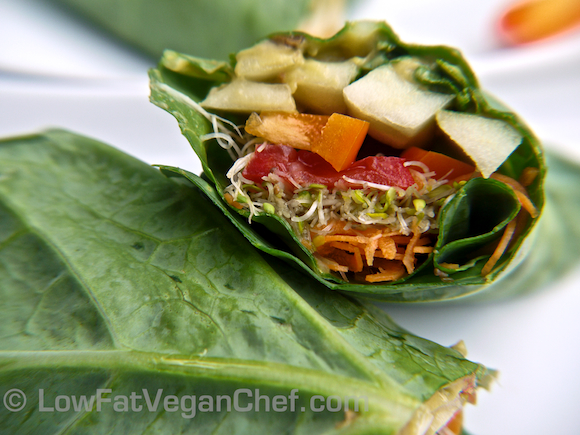
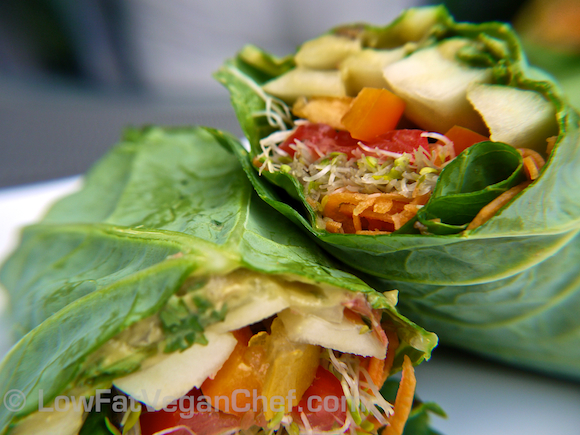
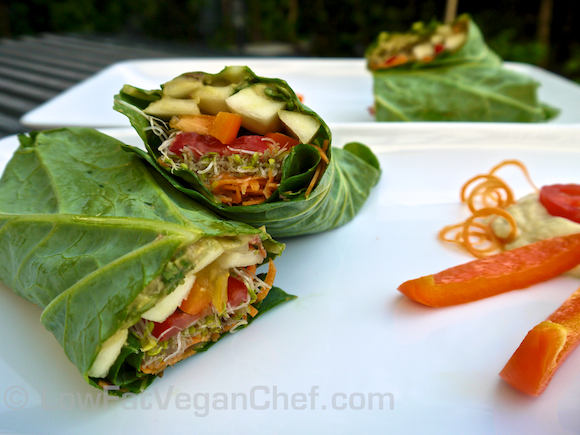
How To Make Raw Vegan Veggie Collard Wrap Sandwich

Raw Collard Wraps With Veggies, Sprouts and Guacamole

Are you looking for a quick and healthy wrap that’s maybe low in calories and more whole foods based? Or maybe you’re looking for a gluten or wheat free sandwich option. Well check out my raw veggie collard wraps!

So… I totally forgot to add these delicious collard wraps to my recipe program Savory Raw Dinner Recipes because they were so easy to make I did not write the recipe down! LOL. When I compiled the recipe book I did not have it on my computer and I forgot about it. So I’m posting it here for you instead. These raw collard wraps are really easy to make if you have access to large size flat collard green leaves and are really impressive to non raw foodies.

If you haven’t checked out Savory Raw Dinner Recipes, I highly recommend you do. I created the recipes and did all the photography myself. These are possibly the sexiest lower fat gourmet recipes you’ve ever seen. Even if you just enjoy some healthy food porn photos, you should check it out!

If you live in the south you can find collard greens at most grocery stores or Walmart, but if you live in the north or in Canada you’ll have to go to Whole Foods or your local community health food store.

In the South it’s about 88 cents (USD) for a bunch of collards. In Canada, it costs us about $2.99 (CAD) for a large bunch. Overall, it’s a pretty cheap wrapper to make a raw burrito or sandwich, just make sure you select a bunch of collards that have lots of large flat leaves, not bent, crushed or small leaves as you’ll more likely end up having to make tiny raw vegan tacos instead because you can’t wrap the collards like a burrito.

If you DON’T have collard greens, it won’t really turn out the same. The key to this wrap is the collard green’s very large, strong and pliable leaf. You can try using other greens, but what you’ll get instead is more of an open face sandwich/taco/boat that you sprinkle toppings in and eat kind of like a hot dog! Probably tastes the same, but will look different. You can try both style of raw wrap.

This is what a collard leaf looks like whole. You will see it’s flat and not curly like kale.

How To Make Raw Vegan Veggie Collard Wrap Sandwich

Raw Collard Wraps With Veggies, Sprouts and Guacamole


How To Make Raw Vegan Collard Wraps

Serves 2

For this recipe you’re going to need:

2 large collard green leaves, washed
1/2 ripe avocado (should give to your thumb when pressed)
julienned or spiralized carrot and/or beets
julienned cucumber
julienned pepper
julienned zucchini
A few sprouts (If you have, I used alfalfa, you can use sunflower, pea shoots etc)
Seasonings if desired: lime/lemon, salt, pepper, olives

Tools:

A sharp knife
Flat surface

Step 1: Lay your collard leaf out flat on a cutting board stem side facing UP. Next take your sharp knife (it needs to be sharp, and not a serrated one, I cut myself once sawing into my finger) and angle it down and into the stem of the leaf. Shave the stem from the leaf horizontally and away from you. You want to do this so you can roll and fold your collard leaf without it cracking and splitting. Keep shaving down the stem a bit at a time, until it is flush with the leaf and then cut the edge off the stem end so it is straight at the bottom. Test your collard leaf now to see if it will roll easily into a small burrito. If it does, you’ve got your collard stem thin enough. Once you do this once, you’ll understand what I’m talking about.

Step 2: Spread 1/4 of a ripe avocado (half of your 1/2 avocado) onto you collard leaf leaving an inch or two from the bottom end of the stem. Spread it in the middle area only, not all the way out to the sides and top. Season if desired over the avocado for flavour.

Step 3: Lay your veggies and sprouts nicely in the bottom portion to middle of your collard leaf, still leaving and inch or two at the bottom part of the stem. Keep everything in the middle and far away from the top and sides, just like you would fill a burrito.

Step 4: Roll the bottom stem end of your collard leaf up and away from you and make a full roll. Tuck in the sides of the leaf and continue rolling and tucking in as you go. Keep your roll tight so when you cut it your filling doesn’t fall out.

Step 5: Hold your wrap tightly and then carefully slice it in half. If desired you can skewer it with a toothpick to hold it together and set it on a plate.

Step 6: Repeat for the other wrap.

I would recommend sticking with a thick creamy filling like avocado, guacamole or my Lower Fat Hemp Hummus (from Savory Raw Dinner Recipes) instead of using a fruit or vinegar based dressing, as the taste of collards is quite strong and with just a vinegar or lemon base it won’t really be that delicious. Unless you’re like a hard core raw foodist, in which case you probably eat raw kale by the bunchfuls… every day… Just kidding! Rock on! 🙂

Serve this wrap with a raw soup, green salad or fruit salad.  This is not a low fat recipe, technically because the veggies and wrap have so little calories. This is why I did not use an entire avocado for the recipe, otherwise it would be very fatty. I want to emphasize that on it’s own this is a very LOW CALORIE wrap, pretty much a snack. Since we don’t want to load up on nuts, seeds and oil on a low fat raw vegan or 80/10/10 diet, this should be part of a meal. We enjoyed this with a fat free soup recipe from Savory Raw Dinner Recipes and lots veggie sticks with my raw hummus. You just can’t see it from the photo, but the soup was present!

I have seen some restaurants steam the collard leaves as well for those who prefer a milder taste (sort of like steamed cabbage in a cabbage roll) so that’s always an option if you’re looking for a softer texture in your wrap!

How To Make Raw Vegan Veggie Collard Wrap Sandwich


 What do you think of these wraps? What did you fill yours with?

Filed Under: Articles, How To, Raw Entrees, Raw Vegan Recipes Tagged With: carrot, collard, cucumber, gluten-free, greens, nut-free, pepper, raw, snack, soy-free, sprouts, wrap, zucchini

  • « Go to Previous Page
  • Page 1
  • Page 2
  • Page 3
  • Page 4
  • Page 5
  • Page 6
  • Go to Next Page »

Primary Sidebar

Follow Us:

Newsletter

Get The Low Fat Vegan Starter Kit

natural organic skin care line

Free Skincare Samples

Earn Free Crypto At Binance

Earn Free Bitcoin on Gemini Exchange

Earn $10 in Bitcoin With Gemini Exchange
Dr. Fuhrman
Dr. Fuhrman
Dr. Fuhrman

Tags

80/10/10 apple avocado banana blueberries breakfast broccoli Carrots celery chickpeas cilantro corn cucumber Curry dill dinner easy Eat To Live fat-free gluten-free how-to Indian Dishes lemon low-fat mango mexican mushrooms nut-free oil-free pasta pineapple plant-based raw raw vegan rice smoothie soup soy-free spinach tofu tomato tomatoes vegan vegetarian vitamix

Secondary Sidebar

Recipes:

  • Cooked Vegan Recipes
  • *My Recipe Books
  • Breads and Baked Goods
  • Breakfast
  • Brunch
  • Burgers
  • Casseroles
  • Curries
  • Desserts
  • Dinner
  • Dips for Veggies or Chips
  • Eat to Live-Dr. Fuhrman Recipes
  • Engine2Diet
  • Ethiopian Dishes
  • Greek
  • Green Dishes
  • Holiday
  • Indian Dishes
  • Mexican
  • One Pot Meals
  • Pasta
  • Pizza
  • Quinoa
  • Salads
  • Sandwiches and Wraps
  • Raw Vegan Recipes
  • 80/10/10
  • Raw Breakfast
  • Raw Desserts
  • Raw Dips
  • Raw Dressings
  • Raw Entrees
  • Raw Juices
  • Raw Salads
  • Raw Smoothies
  • Raw Snacks
  • Raw Soups
  • Sauces
  • Side Dishes
  • Slow Cooker Recipes
  • Snacks
  • Soups and Stews
  • Spices/Seasonings
  • Sushi
  • Thai
  • Vietnamese

Copyright © 2026 · Foodie Pro & The Genesis Framework